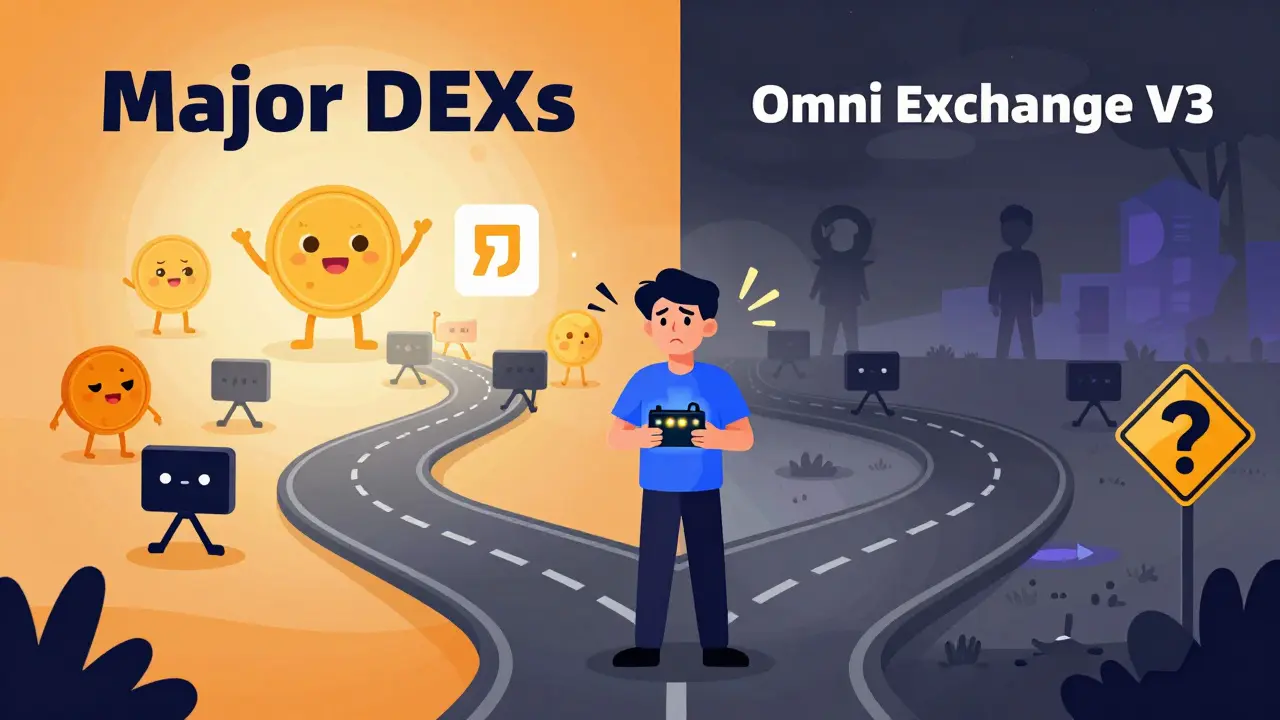
Have you ever connected your wallet to a new crypto exchange, only to realize there’s no customer support chat, no phone number, and barely any information about who built it? That is the reality of navigating smaller decentralized exchanges (DEXs) like Omni Exchange V3. In the crowded world of DeFi, finding a platform that balances low fees with actual security can feel like walking through a minefield. You want the speed of Layer 2 networks and the cheap gas of Binance Smart Chain, but you also need to know your funds won’t vanish into thin air.
Omni Exchange V3 has popped up on tracking sites like CoinGecko, listing two distinct versions: one running on Coinbase’s Base network and another on Binance Smart Chain (BSC). But here is the hard truth: as of mid-2026, this platform lacks the transparency, user reviews, and security audits that major players like Uniswap or PancakeSwap offer. This review cuts through the noise to tell you exactly what Omni Exchange V3 is, where it fits in the market, and whether it is safe enough to put your money in.
What Exactly Is Omni Exchange V3?
To understand Omni Exchange V3, you first need to grasp how decentralized exchanges work. Unlike centralized platforms such as Coinbase or Kraken, which hold your assets and require identity verification (KYC), a DEX allows you to trade directly from your wallet. There is no middleman. Instead, the platform uses smart contracts-self-executing code on the blockchain-to facilitate swaps.
Omni Exchange V3 is an automated market maker (AMM) protocol that operates on multiple blockchain networks. Specifically, it has two main implementations:
- Omni Exchange V3 (Base): Runs on Coinbase’s Layer 2 Ethereum scaling solution.
- Omni Exchange V3 (BSC): Runs on Binance Smart Chain.
The "V3" designation usually implies an upgrade from earlier versions, likely incorporating concentrated liquidity features similar to Uniswap V3, which allows liquidity providers to allocate capital within specific price ranges for greater efficiency. However, unlike its giant competitors, Omni Exchange V3 does not dominate any single market. It sits in a niche, serving users who specifically want to trade tokens native to the Base and BSC ecosystems without using the most popular aggregators.
How Omni Exchange V3 Compares to Market Leaders
If you are used to trading on giants like Uniswap or PancakeSwap, Omni Exchange V3 will feel different-and not always in a good way. Let’s look at the numbers and features side-by-side.
| Feature | Uniswap (Ethereum) | PancakeSwap (BSC) | Omni Exchange V3 |
|---|---|---|---|
| Market Share | ~62% of DEX volume | Dominant on BSC | Niche / Low Volume |
| Networks | Ethereum, L2s | BSC, Ethereum | Base, BSC |
| Security Audits | Multiple top-tier firms | Regular audits | No public audit reports found |
| User Reviews | Extensive community feedback | High engagement | Virtually none |
| Fiat On-Ramp | No (DEX) | No (DEX) | No (DEX) |
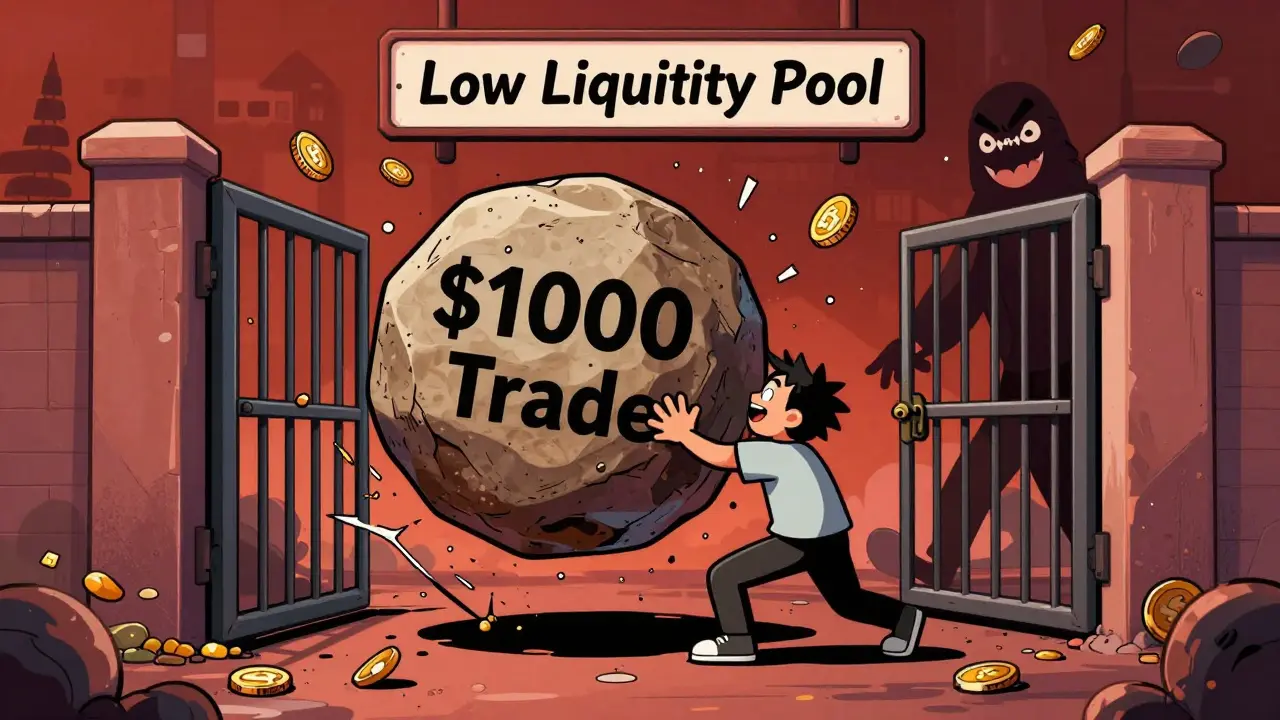
The biggest red flag here is the lack of visibility. Uniswap handles billions in daily volume because people trust its code. PancakeSwap has a massive community on BSC. Omni Exchange V3, while listed on CoinGecko, does not appear in the top rankings for trading volume. This suggests very low liquidity. Why does that matter? Because low liquidity means higher slippage. If you try to swap a large amount of tokens, you might get a much worse price than expected because there aren’t enough buyers and sellers in the pool.
Security Risks: The Silent Threat
In the world of crypto, if you cannot verify the security, assume it is risky. For a DEX, security comes from two main sources: smart contract audits and team transparency.
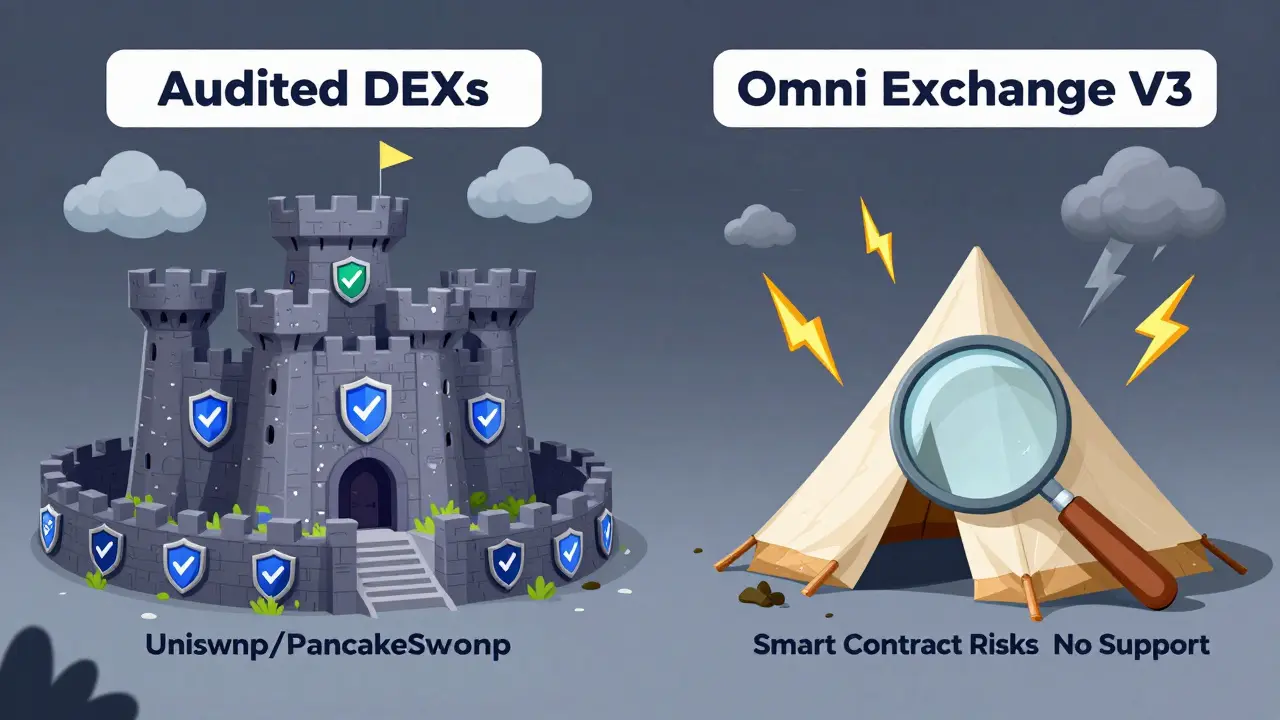
Major protocols hire firms like CertiK, OpenZeppelin, or Trail of Bits to review their code before launch. These audits find bugs that could allow hackers to drain the liquidity pools. When I searched for security documentation for Omni Exchange V3, I found nothing. No audit reports. No bug bounty programs. No public technical whitepapers detailing their security architecture.
This absence is concerning. While the Cryptolegal.uk scam list does not currently flag Omni Exchange V3 as a known fraud, that is merely a negative confirmation-it doesn’t mean the platform is safe; it just means it hasn’t been widely reported as a scam yet. Without independent audits, you are trusting the developers implicitly. If there is a vulnerability in the smart contract, your funds could be lost instantly, and there is no insurance to cover you.
User Experience and Support Vacuum
Let’s talk about what it feels like to use the platform. As a web-based DEX, the interface is likely simple. You connect a Web3 wallet like MetaMask, select the token pair, and approve the transaction. Technically, this is straightforward.
However, the experience falls apart when things go wrong. Have you ever had a transaction fail due to high gas fees or incorrect slippage settings? On established platforms, you can turn to Reddit, Discord, or official support channels for help. Omni Exchange V3 has virtually no community presence. G2 lists related products with zero reviews. Reddit threads are silent. There is no evidence of a knowledge base, tutorial videos, or responsive customer support.
If you make a mistake-say, sending tokens to the wrong address or approving a malicious contract interaction-you are on your own. There is no "undo" button in blockchain transactions. This lack of support infrastructure makes Omni Exchange V3 unsuitable for beginners. It is designed for experienced DeFi users who already know how to troubleshoot wallet issues and read transaction hashes.
Fee Structure and Hidden Costs
Most AMMs charge a standard trading fee, often around 0.3%, which goes to liquidity providers. Omni Exchange V3 likely follows this model. However, the real cost isn’t just the trading fee; it’s the hidden costs of low liquidity.
When liquidity is thin, the price impact of your trade increases. This is called slippage. If you want to swap $1,000 worth of a rare token on Omni Exchange V3, and the pool only has $5,000 in total value, your trade could move the price significantly. You might end up paying $1,100 worth of output tokens for your $1,000 input. Always check the estimated price impact before confirming a swap. If it exceeds 1-2%, consider using a larger aggregator like 1inch or Matcha, which routes your order across multiple DEXs to find the best price.
Is Omni Exchange V3 Legit or a Scam?
This is the question everyone wants answered. Based on available data, Omni Exchange V3 appears to be a legitimate, albeit small, decentralized protocol. It is listed on reputable trackers like CoinGecko, which performs basic due diligence. It operates on established blockchains (Base and BSC), making it harder to pull off a quick rug pull compared to obscure new chains.
However, "legitimate" does not mean "safe." A project can be legal and still be poorly coded, underfunded, or abandoned. The lack of a development roadmap, the absence of a public team, and the minimal user activity suggest that this project may be inactive or struggling to gain traction. In the fast-moving crypto space, projects that don’t grow quickly often fade away. If the developers abandon the site, the smart contracts remain, but the interface might break, and liquidity could dry up completely.
Who Should Use Omni Exchange V3?
I would recommend Omni Exchange V3 only for a very specific type of user:
- Advanced DeFi Users: Those who understand slippage, gas optimization, and wallet security.
- Token Hunters: Individuals looking for specific tokens listed exclusively on Base or BSC that aren’t available on larger DEXs.
- Low-Stakes Traders: People willing to risk small amounts of capital they can afford to lose entirely.
If you fall into any of these categories, proceed with extreme caution. Never invest more than you can afford to lose. Always double-check contract addresses. And never disconnect your wallet from the site after use.
Safer Alternatives for Base and BSC Trading
If you are looking for reliability, security, and better prices, there are superior options for both networks. For Base Network:
- Aerodrome Finance: The leading DEX on Base, backed by strong incentives and high liquidity.
- Uniswap: Available on Base via bridge or direct integration, offering deep liquidity and proven security.
- PancakeSwap: The dominant DEX on BSC with massive liquidity, regular audits, and a huge community.
- Biswap: A solid alternative with lower fees and growing adoption.
These platforms have millions of users, transparent teams, and rigorous security standards. They may have slightly higher competition for liquidity, but the safety margin is infinitely larger.
Final Verdict: Proceed with Caution
Omni Exchange V3 fills a tiny gap in the market by offering DEX services on Base and BSC. But it does so without the trust signals that matter most in crypto: audits, community, and volume. In 2026, with so many robust alternatives available, there is little reason to take the risk. Unless you are hunting for a specific obscure token, stick to the established leaders. Your peace of mind is worth more than saving a fraction of a percent on fees.
Is Omni Exchange V3 regulated?
No. Like most decentralized exchanges, Omni Exchange V3 operates without regulatory oversight. It does not require KYC (Know Your Customer) verification, nor does it comply with financial regulations like those enforced by the SEC or FCA. This means you have no legal recourse if something goes wrong.
Can I deposit fiat currency (USD/EUR) on Omni Exchange V3?
No. Omni Exchange V3 is a pure DEX. It only supports cryptocurrency-to-cryptocurrency swaps. To trade, you must already have crypto in your Web3 wallet (like MetaMask) and sufficient native tokens (ETH for Base, BNB for BSC) to pay for gas fees.
Why is there no customer support for Omni Exchange V3?
Decentralized exchanges typically do not offer traditional customer support because they are run by code, not companies. Since Omni Exchange V3 has no public team or community forums, there is no one to contact. Users are expected to resolve issues independently using blockchain explorers and wallet documentation.
Are my funds safe on Omni Exchange V3?
Your funds are only as safe as the smart contracts underlying the platform. Since Omni Exchange V3 lacks public security audits from reputable firms, there is a higher risk of vulnerabilities. Additionally, low liquidity can lead to significant financial losses through slippage during trades.
What is the difference between Omni Exchange V3 on Base and BSC?
They are separate deployments of the same protocol on different blockchains. The Base version runs on Coinbase’s Layer 2 network, offering faster and cheaper transactions than Ethereum mainnet. The BSC version runs on Binance Smart Chain, known for low fees and high speed. You must connect your wallet to the correct network to use each version.