
You bought Bitcoin back in late 2024. The price has skyrocketed, and you’re looking at a massive profit. But before you celebrate, there’s a catch: if you sell it now, the government wants its cut. In fact, if you’ve been trading actively, that cut could be steep. But here is the good news for those willing to wait. If you hold your cryptocurrency in Portugal for more than one year, that gain might just be completely tax-free.
This isn’t a rumor or a loophole from the past. It is the current law as of 2026. After the major regulatory shifts in 2023, Portugal settled on a clear, dual-tier system that rewards patience. You don’t need to be a tax lawyer to understand it, but you do need to know exactly how the clock starts ticking and where the traps are hidden. Get this wrong, and you owe money. Get it right, and you keep every cent of your long-term growth.
The One-Year Rule: Your Ticket to Zero Tax
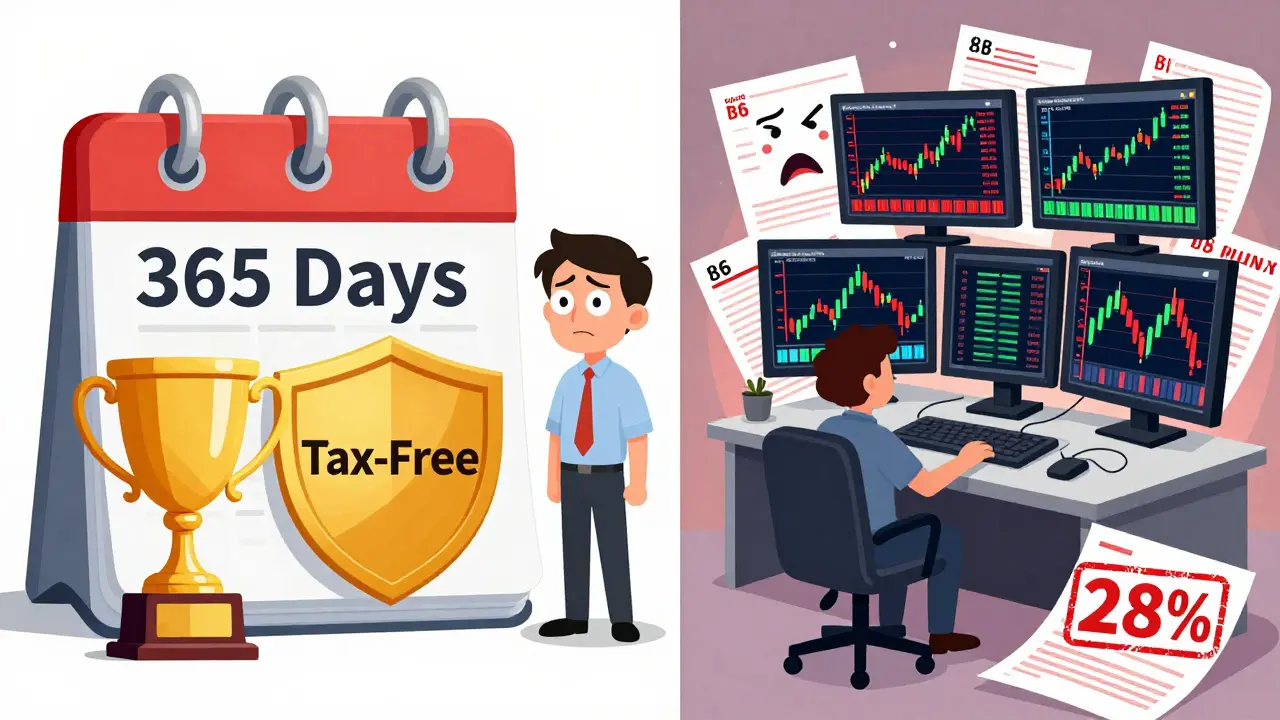
At the heart of Portugal’s crypto tax strategy is a simple number: 365. This is the holding period that separates taxable income from tax-free wealth. Under the Personal Income Tax Code (PIT Code), profits from selling cryptocurrencies held for longer than one year fall under Category G Capital Gains, which includes profits from asset sales where holdings exceed the statutory one-year threshold. If you cross that finish line, the gain is exempt from personal income tax.
Let’s make this concrete. Imagine you buy Ethereum on January 15, 2025. The market dips, then rallies. On February 1, 2026, you decide to cash out. Even though it feels like a long time, you have only held the asset for 383 days? No, wait-count carefully. From Jan 15, 2025, to Jan 15, 2026, is exactly 365 days. Selling on Feb 1 means you are safely in the tax-free zone. However, if you sold on Jan 14, 2026, you would trigger a taxable event.
This rule applies when you convert your crypto into fiat currency, like Euros. It also applies when you use crypto to buy goods or services after the one-year mark. The key is the realization event. Unrealized gains-the paper profits you see on your exchange dashboard while the price goes up-are not taxed. Portugal taxes what you actually pocket or spend, not what you hope to have.
| Activity Type | Holding Period / Context | Tax Rate | Tax Category |
|---|---|---|---|
| Sale of Crypto Assets | Less than 365 days | 28% flat rate (or progressive) | Category G |
| Sale of Crypto Assets | More than 365 days | 0% (Tax-Free) | Category G |
| Staking / Lending Rewards | Any duration | 28% flat rate | Category E |
| Professional Trading / Mining | Frequent transactions | 14.5% - 53% progressive | Category B |
Where the Loopholes Close: Staking and Professional Trading
It’s easy to get excited about the zero-percent rate, but you need to watch out for two specific areas where the taxman still collects: passive income and professional activity. These are treated differently from simple buying and holding.
First, let’s talk about staking. If you hold Proof-of-Stake coins like Cardano or Solana and earn rewards for validating transactions, those rewards are considered Category E Capital Income, which covers passive financial returns such as interest, dividends, and staking yields. This income is taxed at a flat 28% rate, regardless of how long you hold the underlying asset. So, if you stake ETH and receive 4% annual yield, that 4% is taxable income in the year you receive it. You cannot defer this tax by waiting a year. The exemption only applies to the appreciation in value of the principal asset itself, not the income it generates.
Second, be careful if you trade frequently. The tax authorities look for patterns. If you are day-trading, executing dozens of swaps a week, or mining crypto as a primary source of revenue, your activities may be reclassified as Category B Self-Employment Income, which treats frequent commercial activities like high-volume trading or mining as business operations. This is dangerous for your wallet because Category B income is added to your total annual earnings and taxed progressively. Depending on your other income, your effective tax rate could jump anywhere from 14.5% to a staggering 53%. The one-year exemption does not apply here because the activity is viewed as a job, not an investment.
Short-Term Gains: The 28% Flat Rate Option
What if you need to sell before the one-year mark? Maybe you need liquidity for a house down payment, or the market crashes and you want to cut losses. In these cases, you fall into the short-term bucket. By default, short-term capital gains are taxed at a flat 28% rate. This is straightforward and often preferable for high-income earners who are already in the top marginal tax brackets.
However, you have a choice. You can opt to include these short-term gains in your total yearly income instead of paying the flat 28%. This is called "opting-in" to the progressive scale. If your total income (salary + crypto gains) puts you in a lower tax bracket-say, 20% or 25%-this option saves you money. Conversely, if you earn a high salary, adding crypto gains might push you into the 48% or 53% brackets, making the flat 28% much cheaper. Most tax advisors recommend running both calculations during tax season to see which method results in a lower bill.
Crypto-to-Crypto Swaps: A Rare Freedom
Here is a detail that many investors miss: swapping one cryptocurrency for another is generally not a taxable event in Portugal, provided you are not a professional trader. If you swap Bitcoin for Ethereum, you haven’t realized a gain or loss because you haven’t converted to fiat. This allows you to rebalance your portfolio without triggering immediate tax liabilities. Just remember to track the new cost basis of the Ethereum you received. When you eventually sell that Ethereum for Euros, your holding period resets. The clock starts ticking from the date of the swap, not the original purchase of Bitcoin. This reset is crucial. If you swap on Day 360, you lose the tax-free status unless you hold the new asset for another full year.
Reporting and Record-Keeping: Don’t Guess
Portugal operates on a self-assessment system. This means the tax authority, Autoridade Tributária e Aduaneira (AT), expects you to report your own transactions accurately. They do not automatically receive data from every global exchange, but they do share information with other EU countries under MiCA (Markets in Crypto-Assets) regulations and international anti-money laundering standards. Assuming you can hide your trades is a risky gamble.
To stay compliant, you need meticulous records. For every transaction, you must know:
- The exact date and time of acquisition and disposal.
- The purchase price and sale price in fiat terms.
- The fees paid to exchanges.
- The identity of the counterparty (exchange name).
Manual spreadsheets rarely cut it anymore. Most serious investors use specialized software like CoinTracking or Koinly. These tools connect via API to your exchanges, import all trades, calculate the FIFO (First-In, First-Out) or specific identification methods, and generate reports formatted for Portuguese tax filings. This software becomes essential when you need to prove that a specific coin was held for 366 days versus 364 days. Without digital trails, auditors will likely disallow your exemption claim.

Portugal vs. Europe: Why It Still Matters
In the broader European context, Portugal remains an outlier for long-term holders. France taxes all crypto gains at 30%, including social contributions. Italy applies a 26% capital gains tax with no long-term exemption. Spain ranges from 19% to 28% depending on total income, with no blanket zero-rate for long holds. Germany offers a similar one-year exemption, making it Portugal’s closest competitor, but Portugal’s overall residency tax incentives and lifestyle factors often tip the scale for digital nomads.
The 2023 reforms stabilized the landscape. Before that, there was a brief period of total ambiguity followed by rumors of complete taxation. Now, the rules are codified in the State Budget law. This certainty allows investors to plan years ahead. You can structure your entry points knowing that if you hold through a bear market and into the next bull run, your exit will be tax-efficient.
Common Pitfalls to Avoid
Even with clear rules, mistakes happen. Here are the most common errors I see investors make:
- Miscalculating the 365-day window: Counting calendar years instead of actual days. Use a date calculator. Jan 1 to Dec 31 is 365 days, but Jan 1 to Jan 1 is also 365 days. Precision matters.
- Ignoring Staking Taxes: Thinking staking rewards are part of the capital gain. They are separate income events taxed immediately at 28%.
- Residency Confusion: To benefit from these rates, you must be a fiscal resident in Portugal. This usually means spending more than 183 days in the country per year. If you split your time evenly between Portugal and another country, tie-breaker rules in tax treaties determine your residency. Check your status annually.
- Non-EEA Wallets: There are nuances regarding assets held outside the European Economic Area. While the core rule remains, complex offshore structures can trigger different reporting requirements under CRS (Common Reporting Standard). Keep it simple if possible.
Is crypto tax-free in Portugal forever?
No. As of 2026, the tax exemption only applies to capital gains from assets held for more than 365 days. Short-term gains (less than one year) are taxed at 28% or progressive rates. Additionally, passive income like staking rewards is always taxed at 28%.
Do I pay tax if I swap Bitcoin for Ethereum?
Generally, no. Crypto-to-crypto swaps are not considered taxable realization events for non-professional investors. However, your holding period for the new asset (Ethereum) starts from the date of the swap. You must hold the Ethereum for over a year to qualify for the tax-free status upon eventual sale for fiat.
What if I am a digital nomad working remotely?
If you become a tax resident in Portugal (typically by staying more than 183 days a year), you are subject to Portuguese tax laws on your worldwide income. This includes your crypto gains. Ensure you maintain proper records to prove holding periods. Non-residents are only taxed on Portuguese-source income, which rarely includes pure capital gains from foreign-held crypto unless specific conditions are met.
How is staking income taxed?
Staking rewards are classified as Category E income (Capital Income). They are taxed at a flat rate of 28% in the year they are received. This tax is due regardless of whether you sell the staked coins or hold them for decades. It is treated similarly to interest or dividends.
Can I deduct my crypto losses?
Yes, but with restrictions. Capital losses can offset capital gains within the same category (Category G) in the same tax year. Unused losses can be carried forward for up to five years. However, losses cannot offset income from other categories like employment wages or staking rewards (Category E).
Does MiCA change the tax rules?
MiCA (Markets in Crypto-Assets) is a regulatory framework for consumer protection and market integrity across the EU, not a tax law. It does not change the 28% or 0% tax rates. However, it increases transparency and reporting requirements for exchanges operating in Portugal, making it harder to hide transactions from tax authorities.