
When people talk about blockchain, they often mean any kind of decentralized digital ledger. But that’s not quite right. Blockchain is just one type of distributed ledger technology - not the whole thing. If you’ve heard both terms used interchangeably, you’re not alone. Even big companies mix them up. But understanding the difference matters, especially if you’re considering using one for your business, project, or just trying to make sense of the tech news.
What Exactly Is DLT?
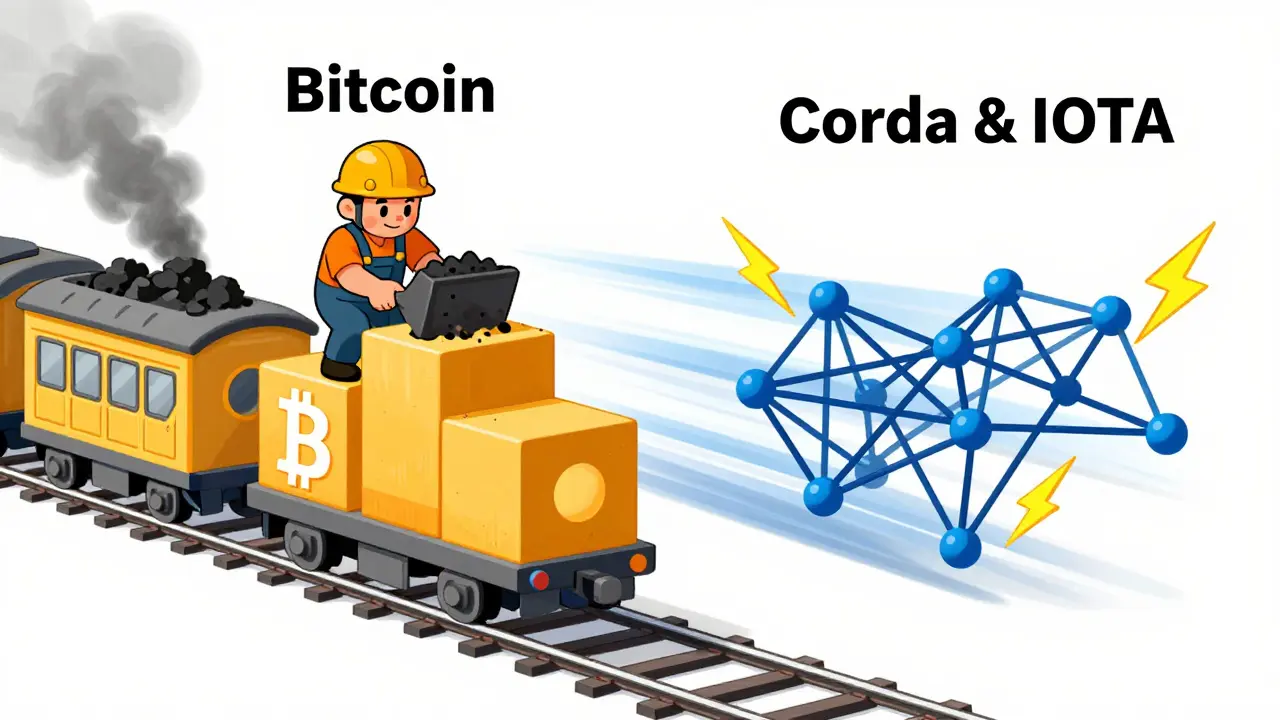
Distributed Ledger Technology, or DLT, is simply a way to store data across multiple computers at once. Think of it like a shared spreadsheet that everyone on the network can see and update, but no single person controls it. Every participant has a copy, and when one person adds a new entry, it gets verified and copied to everyone else’s version. No middleman needed. This isn’t new. The idea of sharing data across a network goes back to early peer-to-peer systems like BitTorrent. But modern DLT adds security through cryptography - meaning each update is digitally signed and tamper-proof. The key point? DLT doesn’t require data to be arranged in blocks or chains. It can be organized in any structure that works for the use case. Real-world examples? R3’s Corda, used by banks to settle trades, doesn’t use blocks. IOTA’s Tangle, designed for IoT devices, uses a directed acyclic graph (DAG) instead of a chain. These are both DLTs - but not blockchains.What Makes Blockchain Different?
Blockchain is a specific kind of DLT that organizes data into blocks, each linked to the one before it using cryptographic hashes. Every block contains a batch of transactions, a timestamp, and the hash of the previous block. Change even one letter in an old block, and every block after it breaks - making the whole chain tamper-evident. This structure creates a strict, chronological order. You can’t just insert a transaction between two others. It has to go at the end, and only after the network agrees on it. That’s where consensus mechanisms come in - Proof-of-Work (like Bitcoin) or Proof-of-Stake (like Ethereum since 2022). These rules decide who gets to add the next block and how the network stays in sync. Bitcoin was the first blockchain. But now, most public blockchains are built on Ethereum’s model, which supports smart contracts - self-executing code that runs when conditions are met. That’s why blockchain became so popular: it’s not just a ledger. It’s a platform for trustless applications.Key Differences: Blocks vs No Blocks
The biggest distinction is structure. Blockchain = blocks in a chain. DLT = any distributed structure.- Blockchain: Data is always grouped into sequential blocks. Each new block points to the last.
- DLT: Data can be arranged as a graph (like IOTA), a tree, or even a flat list. No chain required.
Consensus: Who Gets to Decide?
Public blockchains like Bitcoin and Ethereum rely on open, permissionless consensus. Anyone can join, and the system assumes no one can be trusted. That’s why they use energy-heavy methods like Proof-of-Work - to prevent fraud. DLT systems, especially in enterprise settings, often use permissioned networks. Only approved participants can validate transactions. That means they can use faster, lighter consensus methods like Practical Byzantine Fault Tolerance (PBFT). No mining. No huge electricity bills. According to IBM’s 2022 study, PBFT-based DLTs are 40-60% more scalable than Proof-of-Work blockchains. And they use 99% less energy. A single Bitcoin transaction consumes 1,544 kWh - enough to power a home for over two months. A PBFT transaction? Less than 15 watts.Tokens: Required or Optional?
Public blockchains almost always need a native token. Bitcoin, Ether, Solana - these aren’t just currencies. They’re the fuel that powers the network. You need tokens to pay for transactions, or “gas.” DLT doesn’t require tokens. R3 Corda, used by over 300 financial institutions, runs perfectly without one. BBVA’s trade finance project in 2021 moved millions in documents using Corda - no crypto involved. The system trusted the participants because they were known, regulated banks. No need for tokens to enforce honesty. This makes enterprise DLTs easier to adopt. You don’t have to explain crypto to your CFO. You just say, “It’s a secure, shared database.”Who Uses What - And Why?
The market tells the story. In 2023, 92% of enterprise DLT projects used blockchain architecture, according to Gartner. But that number is misleading. Most of those are private, permissioned blockchains - not public ones like Bitcoin.- Public blockchains (Bitcoin, Ethereum): Used for cryptocurrencies, NFTs, decentralized apps. They need to be trustless and open. Ideal for anonymous users.
- Enterprise DLT (Corda, Hyperledger Fabric): Used by banks, logistics firms, governments. They need speed, privacy, and control. Ideal for known parties.

Real-World Outcomes: Speed, Cost, and Pain
JPMorgan’s Quorum team found that blockchain’s 15-second transaction finality caused delays in high-frequency trading. Sub-second settlement was impossible. They switched parts of their system to a DLT with PBFT consensus - and cut settlement time to under 500 milliseconds. On the flip side, BBVA’s blockchain-based trade finance system reduced document processing time by 80%. But it took 18 months to build. A similar Corda project? Done in 12 months. Why? Corda’s design is simpler for enterprise workflows. No need for mining, no gas fees, no public ledger. Reddit developers in r/blockchain reported that 78% of those working on permissioned networks preferred Hyperledger Fabric over Ethereum. Why? “It doesn’t feel like wrestling with crypto,” one wrote. “It feels like upgrading a database.”What’s the Future?
The lines are blurring. Ethereum’s 2022 Merge cut its energy use by 99.95%. R3’s Corda 5, released in March 2023, now allows optional cryptographic chaining - a nod to blockchain’s strengths. Gartner says DLT has reached the “Plateau of Productivity.” That means it’s no longer hype - it’s being used. 25% of global enterprises already use some form of DLT. But pure blockchain? Still in the “Slope of Enlightenment.” People are learning where it works - and where it doesn’t. The future isn’t blockchain vs DLT. It’s choosing the right tool. Need to build a global, trustless system with anonymous users? Blockchain. Need a fast, private, permissioned ledger for banks or shipping? Use a non-chain DLT. Forrester’s 2023 report puts it simply: “Non-chain DLT architectures will dominate enterprise applications requiring high throughput (>1,000 TPS), while blockchain will maintain dominance in trustless environments and cryptocurrency applications.”Which One Should You Use?
Ask yourself these questions:- Do you need to trust strangers? → Use blockchain.
- Are all participants known and verified? → Use DLT.
- Do you need to process thousands of transactions per second? → Skip blockchain.
- Are you building a public app with crypto tokens? → Blockchain is your only real option.
- Are you integrating with legacy systems in finance or logistics? → DLT will save you time and money.
Is blockchain the same as DLT?
No. Blockchain is a type of DLT, but not all DLTs are blockchains. Think of it like this: all squares are rectangles, but not all rectangles are squares. Blockchain adds a specific structure - blocks chained together - while DLT is the broader category of decentralized ledgers that can use many different formats.
Why do banks use DLT instead of blockchain?
Banks need speed, privacy, and control. Blockchain’s public, slow, and energy-heavy design doesn’t fit. DLTs like R3 Corda or Hyperledger Fabric let banks transact privately with known partners, settle in seconds, and avoid crypto tokens. They also use far less energy - critical for compliance and cost.
Can DLT work without tokens?
Yes. In fact, most enterprise DLTs don’t use tokens. Token-based systems are mostly for public blockchains where you need to incentivize strangers to maintain the network. In permissioned networks - like banks or supply chains - participants are already trusted and paid. Tokens add unnecessary complexity.
Which is more secure: DLT or blockchain?
Both are secure, but in different ways. Public blockchains are designed to resist attacks from anonymous outsiders - that’s why they’re slow and energy-heavy. Enterprise DLTs assume participants are known and vetted, so they use faster consensus methods. Neither is inherently more secure - it depends on the threat model. For open networks, blockchain wins. For closed systems, DLT is just as secure and far more efficient.
Are central bank digital currencies (CBDCs) built on blockchain?
Most aren’t. According to the European Central Bank’s 2023 report, 85% of CBDC projects use non-blockchain DLTs. Why? Because they need to handle millions of daily transactions with low latency. Blockchain’s block-by-block structure can’t keep up. Non-chain DLTs like DAGs or hashgraphs deliver the speed central banks require.
What’s the biggest mistake people make with DLT and blockchain?
Assuming blockchain is the default solution. Many companies rush into blockchain because it’s trendy - only to hit scalability walls, high costs, or regulatory confusion. The smarter move is to start with your use case: Do you need openness and trustlessness? Then go blockchain. Do you need speed, privacy, and control? Choose a non-chain DLT. The tech should serve the problem - not the other way around.
Sammy Tam
December 16, 2025 AT 17:25Man, I used to think blockchain was the only game in town until I saw how Corda handles trade settlements. No mining, no gas fees, just clean, fast, private ledgers. It’s like upgrading from a flip phone to a smartphone-same purpose, way better experience.
Also, the fact that banks are ditching blockchain for DLT? That’s the quiet revolution nobody’s talking about.
Abby Daguindal
December 18, 2025 AT 07:04Blockchain is just crypto hype dressed up as tech. Real enterprises don’t need your magical chain of blocks-they need working systems. Stop pretending it’s revolutionary.
Patricia Amarante
December 19, 2025 AT 01:06So DLT is like a shared Google Doc with locks. Blockchain is that same doc, but every page has to be printed, signed, and mailed before the next one gets added. Yeah, no thanks.
SeTSUnA Kevin
December 20, 2025 AT 14:17The conflation of DLT and blockchain is a lexical error of epic proportions. One is a taxonomy; the other, a subclass. To equate them is akin to calling all mammals ‘dogs.’
Rebecca Kotnik
December 22, 2025 AT 01:51It is my considered opinion, after reviewing extensive empirical data from enterprise deployments across financial, logistical, and governmental sectors, that the fundamental architectural divergence between blockchain and non-chain DLTs is not merely technical-it is philosophical. The former assumes adversarial trustlessness; the latter, institutionalized reliability. This distinction informs not only scalability and energy consumption, but also regulatory compliance, auditability, and organizational adoption curves. To reduce this to a binary choice is to ignore the nuanced reality of distributed systems in practice. The future lies not in dominance, but in appropriate alignment between problem domain and solution architecture.
Kayla Murphy
December 23, 2025 AT 01:50Y’all are overcomplicating this. If you’re building something for the public, go blockchain. If you’re fixing a real business problem? Use DLT. Done. Stop arguing and start building.
Dionne Wilkinson
December 25, 2025 AT 00:46It’s funny how we treat tech like it’s a religion. Blockchain isn’t sacred. DLT isn’t heresy. They’re just tools. Maybe the real question is: what are we trying to build-and who are we building it for?
Florence Maail
December 26, 2025 AT 21:31They’re lying to us. 🤡 The ‘enterprise DLT’ they’re pushing? It’s just a centralized database with a fancy name. They want you to think it’s decentralized so you’ll trust it. But if only approved people can join… that’s not tech. That’s corporate control. And the energy numbers? All propaganda. The NSA is behind this. They don’t want you to know the truth.
Chevy Guy
December 28, 2025 AT 11:41so they say blockchain is slow and energy hungry right
but what if they just dont want you to use it because then you could bypass their banks
they need you to use their dlt so they can watch everything
theyll tell you its secure but its just a locked cage
and the key is in their pocket
they dont want freedom
they want control
and they call it innovation
Kelsey Stephens
December 29, 2025 AT 17:39Thank you for writing this. I’ve been trying to explain this to my boss for months. He kept saying ‘we should use blockchain because it’s the future.’ Now I’ve got something to send him that actually makes sense.
Tom Joyner
December 30, 2025 AT 18:52Anyone who uses the phrase ‘trustless system’ without understanding Byzantine fault tolerance is just regurgitating blog posts. Blockchain’s security assumptions are fragile. Most real-world deployments are permissioned anyway-so why pretend it’s decentralized?
Amy Copeland
December 30, 2025 AT 21:41Oh wow, so now we’re pretending Corda isn’t just a glorified SQL database with a blockchain-shaped sticker on it? How quaint. You’re not innovating-you’re rebranding. And the ‘no tokens’ thing? That’s not progress. That’s surrender.
Timothy Slazyk
January 1, 2026 AT 13:23Let’s cut through the noise. Blockchain’s bottleneck isn’t the chain-it’s the consensus. Proof-of-Work is a relic. Even Ethereum’s PoS is overkill for enterprise. But here’s the kicker: DLTs like Hashgraph or Corda don’t just avoid PoW-they eliminate the need for global consensus entirely. Transactions are confirmed locally, then validated by a small, trusted quorum. That’s why they hit 10K+ TPS. It’s not magic. It’s architecture. And yes, it’s better for 90% of use cases. The crypto bros will cry, but the CFOs are already moving.
Madhavi Shyam
January 2, 2026 AT 00:38DLT is the future. Blockchain is legacy. We deployed Hyperledger Fabric for supply chain traceability-reduced reconciliation time from 72hrs to 2hrs. No tokens. No mining. Just encrypted, immutable, permissioned logs. The term ‘blockchain’ is a marketing trap. Don’t fall for it.