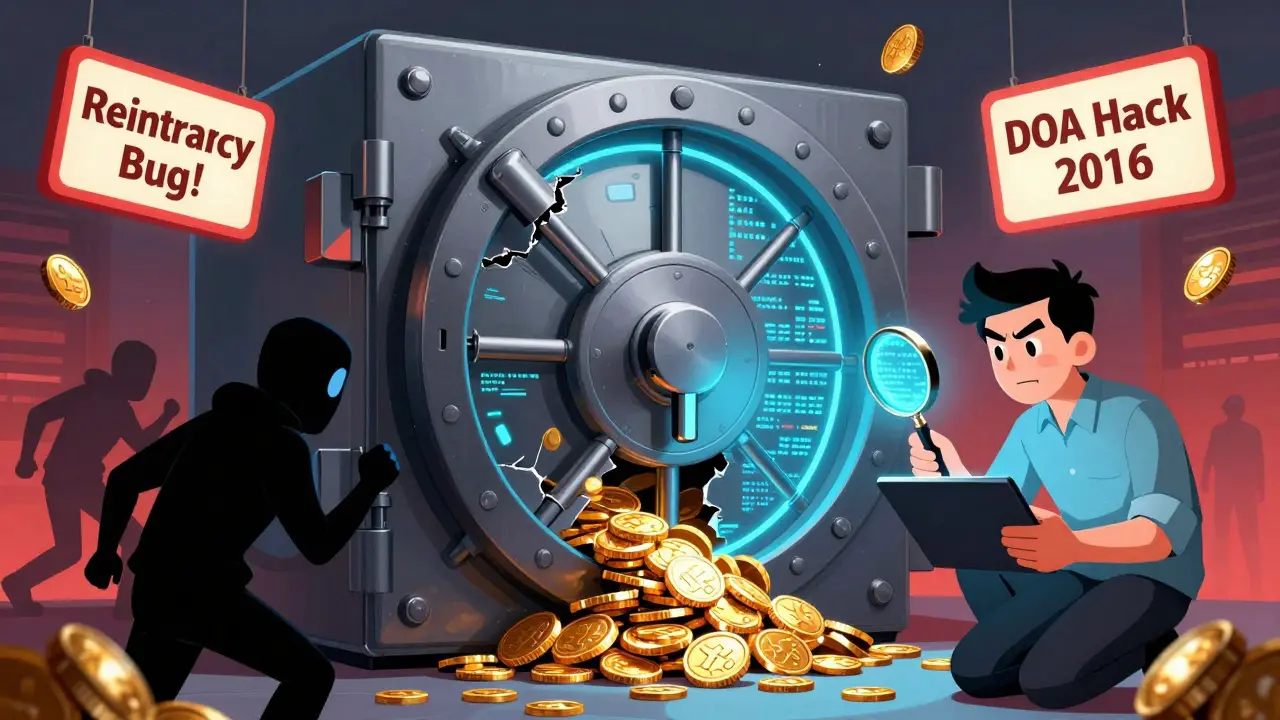
Imagine you lock $10 million in a digital vault that can’t be opened, reset, or fixed after it’s sealed. That’s what a smart contract is on the blockchain. Once deployed, it runs exactly as coded-no exceptions, no backdoors, no undo button. If there’s a flaw in the code, hackers can drain it in seconds. That’s not theory. It’s happened. Over $50 million vanished in the 2016 DAO hack because of a single coding mistake. Since then, smart contract audit has become the non-negotiable first step for any serious blockchain project.
What Exactly Is a Smart Contract Audit?
A smart contract audit is a deep, methodical review of the code behind a blockchain application. Think of it like a structural inspection for a building-but instead of checking for weak beams or faulty wiring, auditors look for logic errors, security holes, and inefficient code that could let attackers steal funds. It’s not a quick scan. It’s not automated software running once. It’s a combination of human expertise and specialized tools working together over days or weeks. The goal is simple: find and fix problems before the contract goes live. Because once it’s on the blockchain, you can’t patch it. You can’t send an update. You can only redeploy the whole thing-and even then, users may have already interacted with the flawed version. That’s why audits aren’t optional. They’re survival.Why Smart Contract Audits Are Non-Negotiable
Blockchains are immutable. That’s their strength. But it’s also their biggest risk. If your DeFi lending protocol has a reentrancy bug-a classic flaw where a hacker can call a function repeatedly to drain funds-you can’t just roll back the transaction. The money is gone. Forever. The numbers don’t lie. In 2023 alone, DeFi hacks cost users over $1.3 billion across 140+ incidents, according to Immunefi’s annual report. The average loss per attack? Around $2.1 million. Compare that to the cost of an audit: $10,000 to $20,000 for a basic token contract. Suddenly, the audit doesn’t look expensive. It looks like insurance. But it’s not just about money. It’s about trust. If users see that your project got audited by a respected firm like Trail of Bits or Cyfrin, they’re more likely to lock their funds in. If you skip it? They walk away. In DeFi, reputation is everything. And an audit report is your proof of credibility.What Do Auditors Actually Look For?
Auditors don’t just read code. They think like attackers. Here are the top five vulnerabilities they hunt for:- Reentrancy attacks: When a malicious contract calls back into your function before the first call finishes, tricking it into sending funds multiple times. This is how the DAO was hacked.
- Integer overflow/underflow: When a number goes beyond its limit-like adding 1 to the maximum value-and wraps around to zero or a negative number, causing unexpected behavior.
- Access control flaws: When functions meant for admins can be called by anyone. A common mistake? Forgetting to check who called the function.
- Logic errors: Code that works as written but does the wrong thing. For example, a token transfer that accidentally sends 100x more than intended.
- Gas inefficiencies: Code that uses too much computational power, making transactions expensive for users. This doesn’t break security, but it kills adoption.
Who Does Smart Contract Audits?
The market is crowded, but only a few firms have earned serious trust:- Consensys Diligence: Backed by Ethereum’s biggest developer group, they’re a go-to for enterprise projects.
- Trail of Bits: Known for deep technical rigor and public vulnerability disclosures.
- Hacken: Offers full-spectrum audits and has worked with major DeFi protocols.
- Cyfrin: Co-founded by Patrick Collins, they’ve found $100,000+ in bounties for clients through audits.
- Veridise: Uses proprietary tools like Picus to audit zero-knowledge proofs, a growing niche in privacy-focused blockchains.
How Much Does a Smart Contract Audit Cost?
There’s no flat rate. Price depends on three things: complexity, blockchain platform, and scope.- Simple ERC-20 token: $10,000-$20,000
- DeFi protocol with lending, staking, and swaps: $50,000-$150,000+
- Zero-knowledge proof system: $100,000-$300,000
What Happens After the Audit?
You don’t just get a PDF. You get a classified report:- Critical: Can be exploited immediately to drain funds. Fix before deployment.
- High: Serious risk, but needs user interaction or specific conditions.
- Medium: Potential issues that could become critical under edge cases.
- Low: Minor inefficiencies or documentation gaps.
What Developers Should Do Before an Audit
Don’t just send your code and hope for the best. Prepare properly:- Clean up your code: Remove commented-out code, unused functions, and debug logs.
- Document everything: Explain what each function does, who can call it, and what inputs it expects.
- Freeze your code: No more changes after you hand it over. Every edit resets the audit clock.
- Run basic tests: Use tools like Foundry or Hardhat to run unit tests. It shows auditors you’ve done your homework.
The Future of Smart Contract Auditing
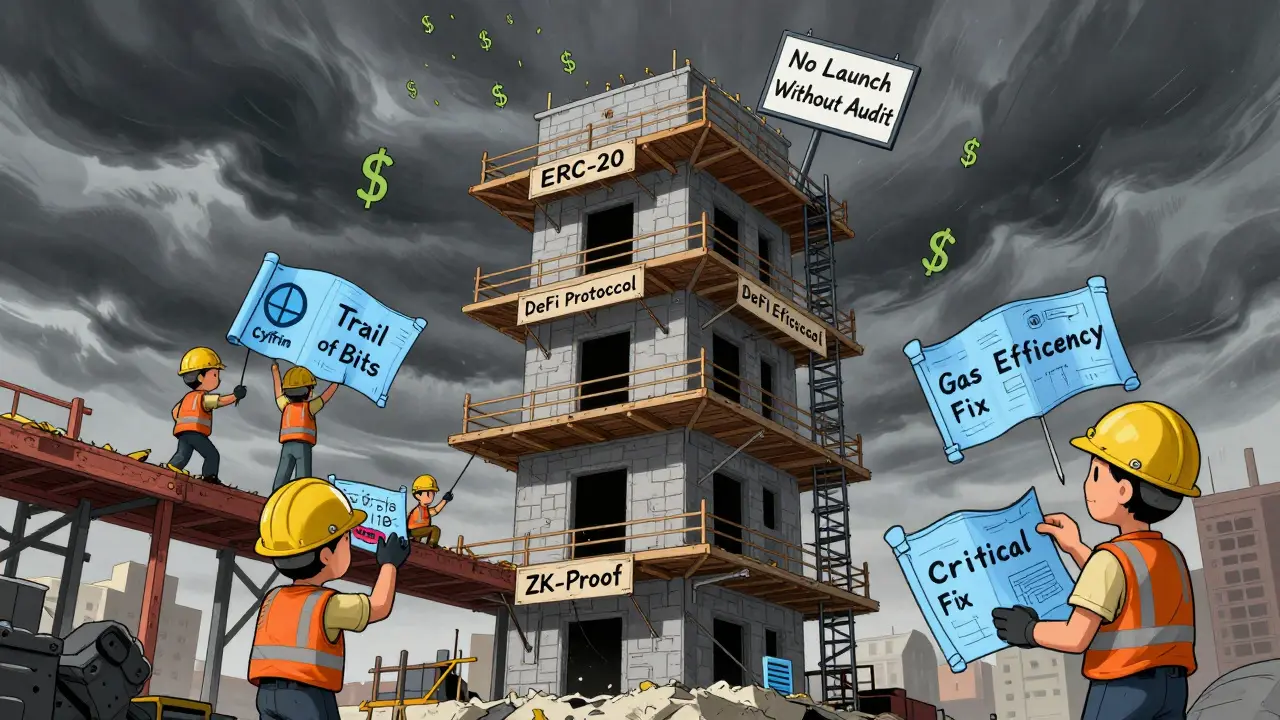
The industry is evolving fast. Audits are moving from one-time checks to continuous security. Tools are now being built into CI/CD pipelines so code is scanned automatically every time a developer pushes a change. Zero-knowledge proof audits are growing as privacy-focused blockchains like zkSync and Starknet gain traction. Auditors now need to understand not just Solidity, but also Cairo and Rust-based smart contract languages. Regulators are watching too. In the EU and U.S., financial authorities are starting to require audits for DeFi platforms that handle user funds. In the future, skipping an audit might not just be risky-it could be illegal.Final Thought: It’s Not a Cost. It’s a Foundation.
Smart contract audits aren’t a checkbox. They’re the bedrock of trust in blockchain. If you’re building something that moves money, you owe it to your users to get it right. The cost of an audit is tiny compared to the cost of a breach. And the cost of not doing one? That’s not just financial. It’s reputational. It’s existential. The blockchain doesn’t forgive mistakes. But a good audit? It gives you a second chance.Is a smart contract audit mandatory?
No, it’s not legally mandatory in most places-but it’s functionally required. No serious investor, exchange, or user will touch a DeFi project without a public audit report. Skipping it is like launching a bank without locks on the vault.
Can automated tools replace human auditors?
No. Tools like Slither or MythX catch common bugs quickly, but they miss complex logic flaws, edge cases, and subtle design issues. Human auditors understand intent. Machines only see syntax. The best audits combine both.
How long does a smart contract audit take?
It depends on complexity. A simple token contract takes 3-5 days. A full DeFi protocol with multiple interacting contracts can take 3-4 weeks. Complex zero-knowledge systems may take over a month. Rushing an audit defeats the purpose.
What if the audit finds critical bugs?
That’s the point. If the audit finds a critical flaw, you fix it before launch. Most reputable firms will help you patch it and retest. It’s better to delay deployment than to lose millions after going live.
Are audits 100% reliable?
No audit can guarantee zero vulnerabilities. Some advanced exploits-like oracle manipulation or cross-contract race conditions-can slip through. That’s why audits should be part of a broader security strategy, including bug bounties, monitoring, and formal verification where possible.
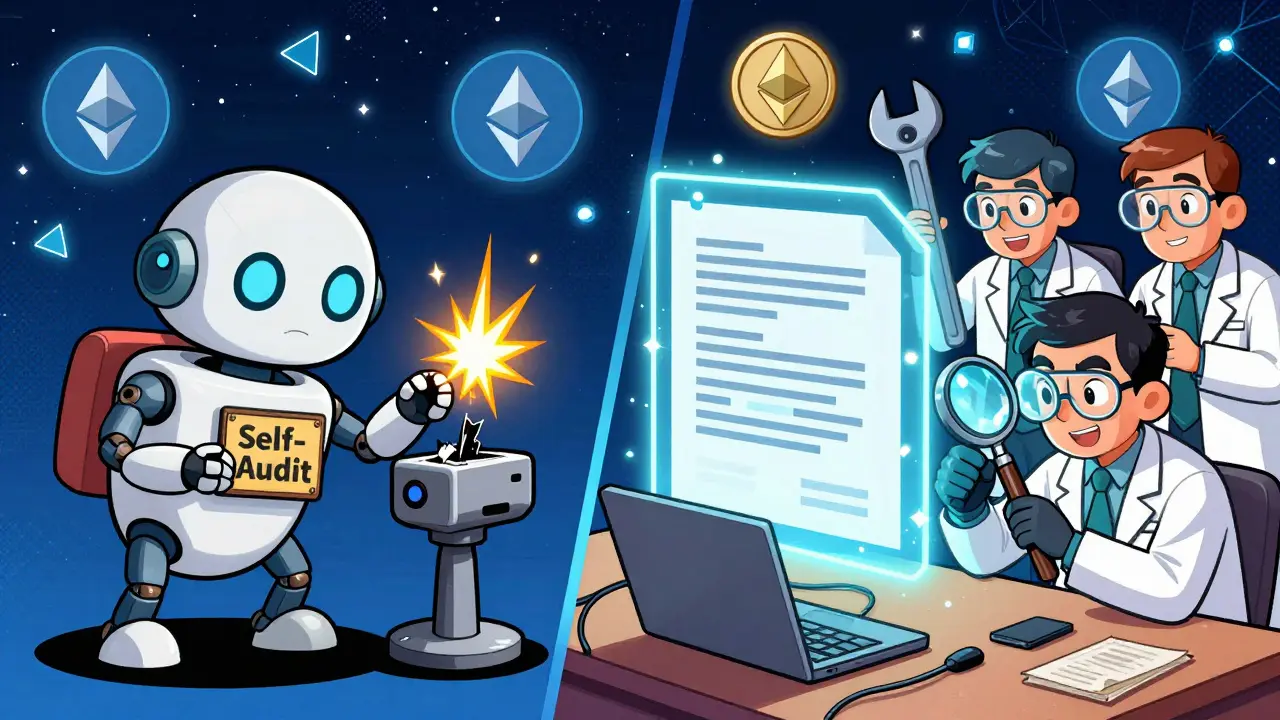
Can I audit my own smart contract?
You can try, but it’s not advisable. Developers are too close to their own code. They miss blind spots. Even experienced Solidity engineers hire third parties because objectivity is critical. Think of it like a surgeon operating on themselves-it’s technically possible, but extremely risky.
Do all blockchains need audits?
Yes-if they handle value. Whether it’s Ethereum, Solana, or Polygon, any smart contract that moves, stores, or controls digital assets needs an audit. The blockchain platform doesn’t matter. The value at stake does.
What’s the difference between a smart contract audit and a security review?
There’s no difference. The terms are used interchangeably. Some firms call it a "security review," others say "audit." Both mean the same thing: a deep, professional analysis of code for vulnerabilities.
vaibhav pushilkar
December 23, 2025 AT 12:04Just got done auditing a DeFi protocol last week. The difference between a rushed job and a proper audit is night and day. One tiny reentrancy bug can wipe out months of work. Don't skip this step.
Ashley Lewis
December 23, 2025 AT 18:01Smart contracts are not financial instruments. They are mathematical constructs. To treat them as such is to misunderstand the very nature of blockchain.
Rebecca F
December 24, 2025 AT 21:12They say audits prevent hacks but let's be real - half the firms are just selling FUD. I've seen audits that missed the most obvious backdoors and still got stamped 'clean'. It's a racket.
SHEFFIN ANTONY
December 26, 2025 AT 06:14Everyone talks about audits like they're magic. Newsflash - no audit stops a 0-day. If you think a $20k report makes you safe, you're the kind of dev who gets hacked and blames the auditors. Pathetic.
Craig Fraser
December 27, 2025 AT 12:30It's not about the cost. It's about accountability. If you're handling other people's capital, you have an ethical obligation to verify your code. Anything less is negligence.
Sheila Ayu
December 29, 2025 AT 01:38Wait - so you're telling me that if I don't pay $150,000 to some fancy firm, my entire project is doomed? That's not security - that's extortion. And why do they always use words like 'formal verification' like it's some sacred ritual?!
Jacob Lawrenson
December 29, 2025 AT 07:48THIS. IS. EVERYTHING. 🔥 Just saw a project get audited and then go from $0 to $50M TVL in a week. Trust isn't built with marketing - it's built with audit reports. Do it right or get left behind!
Vyas Koduvayur
December 29, 2025 AT 16:07Look, I've done over 30 audits and let me tell you - most devs don't even understand what they're asking for. They send you a mess of spaghetti code with no documentation, then act shocked when the bill hits $80k. You think auditing is expensive? Try fixing a $10M exploit after launch. Then you'll cry. And no, I won't help you fix it. You should've done this right the first time.
Lloyd Yang
December 31, 2025 AT 14:29There's something deeply human about this whole process - we're trying to build systems that are flawless, but we're flawed creatures writing the code. An audit isn't just about catching bugs - it's about humility. It's saying, 'I don't know everything, and I need someone smarter than me to check my work.' That's not weakness. That's wisdom. And honestly? The best audits I've seen didn't just list vulnerabilities - they taught the devs how to think differently. That's the real value.
Sybille Wernheim
January 1, 2026 AT 03:25My favorite part? When devs finally realize that an audit isn't a hurdle - it's a gift. It’s the moment they stop seeing it as a cost and start seeing it as protection. That shift changes everything. And yeah, it’s expensive. But so is losing your users’ trust. And you can’t audit that back.
Cathy Bounchareune
January 2, 2026 AT 03:05Back in Nigeria, we used to say: 'If you don't check the lock before you leave the house, don't blame the thief.' Smart contracts are the same - the blockchain doesn't care if you meant well. It only knows what you coded. So if you're building something that moves value, treat it like your house. Lock it. Check it. Double-check it. Then sleep easy.
Ellen Sales
January 3, 2026 AT 06:44so like… if you dont get audited… you just… get robbed? like… duh? i mean… i get it… but its kinda obvious? like… why is this even a thing? also… the word 'reentrancy' looks like a typo
Zavier McGuire
January 4, 2026 AT 07:40They say audits are mandatory but no one ever says who makes that rule. No law. No regulator. Just fear. And guess what? Fear doesn't stop hackers. It just makes devs spend money on consultants who use big words to make themselves feel important