Crypto Sanctions: How Governments Block Crypto Transactions and What It Means for You
When you hear crypto sanctions, government-imposed restrictions that block individuals or entities from using cryptocurrency due to political, legal, or financial reasons. Also known as cryptocurrency restrictions, these are no longer theoretical—they’re actively shutting down wallets, freezing accounts, and blocking access to major exchanges. It’s not about banning crypto itself. It’s about controlling who can use it, where, and under what conditions. The U.S. Treasury’s OFAC sanctions, a list of individuals, organizations, and countries blocked from the U.S. financial system, including crypto platforms that serve them is the most visible tool here. If you’re in Iran, Syria, North Korea, or Crimea, your access to exchanges like Binance, Coinbase, or Kraken is automatically cut off—not because the exchange hates you, but because they’re legally forced to comply.
These sanctions don’t just hit users. They force exchanges to use blockchain analytics, software tools that trace crypto transactions to identify wallets linked to sanctioned entities to screen every deposit and withdrawal. Platforms like Chainalysis and Elliptic help exchanges flag risky addresses before a single coin moves. That’s why even if you’re not sanctioned, using a wallet that once held funds from a blocked address can trigger a freeze. It’s not perfect, but it’s the system we have. And it’s getting stricter. Countries like Germany and the EU are now enforcing crypto compliance, the set of rules exchanges must follow to verify users, report transactions, and prevent money laundering under MiCA and Travel Rule laws. This isn’t just about stopping criminals—it’s about controlling the flow of money across borders, no matter the technology.
What does this mean for you? If you’re in a sanctioned country, you’re not out of options—but your path is narrower. Decentralized exchanges like Uniswap or Curve don’t ask for ID, so they’re the only way many Iranians trade. But even then, liquidity is thin, prices swing wildly, and you’re on your own if something goes wrong. If you’re outside those countries, sanctions still affect you. They shrink the market, reduce trading volume, and push risky tokens into the spotlight as people look for loopholes. The same exchanges that block Iranian users also ban users from Venezuela, Sudan, and other sanctioned regions. It’s not random. It’s policy. And it’s changing how crypto works in practice—not just in theory.
You’ll find real examples below: how Iranian traders use DAI on Polygon to bypass restrictions, why KickEX and Betconix are red flags for compliance risks, and how exchanges like ZG.com and KoinBay operate in gray zones. These aren’t hypotheticals. They’re live cases. Some people are working around sanctions. Others are getting caught. And the rules are tightening every year. This isn’t about politics. It’s about access, risk, and survival in a system that’s no longer anonymous.
5
Nov
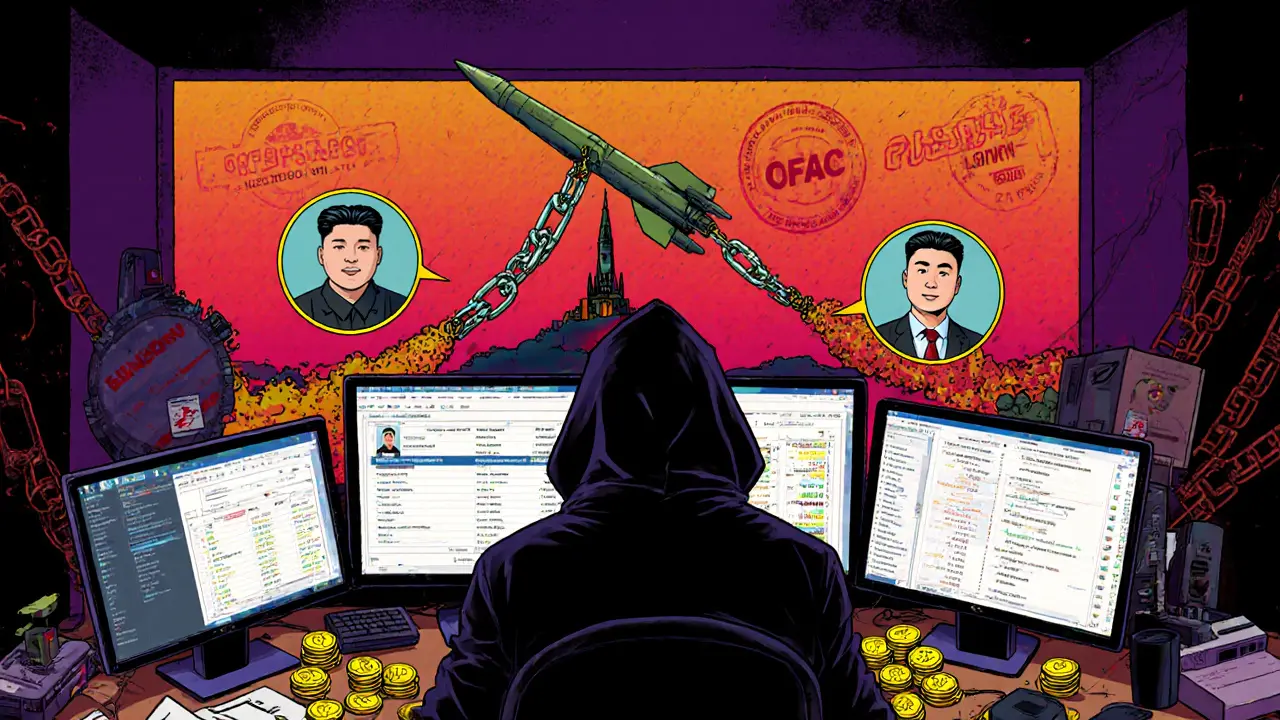
OFAC has targeted North Korean crypto networks that stole over $2.1 billion in 2025, using fake IT workers and global laundering schemes to fund weapons programs. Here's how the U.S. is fighting back.
Read More