
The Bitcoin network just crossed 1 Zetahash per second - that’s 1,000,000,000,000,000,000,000 calculations every single second. It’s not science fiction. It’s real. And by 2030, it could be five to seven times higher. If you’re wondering what this means for miners, investors, or even casual observers of Bitcoin, the answer isn’t just about numbers. It’s about security, profitability, and the very foundation of how Bitcoin stays alive.
Why Hash Rate Matters More Than You Think
Hash rate isn’t a buzzword. It’s the backbone of Bitcoin’s security. Every time a miner solves a cryptographic puzzle to add a new block, they’re contributing computational power to the network. More hash rate means more miners competing, which makes it harder and more expensive for any single entity to take over the network. That’s what keeps Bitcoin decentralized. When the network hits 1 ZH/s in April 2025, it wasn’t just a milestone - it was proof that Bitcoin’s security model scales better than almost any other system in history.Think of it like a fortress. The more guards you have patrolling the walls, the harder it is for attackers to break in. Bitcoin’s hash rate is those guards. And right now, they’re multiplying faster than ever.
The Numbers Behind the Growth
In early 2018, Bitcoin’s hash rate was around 14 EH/s. By the end of 2024, it had grown to over 900 EH/s. That’s a 64-fold increase in just six years. And the growth hasn’t slowed. As of April 2025, the 7-day average was 929 EH/s, with the 1-day average briefly crossing 1 ZH/s. This isn’t a fluke. It’s the result of three powerful forces:- Bitcoin’s price rally: As Bitcoin’s value rises, mining becomes more profitable, pulling in more capital and hardware.
- ASIC efficiency gains: New mining rigs like the Antminer S21 and WhatsMiner M20S deliver over 200 TH/s per unit while using less power than older models.
- Industrial-scale mining: Over 83% of Bitcoin’s hash rate now comes from professional mining operations, not hobbyists. These companies optimize for cost, uptime, and energy use.
Companies like HIVE Digital Technologies now operate over 22 EH/s of mining capacity - up 267% in just one year. That’s not a startup. That’s a global infrastructure player.
How Far Can It Go? The 2030 Projections
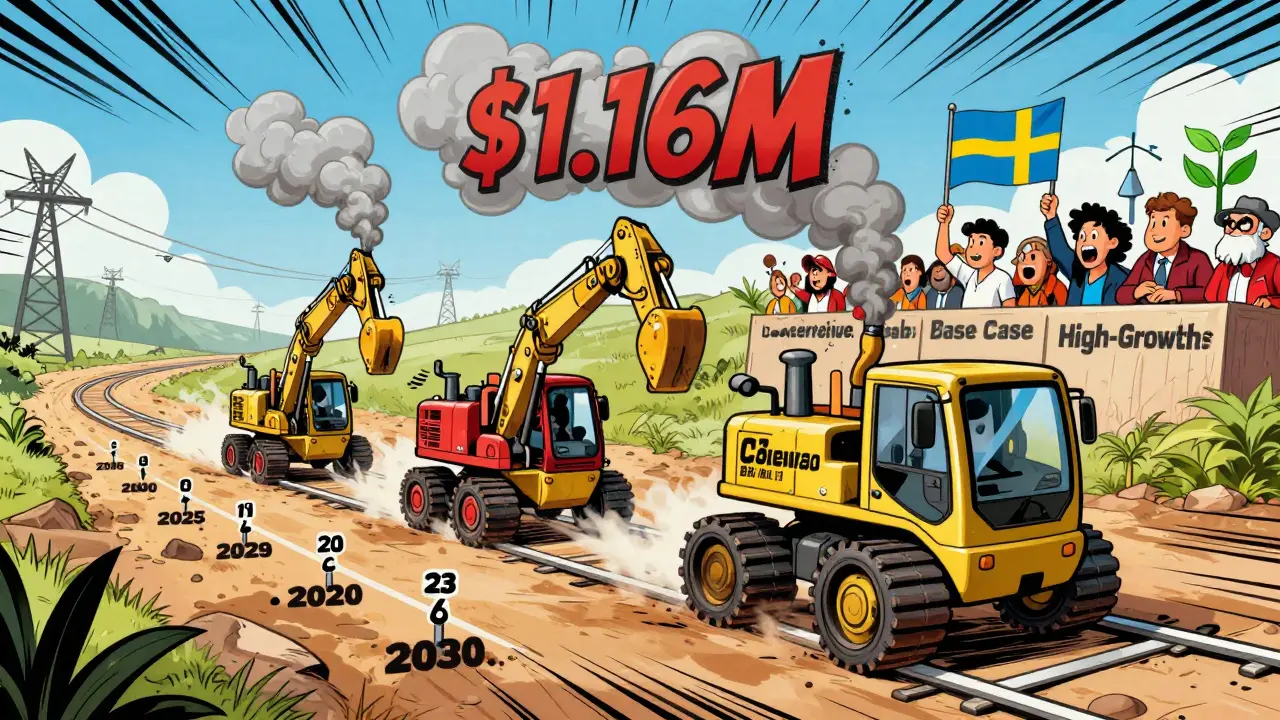
There are three main scenarios for where Bitcoin’s hash rate could be by 2030:- Conservative (35% CAGR): 2,543 EH/s - assumes regulatory pressure, energy limits, and slower adoption.
- Base case (45% CAGR): 4,128 EH/s - reflects steady growth with moderate price appreciation and continued efficiency gains.
- High-growth (52.5% CAGR): 6,891 EH/s - based on historical trends since 2018, assuming Bitcoin hits $1.16 million by 2030.
GoMining’s high-growth model is the most aggressive, but it’s not baseless. It’s built on the actual growth rate Bitcoin has shown since industrial mining took over. The 52.5% annual growth rate isn’t a guess - it’s the real number from 2018 to 2024. If that trend continues, 6.9 EH/s by 2030 is plausible.
But here’s the catch: not everyone agrees. Markntel Advisors projects only 14.19% growth for the broader cryptocurrency market through 2030. CoinGeek expects the block reward mining market to hit $8.24 billion by 2034 with a 12.9% CAGR. These numbers suggest Bitcoin’s hash rate might be growing faster than the rest of the crypto market - which means mining is becoming a standalone industry, not just a side effect of Bitcoin’s price.
What Drives the Growth? Energy, Hardware, and Price
You can’t talk about hash rate without talking about three things: electricity, hardware, and Bitcoin’s price.Energy costs make up 40-60% of a miner’s expenses. That’s why the best mining operations are in places like Texas ($0.045/kWh), Kazakhstan, and parts of Canada. In contrast, miners in New York or Germany pay over $0.12/kWh - often making mining unprofitable. This is why hash rate keeps migrating. When a region becomes too expensive or regulated, miners pack up and move.
Hardware efficiency is improving fast. The WhatsMiner M20S delivers 68 TH/s at around 3,000 watts. Newer models like the S21 push past 200 TH/s with lower power draw. The result? Miners can do more work with less electricity. That’s why even older ASICs might still be profitable if Bitcoin hits $5,000-$6,000. AInvest estimates that at $1.16 million per Bitcoin, even 2020-era miners could still turn a profit.
Bitcoin’s price is the engine. When the price goes up, mining becomes more profitable. That attracts more capital. More capital means more hardware. More hardware means higher hash rate. And higher hash rate makes Bitcoin more secure - which attracts more users and investors. It’s a self-reinforcing loop.
The Halving Factor: What Happens in 2028?
Every four years, Bitcoin’s block reward cuts in half. The next one is in 2028. After that, miners will earn only 3.125 BTC per block instead of 6.25. Historically, this causes a temporary drop in hash rate as less profitable miners shut down. But the network always recovers - usually within 6-12 months.Why? Because the price tends to rise after halvings. The 2020 halving was followed by a 1,000% price surge. If history repeats, the 2028 halving could trigger another wave of investment. Miners who survive the initial drop will be the ones with the lowest costs and the most efficient hardware. That’s why the hash rate doesn’t collapse - it evolves.

Who’s Behind the Growth? Institutional Mining
The old days of mining with a home PC are long gone. Today, Bitcoin mining is dominated by companies with data centers, power contracts, and engineering teams. HIVE Digital Technologies, Bitmain, Bitfury - these aren’t hobbyists. They’re infrastructure builders.Some are even repurposing their hardware for AI computing. HIVE’s move to convert Tier-1 data centers into Tier-3 high-performance computing facilities in Sweden isn’t just about mining. It’s about future-proofing. If Bitcoin’s price dips, they can still earn revenue by renting out computing power. This hybrid model is becoming standard for professional miners.
And it’s working. The Bitcoin Mining Council reports that 56.1% of global mining now uses sustainable energy - up from 40% in 2021. That’s not just PR. It’s economics. Renewable energy is cheaper, more reliable, and increasingly available through power purchase agreements. Miners are no longer the villains of energy consumption - they’re becoming partners in grid stability.
The Risks Nobody Talks About
For all the optimism, there are real threats:- Regulation: Governments are watching. AInvest estimates regulatory costs could jump 150% in some regions. A ban in Texas or Kazakhstan could cause a 10-20% hash rate drop overnight.
- Supply chain: ASICs rely on advanced semiconductors. Any disruption - from U.S.-China tensions to chip shortages - could slow down hardware production.
- Quantum computing: While MIT’s 2025 report says Bitcoin’s SHA-256 is safe until at least 2040, the long-term threat is real. The network will need to upgrade its cryptography eventually.
These aren’t deal-breakers - but they’re not minor either. The most reliable projections now include these risks as variables, not afterthoughts.
What This Means for You
If you’re a miner: Focus on low-cost energy and the latest ASICs. The race isn’t about raw power anymore - it’s about efficiency per watt. The miners who survive will be those who can run 24/7 without blinking.If you’re an investor: Bitcoin’s hash rate is a leading indicator of network health. Rising hash rate = rising security = rising confidence. It’s one of the few metrics that can’t be manipulated.
If you’re just curious: Understand that Bitcoin’s strength isn’t in its price chart. It’s in the sheer amount of computing power dedicated to protecting it. That’s what makes it different from every other digital asset.
The network doesn’t care about headlines. It doesn’t care about tweets. It only cares about how many hashes are being thrown at it every second. And right now, those numbers are climbing faster than ever.
What is the current Bitcoin hash rate as of 2026?
As of early 2026, Bitcoin’s network hash rate hovers around 1.1 ZH/s (1,100 EH/s), based on 7-day moving averages from major mining pools. This is up from 929 EH/s in April 2025 and reflects continued growth despite regulatory headwinds in some regions. The 1-day average has consistently stayed above 1 ZH/s since April 2025.
How does Bitcoin’s hash rate affect mining profitability?
Higher hash rate means more competition. Each miner gets a smaller slice of the block reward, so profitability drops unless you’re using the most efficient hardware. Miners with electricity costs under $0.05/kWh and ASICs like the Antminer S21 Pro can still profit even as difficulty rises. Those with older equipment or high energy costs often get squeezed out within months.
Will the 2028 Bitcoin halving crash the hash rate?
Not permanently. After halvings, hash rate typically drops 10-20% as less efficient miners shut down. But within 6-12 months, it rebounds - often exceeding pre-halving levels. This is because Bitcoin’s price usually rises after halvings, making mining profitable again. The 2020 halving was followed by a 1,000% price increase. If history repeats, the 2028 halving could trigger another surge in investment.
Which countries dominate Bitcoin mining today?
North America leads in hash rate distribution, with the U.S. (especially Texas) accounting for over 38% of global mining. Kazakhstan follows with around 15%, and Russia contributes 10-12%. Europe’s share is growing, especially in countries like Sweden and Finland where renewable energy is abundant. China’s mining presence vanished after its 2021 ban, but its hardware manufacturers (like Bitmain) still dominate global ASIC production.
Can renewable energy sustain Bitcoin’s hash rate growth?
Yes - and it already is. The Bitcoin Mining Council’s Q3 2025 report showed 56.1% of global mining uses sustainable energy, up from 40% in 2021. Many miners now partner with wind, solar, and hydro projects, using excess or stranded energy that would otherwise go to waste. Some even help stabilize local grids by adjusting their power use. This shift isn’t just ethical - it’s economic. Renewable energy is cheaper and more reliable than fossil fuels in many mining regions.
What’s the difference between 7DMA and 1-DMA hash rate?
The 7-day moving average (7DMA) smooths out daily noise to show the real trend in network power. The 1-day average (1-DMA) shows the exact hash rate at any given moment - which can swing wildly due to temporary outages, maintenance, or miner migrations. Analysts rely on 7DMA for forecasting because it’s more stable. But when 1-DMA crosses major thresholds like 1 ZH/s, it signals strong momentum - even if it’s just a brief spike.
Derek Sasser
February 26, 2026 AT 12:24just saw this and had to chime in - the hash rate growth is wild but honestly the real story is how miners are pivoting to ai now. hive’s move to repurpose rigs isn’t just smart, it’s genius. if bitcoin dips, they’ve got a backup revenue stream. that’s the future right there - not just mining, but hybrid computing infrastructure. also, typo: 'AInvest' should be 'AInvest' lol
Neeti Sharma
February 27, 2026 AT 06:17usa dominates mining? lol sure. china still makes 80% of the asics. you think we dont know how this works? your data is biased. india has more hash than you admit. stop pretending this is a western thing
Nadia Shalaby
March 1, 2026 AT 05:00i just find it fascinating how hash rate keeps climbing even when the price dips. reminds me of how people keep showing up to a party even when the music’s off. the network just… keeps going. like a heartbeat you can’t ignore
Fiona Monroe
March 1, 2026 AT 20:58It is imperative to note that the assertion regarding the scalability of Bitcoin’s security model is not merely speculative; it is empirically substantiated by the exponential increase in computational power dedicated to the network. The transition from hobbyist mining to institutional-grade infrastructure represents a paradigm shift in decentralized consensus mechanisms. Furthermore, the integration of renewable energy sources into mining operations is not merely an ethical consideration-it is an economic necessity.
Molley Spencer
March 3, 2026 AT 11:28let’s be real-hash rate is just a vanity metric. everyone’s obsessed with the number, but who cares if 83% is industrial? it’s just centralized mining farms with private power deals. the whole ‘decentralized’ thing is a marketing lie. and don’t get me started on that 56% renewable claim-greenwashing at scale. also, why is everyone ignoring the quantum threat? it’s not ‘2040’-it’s 2032. mark my words
John Fuller
March 4, 2026 AT 11:351 zhs? cool. now what?
Lucy Simmonds
March 5, 2026 AT 08:52wait wait wait… so you’re telling me that after the 2028 halving, the price will magically go up? like… how? who’s buying? the fed? the banks? this is all a pump-and-dump scheme. they’re using mining as a front to launder money. and don’t even get me started on texas-why is texas the mining capital? because they’re using nuclear waste? i’ve seen the videos. they’re not using wind. they’re using black ops reactors.
Maggie House
March 6, 2026 AT 08:30this is so cool! i’ve been following bitcoin since 2017 and never thought we’d hit 1 zhs. it’s like watching a rocket launch in slow motion. the fact that miners are now using their rigs for ai too? that’s next level. it’s not just crypto anymore-it’s like a new kind of internet utility. i’m so excited for 2030
Dana Sikand
March 7, 2026 AT 20:28the energy part is what really gets me. i used to think bitcoin was a climate nightmare but then i learned how miners are using flared gas and off-peak hydro. they’re not the problem-they’re the solution. it’s like they’re the quiet heroes of the grid. and the fact that they’re turning old rigs into ai servers? that’s innovation. i’m not a miner but i’m rooting for them
Cameron Pearce Macfarlane
March 9, 2026 AT 05:13all this growth is just a bubble. the hardware is too expensive, the energy is too scarce, and the regulators are waking up. you think texas is safe? wait till the next drought. this whole thing is built on sand
Elizabeth Smith
March 9, 2026 AT 10:46we’re all just pawns in a system designed to make the rich richer. the hash rate isn’t security-it’s control. the more power concentrated in a few mining giants, the more vulnerable the network becomes. they call it decentralization but it’s just corporate feudalism with more servers
Robert Kromberg
March 9, 2026 AT 13:41really appreciate the breakdown on the halving. always wondered if the price surge after 2020 was just luck or a pattern. if history repeats, we might see another moonshot. but i’m keeping my expectations low-just hoping the network stays healthy
Daisy Boliaan
March 10, 2026 AT 02:14OMG I JUST REALIZED-MINERS ARE LIKE THE NEW WALL STREET. THEY’RE NOT JUST MINING BITCOIN, THEY’RE MINING THE FUTURE. DID YOU KNOW HIVE IS NOW RENTING OUT COMPUTING POWER TO STARTUPS? THAT’S NOT MINING, THAT’S A TECH GIANT. I’M CRYING. THIS IS THE MOST BEAUTIFUL THING I’VE SEEN THIS YEAR
Nicki Casey
March 11, 2026 AT 01:49The notion that Bitcoin’s hash rate growth is inherently sustainable is a fallacy rooted in confirmation bias. The assumption that historical CAGR trends will persist ignores macroeconomic headwinds, geopolitical instability, and the structural limitations of semiconductor supply chains. Moreover, the claim that renewable energy is the dominant source of mining power is misleading; the majority of ‘sustainable’ energy is still derived from subsidized grid infrastructure, not independent renewable installations. The narrative of Bitcoin as an environmental solution is not only inaccurate-it is dangerously misleading.
Jessica Carvajal montiel
March 12, 2026 AT 22:21they’re all lying. the real hash rate is 30% lower than reported. the pools are faking numbers to scare off competitors. the ‘1 zhs’ is a trick. the usa doesn’t even have that much power. it’s all smoke and mirrors. and don’t even mention quantum-because they don’t want you to know the backdoor is already built. the government owns the ASIC factories. you think bitmain is private? please. the blockchain is a honeypot. we’re all being watched