
You’ve probably heard the hype about Bitpanda being the go-to crypto platform for Europeans. But with so many exchanges out there, why does this Austrian-based broker keep popping up in conversations? The short answer is regulation and simplicity. If you live in Europe and want to buy Bitcoin without worrying if your money will vanish overnight, Bitpanda offers a level of security that many offshore competitors just can’t match. But is it the best choice for everyone? Not exactly. Let’s break down what actually works, where it falls short, and whether it fits your trading style.
| Feature | Details |
|---|---|
| Headquarters | Austria (EU Regulated) |
| User Base | 7+ Million Users |
| Assets Available | 650+ Cryptocurrencies, Stocks, ETFs, Metals |
| Standard Fees | Up to 1.49% |
| Fusion Fees | Lower tiered rates (approx. 0.1% - 0.3%) |
| Best For | European investors, beginners, multi-asset portfolios |
| Not Ideal For | US residents, high-frequency day traders seeking lowest possible fees globally |
Why Regulation Matters More Than You Think
Let’s be real: the crypto world is full of horror stories. Exchanges collapse, funds disappear, and users are left holding the bag. That’s why Bitpanda's regulatory status is its biggest selling point. Operating under the strict oversight of Austria’s Financial Market Authority (FMA) and recently approved under the EU’s Markets in Crypto-Assets Regulation (MiCAR), Bitpanda isn’t just another website with a nice interface. It’s a licensed financial institution.
This means your assets aren’t just floating in some vague digital ether. They are held in trust, backed by real assets, and stored in secure cold and warm wallets. Unlike platforms that gamble with user deposits, Bitpanda keeps client funds separate from operational capital. For anyone living in the EU, this compliance isn’t just a checkbox; it’s peace of mind. In January 2025, receiving approval from Germany’s BaFin allowed them to operate legally across all 27 EU member states, cementing their position as a serious player for European wealth management.
More Than Just Crypto: The Multi-Asset Approach
If you’re tired of juggling three different apps-one for stocks, one for gold, and another for Bitcoin-Bitpanda solves that headache. While most exchanges focus solely on digital coins, Bitpanda lets you trade over 3,000 digital assets. Yes, that includes the standard Bitcoin and Ethereum, but also fractional shares of US stocks, Exchange-Traded Funds (ETFs), precious metals like gold and silver, and even commodities.
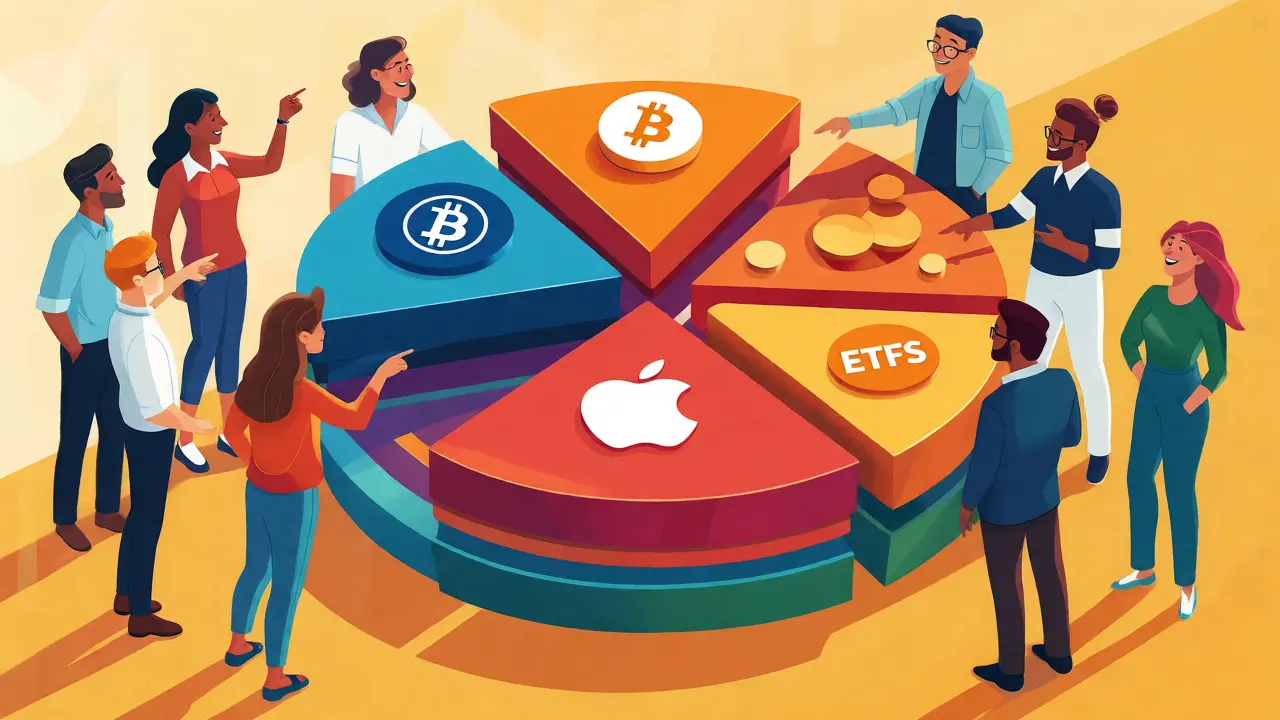
This integration is huge for portfolio diversification. Imagine buying a slice of Apple stock, some Ethereum, and a bit of physical gold-backed token, all within the same dashboard. You don’t need to move money between banks and brokers. The platform handles the currency conversion and settlement automatically. For long-term investors who believe in mixing traditional finance with blockchain technology, this convenience is hard to beat.
The Fee Structure: Where Things Get Tricky
Here is the part that trips people up. Bitpanda’s fee structure has two distinct modes, and understanding the difference saves you money. When you use the standard "Buy" button on the main interface, you’re paying for convenience. The spread and fees combined can reach up to 1.49%. For small, occasional purchases, this might feel acceptable because it’s simple. No complex order books, no confusing charts.
But if you plan to trade regularly, stick around for Bitpanda Fusion. This is their professional trading interface. Here, fees drop significantly, often starting around 0.1% to 0.3% depending on your volume. Fusion gives you access to deeper liquidity pools and advanced order types like limit orders and stop-losses. If you ignore Fusion and keep using the basic app for active trading, you’ll bleed cash on spreads. My advice? If you’re investing more than €100 a month, learn the Fusion interface. The learning curve is worth the savings.
Security Features That Actually Work
We’ve all seen headlines about hacked exchanges. So, how does Bitpanda keep your keys safe? First, they maintain a clean track record with no major security breaches reported through 2025. They utilize industry-standard encryption and require Two-Factor Authentication (2FA) for every login. Beyond the basics, they support external hardware wallets like Ledger, allowing you to withdraw assets to self-custody easily.
Crucially, Bitpanda doesn’t lend out your deposited crypto for interest generation without explicit consent and clear terms. Your assets remain yours. This conservative approach contrasts sharply with platforms that promised 8% yields only to freeze withdrawals when markets turned sour. For risk-averse investors, this transparency is non-negotiable.

Who Should Use Bitpanda?
Let’s get specific. Bitpanda is an excellent fit if:
- You reside in the European Union or EEA (note: availability in the UK has fluctuated, check current status).
- You value regulatory safety over aggressive yield chasing.
- You want to manage crypto, stocks, and commodities in one place.
- You prefer a mobile-first experience with a clean, intuitive design.
Conversely, you might want to look elsewhere if:
- You are based in the United States (Bitpanda does not serve US customers).
- You are a high-frequency day trader needing sub-0.1% maker/taker fees and massive leverage options.
- You want access to obscure altcoins before they hit major centralized exchanges (Coinbase or Binance might list niche tokens faster).
Final Verdict: A Solid Choice for European Investors
Is Bitpanda perfect? No platform is. The standard interface fees are high, and the asset selection, while broad, doesn’t always have the deepest liquidity for minor altcoins compared to global giants like Binance. However, for the average European investor looking to enter the crypto space safely, it’s arguably the best entry point available today. The combination of MiCAR compliance, multi-asset capability, and user-friendly design creates a compelling package.
If you prioritize keeping your money safe and accessible within a regulated framework, Bitpanda earns a strong recommendation. Just remember to switch to Fusion for better rates once you’re comfortable with the basics.
Is Bitpanda safe to use?
Yes, Bitpanda is considered highly safe due to its strict regulation by the Austrian FMA and EU MiCAR standards. It holds customer assets in secure cold storage and maintains a clean history with no major security breaches.
Can I buy stocks on Bitpanda?
Yes, Bitpanda allows you to buy fractional shares of thousands of global stocks, as well as ETFs and precious metals, alongside cryptocurrencies. All trades settle in EUR.
What are the withdrawal fees?
Bitpanda generally charges no deposit fees for bank transfers. Withdrawal fees vary by asset type; fiat withdrawals may incur small costs depending on the method, while crypto withdrawals cover network gas fees. Always check the specific fee schedule for the asset you are moving.
Does Bitpanda offer staking rewards?
Yes, Bitpanda offers staking opportunities for various blockchain assets. Rewards are paid directly into your account, and unlike some competitors, there are typically no mandatory vesting periods, allowing for immediate liquidity access.
Is Bitpanda available in the USA?
No, Bitpanda does not currently serve customers residing in the United States. It primarily focuses on the European market, covering over 40 countries including EU members and Switzerland.
Andy Hunns
September 19, 2026 AT 18:18I absolutely despise how this platform locks out Americans while preaching about global financial freedom. It is pure arrogance to assume the EU knows better than us regarding asset custody and regulatory oversight. We have the SEC, we have the CFTC, yet Bitpanda acts as if they are the only ones who figured out how to hold a private key without losing it in a rug pull. This exclusionary policy smells like protectionism dressed up as compliance. I am tired of seeing European brokers pat themselves on the back for basic due diligence while US exchanges fight tooth and nail for clarity. They should be ashamed of their gatekeeping.
Newman Thurairatnam
September 20, 2026 AT 07:40The notion that 'regulation equals safety' is a comforting lie told by the state to keep the sheep calm while the wolves eat the shepherds.
Consider the history: Mt. Gox was regulated in Japan. FTX had offices in the Bahamas with proper licenses. Regulation does not prevent fraud; it merely creates a paper trail for when the money has already vanished into offshore accounts.
Bitpanda's reliance on the Austrian FMA is a single point of failure. What happens when the next geopolitical crisis hits Europe? Do you think the Austrian government will bail out crypto holders, or will they freeze accounts under emergency powers just like they did with bank deposits in Cyprus?
We must remain vigilant against the illusion of security provided by bureaucratic institutions. The true enemy is centralization, and Bitpanda is simply another centralized custodian wearing a suit and tie.
They claim cold storage, but who audits the audit? Who verifies the proof of reserves in real-time? These are questions the mainstream media refuses to ask because they are funded by the same banks that want you to trust Bitpanda over your own hardware wallet.
I suspect that behind the scenes, Bitpanda is leveraging user assets in ways that are not fully disclosed in their terms of service.
The 'trust' model is fundamentally broken when one party holds the keys and the other holds the risk.
Do not let the shiny interface distract you from the underlying fragility of the system.
If the EU decides to ban self-custody wallets tomorrow, what then? Will Bitpanda protect your rights, or will they comply with the new mandate and lock you out of your own wealth?
I have seen too many instances where 'regulated' entities fail spectacularly, leaving retail investors holding worthless IOUs.
This is not fear-mongering; it is historical precedent.
The MiCAR framework is still young and untested in a severe market downturn.
We cannot afford to be complacent with our digital sovereignty.
Trust no one, especially not those who charge you 1.49% for the privilege of being watched.
:)
Sue Long Merrill
September 20, 2026 AT 21:45This review lacks sufficient critical depth regarding the tax implications for cross-border traders. The author glosses over the complexities of capital gains reporting within the EU framework, which is a significant oversight for serious investors. Furthermore, the comparison to offshore competitors is superficial at best.
Alvin Sunderland
September 21, 2026 AT 01:10Wait, wait, WAIT!!! Hold on a second...
You are telling me that 'Regulation' is the main selling point?? In 2026?? After everything that happened with the banking sector collapses in '23 and '24??
This is exactly the kind of narrative pushed by the establishment to keep the masses dependent on centralized intermediaries!!
Think about it... really think about it...
If Bitpanda is so heavily regulated, why do they need to hide behind 'Fusion' fees to make trading viable?? Because the base layer is bloated with compliance costs that get passed down to YOU!!!
It’s a racket... a sophisticated, well-marketed racket designed to extract value from people who are too scared to run their own nodes!!
And don’t get me started on the 'Multi-Asset' approach... mixing stocks and crypto in one dashboard is a psychological trick to dilute the volatility perception!!
It’s gaslighting via UI design!!!
You think you’re diversified, but you’re just exposed to the same macro-economic levers pulled by the same few hands!!
The fact that they don’t serve the US proves they know their model can’t withstand the scrutiny of a truly decentralized market environment!!
Wake up!!!
William Newcombe
September 21, 2026 AT 22:10One must consider the ontological status of 'ownership' within such a framework. When assets are held in trust by a regulated entity, the user possesses a claim against the institution rather than direct dominion over the cryptographic primitive itself. This distinction is crucial for understanding the systemic risks inherent in centralized brokerage models. The convenience of integration often comes at the cost of philosophical autonomy regarding one's wealth.
Manish Pahuja
September 23, 2026 AT 16:03Hey everyone! 👋 Just wanted to add some positive vibes here. If you're starting out in Europe, honestly, the simplicity is a huge win. Don't stress about the complex stuff right away. Start small, learn the ropes, and maybe move to Fusion later if you get into active trading. Keep pushing forward! 🚀
clarence bustos
September 25, 2026 AT 02:25It is morally wrong to prioritize convenience over security. Every time you click that simple buy button, you are surrendering your agency to a corporation. :(
We have a duty to educate ourselves on self-custody. Relying on Bitpanda is a shortcut that leads to long-term vulnerability. You should feel responsible for your own financial journey. :)
Don't let them fool you with pretty charts. Real strength comes from holding your own keys.
Prince Johny
September 26, 2026 AT 16:55From a cultural perspective, the adoption of platforms like Bitpanda in Africa is interesting. While it serves Europe, the model of fractional investing could revolutionize how emerging markets access global assets. However, the aggressive fee structure might hinder mass adoption in regions with lower purchasing power. We need more localized solutions that understand the nuances of African fintech landscapes.
Deke Parrott
September 27, 2026 AT 06:30I appreciate the balanced view here. It’s refreshing to see a review that acknowledges both the strengths in regulation and the weaknesses in fees. For many of us, the trade-off between ease of use and cost is a personal decision. Respectfully, I think highlighting the learning curve for Fusion is a very helpful tip for beginners. :)