
You bought the shiny new Antminer S21 is a high-efficiency Bitcoin mining device using 3nm chip technology.. You plugged it in. It’s humming. But are you actually making money? Or are you just paying your electric bill with extra steps?
This is the exact question every miner faces today. The days of mining Bitcoin on a laptop are long gone. Now, it’s a game of margins, electricity rates, and hardware efficiency. That’s where an ASIC Miner Profitability Calculator is a specialized computational tool designed to estimate potential earnings and return on investment for cryptocurrency mining operations. comes in.
These tools aren’t just guesswork anymore. Since their early days on forums like BitcoinTalk around 2013-2014, they’ve evolved into sophisticated engines that track real-time data. But here’s the catch: if you plug in wrong numbers, you get wrong results. And in this business, wrong results mean lost capital.
Key Takeaways
- Electricity is king: Your power cost ($/kWh) accounts for 60-85% of your operational expenses. If your rate is above $0.10/kWh, profitability is extremely tight.
- Calculators lie by omission: Most online tools overestimate profits by 20-30% because they ignore hardware degradation and cooling overheads.
- Real-time matters: Network difficulty adjusts every two weeks. Static calculators fail during volatility; use tools with minute-by-minute updates.
- The Halving Effect: Post-April 2024 halving, block rewards dropped to 3.125 BTC. Calculators must reflect this new baseline to be accurate.
- Compare multiple sources: Industry best practice is to average results from at least two different calculators (e.g., WhatToMine and ASICMinerValue).
How ASIC Profitability Calculators Actually Work
An ASIC Miner Profitability Calculator takes raw technical inputs and converts them into financial projections. It doesn’t predict the future-it models the present based on current market conditions. To get a realistic number, you need to understand the four pillars of input data.
- Hash Rate (TH/s): This is your machine’s speed. For example, the Antminer S19 Pro delivers 110 TH/s. Higher hash rate means more chances to solve blocks, but only if the network difficulty stays stable.
- Power Consumption (Watts): ASIC rigs are power-hungry beasts. A typical setup draws between 2,000W and 3,500W. This number directly multiplies with your electricity rate to determine your biggest expense.
- Electricity Rate ($/kWh): This is the make-or-break variable. In the U.S., the average sits around $0.138/kWh as of mid-2024. If you’re paying residential rates, you’re likely unprofitable. Industrial miners often secure rates below $0.05/kWh.
- Network Difficulty & Block Reward: Difficulty adjusts every 2,016 blocks (roughly every two weeks). After the April 2024 halving, the reward per block dropped to 3.125 BTC. Calculators must pull live difficulty data to remain relevant.
When these variables align, the calculator outputs daily profit, monthly ROI, and payback period. But remember: accuracy depends entirely on the precision of your inputs. Garbage in, garbage out.
Top ASIC Calculators Compared: Which One Should You Use?
Not all calculators are created equal. Some prioritize simplicity, others depth. Here’s how the major players stack up in 2026.
| Platform | Update Frequency | Key Strength | Main Weakness | Best For |
|---|---|---|---|---|
| WhatToMine | 5-10 minutes | Cross-crypto support (150+ coins) | Slower refresh; can lag during volatility | Miners diversifying beyond Bitcoin |
| Mining Now | 1 minute | Real-time Bitcoin tracking | Bitcoin-only focus | Pure-play BTC miners |
| ASICMinerValue | 60 seconds | Live pricing across 47+ ASIC models | Less detailed cost breakdowns | Hardware shoppers comparing ROI |
| EcoHash Cloud | Variable | Carbon savings & renewable integration | Complex interface for beginners | Sustainable/green mining operations |
| BlockForge | Real-time | Enterprise thermal management costs | Requires >1 PH/s hash rate | Industrial-scale mining farms |
If you’re a solo miner with one or two rigs, ASICMinerValue or Mining Now offers the best balance of speed and simplicity. They update frequently enough to catch price spikes. However, if you’re running a large operation, you need something like BlockForge, which factors in thermal management-a cost that can eat up 15-20% of your profits if ignored.
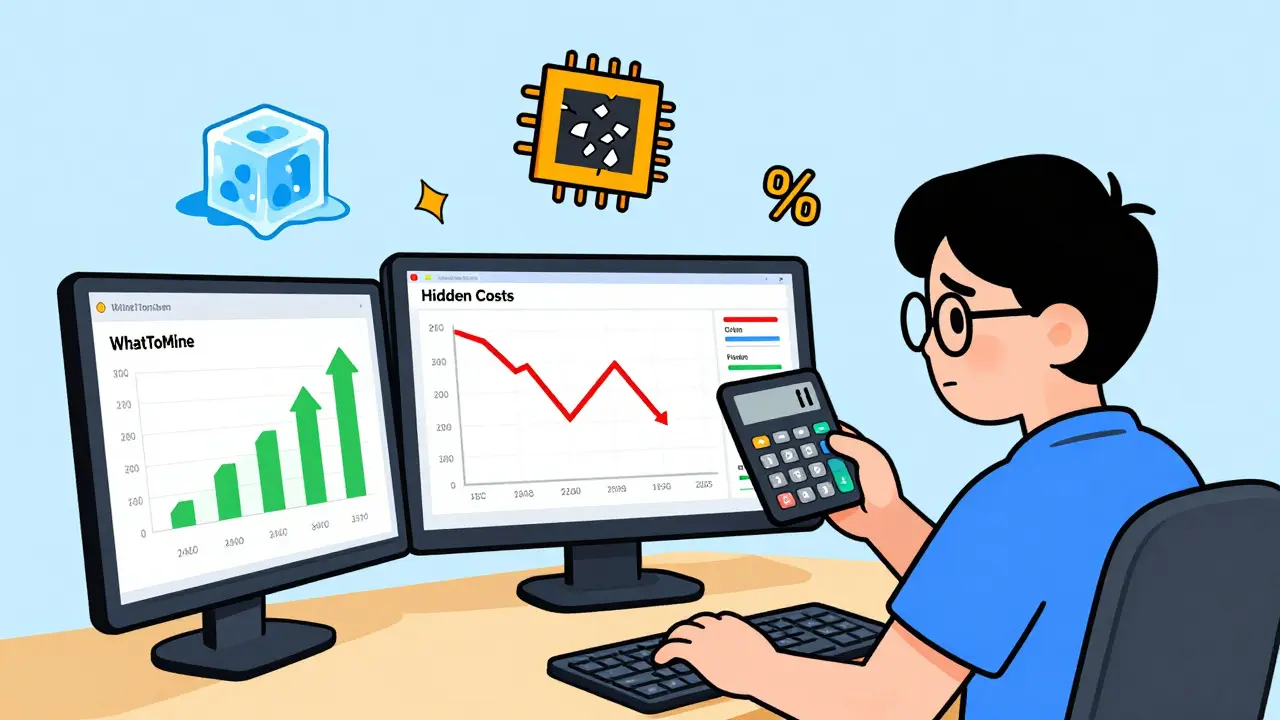
The Hidden Costs Most Calculators Ignore
Here’s where most people lose money. Online calculators give you a "net profit" figure, but that number is often optimistic. Dr. Alex de Vries, founder of Digiconomist, noted in May 2024 that most tools overestimate profitability by 20-30% because they skip critical operational realities.
What are those hidden costs?
- Hardware Degradation: ASIC chips don’t last forever. Heat and dust reduce efficiency over time. A rig that starts at 110 TH/s might drop to 105 TH/s within six months. Most calculators assume constant performance.
- Cooling Overhead: Your AC or immersion cooling system uses power too. Add 10-15% to your electricity estimate to account for cooling. If you ignore this, your profit margin shrinks instantly.
- Pool Fees: Mining pools charge 1-3% for their services. While small, this fee compounds over millions of hashes. Ensure your calculator includes this deduction.
- Transformer Losses: Power conversion isn’t 100% efficient. ASICMinerValue’s July 2024 update highlighted a 5-8% energy loss in transformers. That’s free money vanishing before it hits your rig.
- Regulatory Compliance: In the EU, MiCA regulations now add 2-5% to operational costs for compliance reporting. If you’re operating in regulated jurisdictions, factor this in.
To get a true picture, take the calculator’s output and subtract an additional 15-20%. That’s your realistic net profit.
Step-by-Step: How to Run a Accurate Profit Calculation
Don’t just click buttons. Follow this workflow to ensure your numbers hold up.
- Gather Exact Hardware Specs: Don’t guess. Check the manufacturer’s sheet. For an Antminer S19 Pro, use 110 TH/s and 3,250W. Using generic averages introduces error.
- Find Your True Electricity Rate: Look at your last bill. Include any demand charges or tiered pricing. If you’re on a commercial plan, confirm if there are peak-hour surcharges.
- Add Cooling Buffer: Multiply your total wattage by 1.15 to account for cooling systems. Input this adjusted power draw into the calculator.
- Input Current Pool Fees: Check your chosen pool’s documentation. NiceHash, for instance, lists its fees clearly. Enter the exact percentage.
- Run Multiple Scenarios: Test three cases: Best Case (low difficulty, high BTC price), Average Case (current metrics), and Worst Case (high difficulty, low BTC price). This gives you a risk range.
- Calculate Payback Period: Divide the total cost of the ASIC (including shipping and import taxes) by your monthly net profit. If the payback period exceeds 18 months, reconsider the investment.
Experienced miners complete this process in under five minutes. Beginners should take their time-mistakes here cost thousands.

Why Network Difficulty Changes Everything
Bitcoin’s protocol is designed to keep block times steady at 10 minutes. It does this by adjusting difficulty every 2,016 blocks. If more miners join, difficulty goes up. If miners leave, it goes down.
Post-halving in 2024, difficulty has been climbing steadily. MiningPoolStats reported a 14.2% monthly increase in average difficulty. This means your same rig earns less BTC each month unless the price of Bitcoin rises proportionally.
Static calculators fail here. They show yesterday’s difficulty. Always use a tool with real-time or near-real-time difficulty feeds. Tools like Mining Now update every minute, ensuring your projection reflects the current competitive landscape. If you’re using a calculator that hasn’t updated in hours, your profit estimate is already outdated.
Future-Proofing Your Mining Investment
The mining industry is shifting. By 2025, Messari predicts 90% of calculators will include environmental impact metrics due to regulatory pressure. In California and the EU, green energy usage is becoming a financial advantage, not just a moral choice.
If you’re planning a long-term operation, consider tools like EcoHash Cloud, which integrates carbon savings. As regulations tighten, miners using renewable energy may qualify for tax credits or lower grid fees. These benefits won’t appear in standard profit calculators yet, but they will soon.
Also, watch for AI-driven forecasting. Mining Now announced machine learning-based difficulty predictions in Q3 2024, aiming to cut estimation errors by 35%. As these tools mature, relying on manual calculations will become obsolete. Stay ahead by adopting platforms that evolve with the tech.
Is ASIC mining still profitable in 2026?
Yes, but only for those with access to cheap electricity (below $0.08/kWh) and modern hardware like the Antminer S21 series. Residential miners with high power rates typically operate at a loss after accounting for cooling and maintenance.
Which ASIC profitability calculator is the most accurate?
No single calculator is perfect. Industry experts recommend averaging results from ASICMinerValue and Mining Now. Both offer real-time data, but combining them helps mitigate individual platform biases or data lags.
How much do pool fees affect my profits?
Pool fees typically range from 1% to 3%. While this seems small, on a large scale, it can amount to hundreds of dollars monthly. Always input the exact fee percentage from your pool’s documentation into your calculator.
Do I need to adjust for the Bitcoin halving?
Absolutely. The April 2024 halving reduced block rewards to 3.125 BTC. Any calculator not reflecting this new reward structure will significantly overestimate your earnings. Ensure your tool uses post-halving parameters.
What is the ideal payback period for an ASIC miner?
Aim for a payback period of 12-18 months. Anything longer increases the risk of hardware failure or market downturns wiping out your investment. If your calculation shows a 24-month payback, the investment is likely too risky.
Can I mine other cryptocurrencies with an ASIC?
Most ASICs are designed for specific algorithms (like SHA-256 for Bitcoin). However, some newer models support multiple coins. Use cross-crypto calculators like WhatToMine to compare profitability across different assets before committing.