
Imagine you have $10,000 in Ethereum. You can lock it up to help secure the network and earn a steady 4% annually, or you can throw it into a decentralized liquidity pool where the yield might hit 50%-but only if you don't get caught by impermanent loss or a smart contract bug. This is the core dilemma facing many cryptocurrency holders today: choosing between the safety of staking and the high-risk, high-reward world of Yield Farming is a DeFi strategy involving depositing assets into liquidity pools to earn trading fees and protocol incentives.
The decision isn't just about which one pays more; it's about how much time you want to spend managing your money and how much volatility you can stomach. One approach feels like putting cash in a savings account, while the other feels like running a small hedge fund from your living room. Let's break down exactly how these two methods work, what they cost you, and who they are actually for.
How the Mechanics Actually Work
To understand the difference, you have to look at what happens under the hood when you click "stake" versus "provide liquidity."
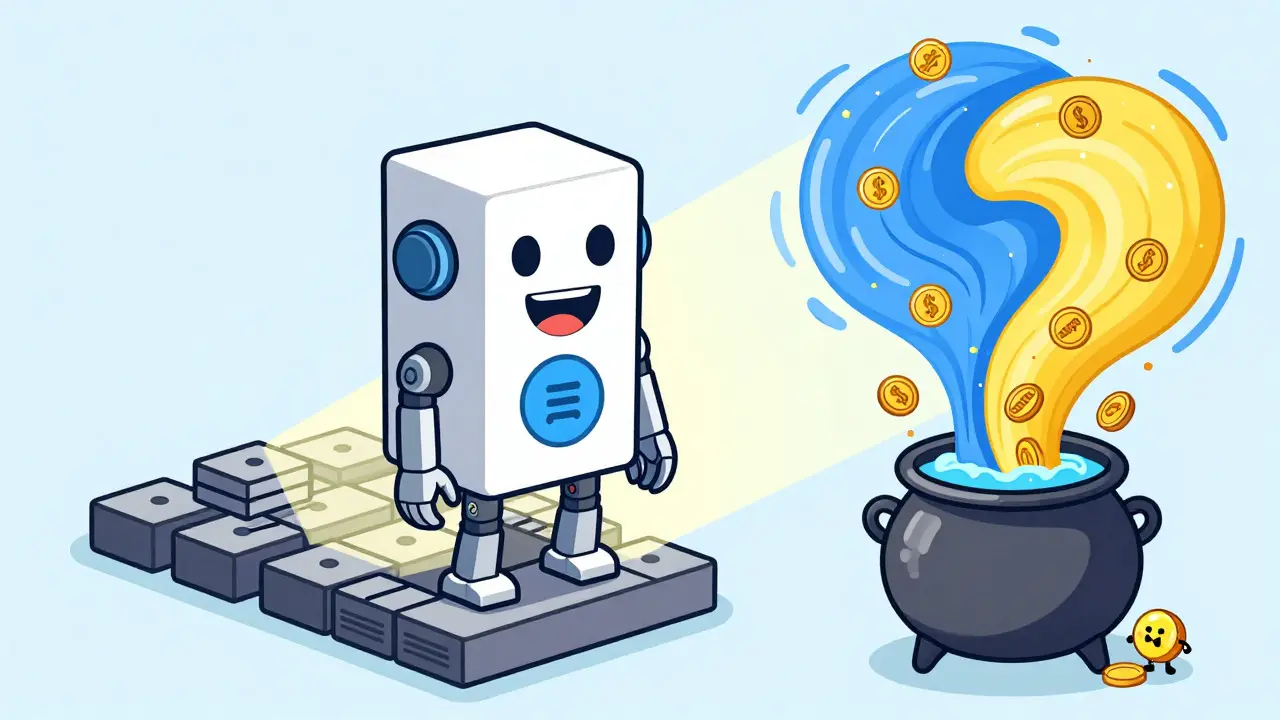
Staking is the process of locking cryptocurrency tokens to support proof-of-stake blockchain networks. When you stake, you are essentially helping the network validate transactions. In return, the network pays you in its native token. It’s a straightforward exchange: you provide capital (and sometimes hardware) to secure the chain, and the chain rewards you with inflationary emissions. The most prominent example is Ethereum, a leading blockchain platform that transitioned to proof-of-stake consensus. On Ethereum, solo staking requires holding 32 ETH, but most people use liquid staking protocols or exchanges to lower this barrier. The key here is that your asset remains the same type of token you put in. If you stake ETH, you earn ETH.
Yield Farming, on the other hand, operates within Decentralized Finance (DeFi). Here, you aren't securing a single chain; you are providing liquidity to an Automated Market Maker (AMM). To do this, you usually need to deposit two different tokens in equal value-for example, half ETH and half USDC. These pairs go into a pool that traders use to swap assets without an order book. You earn a share of the trading fees generated by that pool, plus additional rewards in the protocol's governance token. Unlike staking, your exposure is to the price relationship between two assets, not just one.
Risk Profiles: Where the Money Can Go
This is where the conversation gets serious. Staking risks are relatively well-understood, while yield farming introduces several layers of uncertainty that can wipe out gains quickly.
The primary risk in staking is slashing. If a validator makes a mistake, like double-signing a block or going offline for too long, the network penalizes them by burning a portion of their staked funds. For individual users using pooled staking services, this risk is diluted across thousands of validators, making it extremely rare. There is also the risk of opportunity cost due to lock-up periods. If you stake on Ethereum, you generally cannot withdraw immediately; there is an unbonding period. During this time, if the market crashes, you are stuck holding the bag.
Yield farming adds impermanent loss to the mix. This occurs when the price of the two tokens in your liquidity pair diverges significantly. If you farm an ETH/USDC pair and ETH doubles in price while USDC stays flat, you will end up with less ETH than if you had just held it. Depending on the divergence, this loss can range from 5% to over 20%. Then there is the risk of smart contract exploits. Since you are interacting with code that hasn't been audited as thoroughly as major chains, bugs can happen. The SQUID token incident is a stark reminder: prices dropped from nearly $2,900 to fractions of a cent in seconds due to a flash loan attack. Finally, there is the "rug pull" risk, where project developers abandon the protocol and take the liquidity with them.
| Feature | Staking | Yield Farming |
|---|---|---|
| Primary Mechanism | Validating transactions on PoS networks | Providing liquidity to AMM pools |
| Typical APY Range | 3% - 12% | 5% - 100%+ (highly variable) |
| Main Risk Factor | Slashing, Lock-up periods | Impermanent Loss, Smart Contract Bugs |
| Management Effort | Low (Passive) | High (Active Monitoring) |
| Liquidity Access | Delayed (Unbonding period) | Immediate (But potentially at a loss) |
| Minimum Investment | $100 - $500 (via exchanges) | $5,000+ (to offset gas fees effectively) |
Return Expectations and Real-World Numbers
Let's talk numbers, because that's usually why people ask this question. Staking offers predictability. Established networks like Ethereum currently offer around 4-6% APY. Cardano and Solana sit in similar ranges, depending on network participation rates. These yields are lower than traditional stock dividends in some cases, but they come with the upside potential of the underlying asset appreciating. If ETH goes up 50% and you earn 5% in staking rewards, your total return is roughly 55%.
Yield farming promises moonshots. During bull markets, APYs on popular protocols can exceed 50% or even 100%. However, these figures are often misleading. They assume you stay in the pool until the end of the reward period and ignore transaction costs. A typical yield farmer might move their assets every few days to chase higher yields. Each move incurs gas fees. On Ethereum mainnet, a single transaction can cost $10 to $50 during normal times, but spikes to $100+ during congestion. If you're moving a $5,000 position weekly, those fees can eat up 10-20% of your annual gains. Successful farmers report net returns of 15-50% after fees and losses, which is impressive but requires significant effort to achieve.
Time Commitment and Technical Complexity
If you consider yourself a passive investor, staking is the clear winner. You can set it and forget it. Many centralized exchanges now offer one-click staking buttons. You buy the coin, click stake, and watch the balance grow. The technical barrier is low. You don't need to understand validator nodes or consensus algorithms deeply; you just need to trust the platform or protocol.
Yield farming is a job. Experienced farmers report spending 5 to 10 hours a week monitoring positions. You need to track which pools are offering the best risk-adjusted returns, monitor the health of the protocols you're using, and calculate impermanent loss scenarios before entering. You also need to be comfortable using non-custodial wallets like MetaMask or Rabby and interacting directly with smart contracts. For beginners, the learning curve is steep. It typically takes 2-4 weeks to feel confident enough to manage a portfolio without making costly mistakes. If you don't have time to dedicate to this, the friction of yield farming will likely result in negative returns once you factor in the time cost.
Who Should Choose Which Strategy?
Your choice depends heavily on your experience level, risk tolerance, and portfolio size.
- Choose Staking if: You are new to DeFi, you prefer predictable income, you have a smaller portfolio (under $10,000), or you want a truly passive investment. It’s ideal for long-term holders who believe in the growth of specific networks like Ethereum or Polkadot.
- Choose Yield Farming if: You have intermediate to advanced DeFi knowledge, you have a larger portfolio ($5,000+) that can absorb gas fees, you enjoy active management, and you have a high risk tolerance. It suits traders who already monitor markets daily and view crypto as a speculative asset class rather than a store of value.
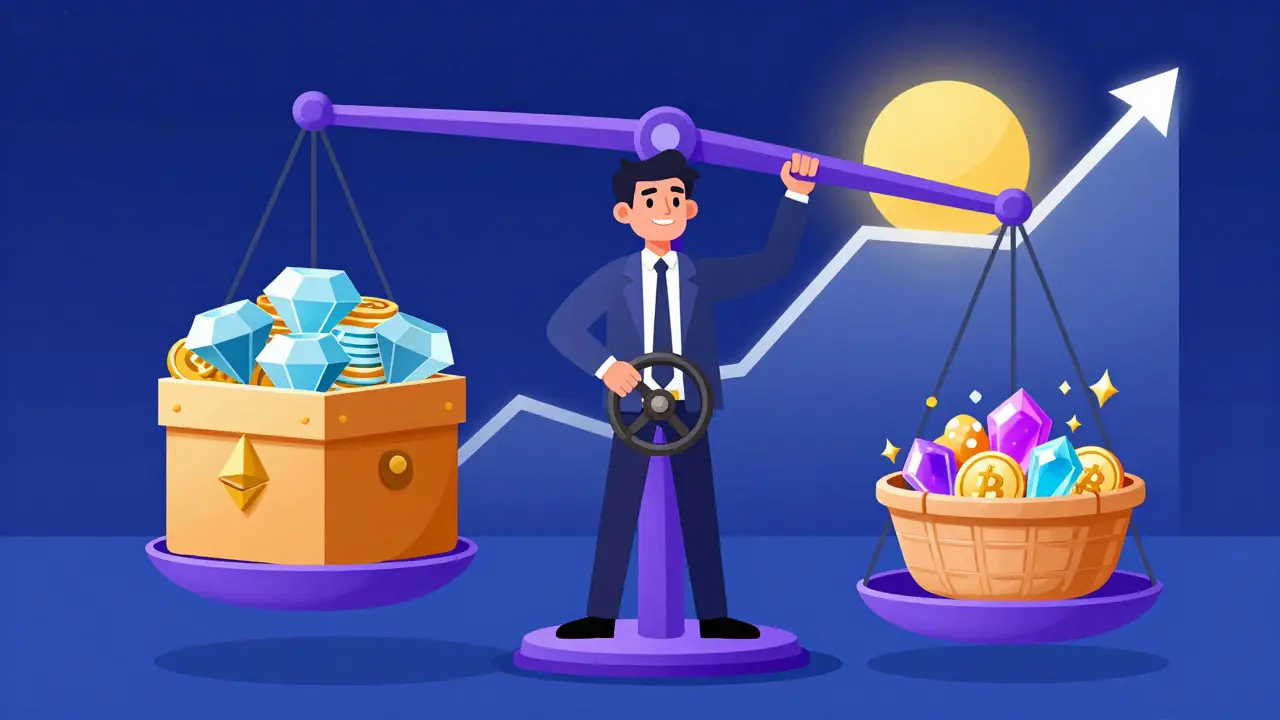
Many sophisticated investors use a hybrid approach. They stake their core holdings for stability and base rate returns, while allocating a smaller percentage (say 10-20%) to yield farming for aggressive growth. This balances the security of staking with the upside potential of DeFi.
Frequently Asked Questions
Is yield farming safer than staking?
Generally, no. Staking has fewer variables. While both carry smart contract risks, yield farming adds impermanent loss and higher volatility. Staking is considered the lower-risk option for passive income.
What is the minimum amount needed to start yield farming?
While there is no hard minimum, experts recommend starting with at least $5,000. With smaller amounts, transaction fees can consume a large portion of your profits, making the strategy inefficient compared to simple holding or staking.
Can I lose all my money in staking?
It is highly unlikely to lose everything unless the entire blockchain fails or the staking provider runs away with funds. Slashing penalties are usually small percentages (e.g., 0.05% to 1%) of the staked amount, not total loss.
Do I pay taxes on staking rewards?
In most jurisdictions, yes. Staking rewards are typically taxed as ordinary income when received, not when sold. Keep detailed records of the date and value of each reward payout for accurate reporting.
Which is better for long-term wealth building?
For most people, staking is better for long-term wealth building because it reduces friction and allows you to focus on asset selection rather than tactical trading. Yield farming is better for short-to-medium term tactical gains by experienced operators.
Kiran Jayaram
August 20, 2026 AT 14:45look at this garbage chart again. you are all just gambling on a casino run by nerds in hoodies. staking is just slow death for your money while the real alpha is hiding in the rugs. i made 40k last month on a pool that vanished in an hour so why are you even reading this boring article
Uday N M
August 22, 2026 AT 08:32The mechanics described here are standard for Western DeFi protocols, but one must consider the regulatory landscape in India where staking has been taxed aggressively. The risk profile changes significantly when the government decides to reclassify these rewards as speculative income rather than passive yield. It is a subtle point often missed by global-centric analysis.
Melissa G
August 22, 2026 AT 20:10This distinction between securing a network and providing liquidity is fundamentally a question of utility versus speculation. Staking aligns the holder’s interest with the protocol’s survival, creating a symbiotic relationship where value accrues through security provision. Yield farming, conversely, is a zero-sum game of arbitrage that extracts value from price inefficiencies without necessarily contributing to the underlying asset's long-term health. One builds infrastructure; the other harvests it. The philosophical implication is that we are choosing between being citizens of a digital state or tourists in a marketplace. The former requires patience and trust; the latter demands vigilance and cynicism. Neither is morally superior, but they demand different character traits from the investor. We must ask ourselves what kind of digital society we wish to inhabit. Do we want robust networks secured by dedicated validators? Or do we prefer chaotic pools driven by short-term greed? The answer shapes our future financial architecture. It is not merely about the percentage yield. It is about the nature of our participation in the blockchain economy. Are we stakeholders or speculators? This identity shift is the most critical aspect of modern crypto investing. The technical details matter less than the intent behind the capital deployment. A clear mind sees the difference immediately. A confused mind only sees the numbers. Choose your path wisely, for it defines your relationship with technology itself.
Patrick Pat
August 23, 2026 AT 09:11So basically if you don't have time to watch charts like a hawk, you're stuck with 4% returns. Sounds like a job description for a bored accountant. I've seen more stable returns from my savings account in Dublin than from any 'passive' staking scheme that promises moonshots. The gas fees alone on Ethereum make me want to throw my wallet into the Liffey. Who actually enjoys paying $50 to move their own money? It feels less like investing and more like donating to the validator class. But sure, keep telling yourselves it's 'passive' income while you refresh the page every ten minutes hoping the pool doesn't rug pull. Very relaxing. Truly the pinnacle of financial freedom. Just don't mention the word 'risk' in the same breath as 'yield farming' because let's be honest, the only thing you're farming is anxiety. And maybe some tax headaches for the IRS later on. But hey, at least you can say you tried to be a decentralized finance guru from your living room couch.
Claudio Perrone
August 23, 2026 AT 23:08the real problem is people dont get it its all a big conspi racy anyway the banks are watching us all and staking is just a trap set by the elites to control our wallets. i read somewhere that the smart contracts are actually backdoors for the fbi to freeze your funds. anyone else notice how every big farm crashes right before the election? weird timing huh. i think the whole defi thing is just a way to track who is rich and who is poor. very deep stuff. need to stay awake for this one. also typo sorry was typing fast because the truth is coming out soon. wake up sheeple. the matrix is real and eth is just the battery we plug into it. no one talks about this because they are scared. i am not scared. i am ready. pass the salt. wait wrong thread. sorry. back to the conspiracy. the whales know something we dont. they are moving their funds to stable coins because they know the crash is coming. join me in the dark web forum we discuss this daily. link in bio. trust no one. especially not the stakers. they are the enemy of progress. freedom is out there. just look harder. or maybe buy more memecoins. who knows. life is a mystery. especially when you are holding bags of low cap tokens at 3am. the pain is real. the fear is real. but the hope is stronger. always remember that. keep your keys safe. literally. put them in a lead box under the floor. just in case.
Aaron Morrissey
August 25, 2026 AT 17:11It is, quite frankly, a magnificent dichotomy presented here. One stands before the precipice of financial destiny, torn between the stoic reliability of the staker and the tempestuous volatility of the farmer. To choose staking is to embrace the quiet dignity of the anchor, holding firm against the tides of market sentiment. To choose yield farming is to dance upon the edge of the blade, seeking the nectar of high returns amidst the storm of impermanent loss. Both paths require courage, yet they demand different flavors of bravery. The staker braves the boredom of stability; the farmer braves the chaos of opportunity. In this grand theater of digital assets, we are all actors playing our parts with varying degrees of conviction. Let us not judge the staker for his caution, nor the farmer for his recklessness. For in the end, it is the balance of both forces that keeps the ecosystem alive. May your blocks be validated and your pools remain liquid. A truly poetic conclusion to a complex financial inquiry. Bravo to the author for laying out such a vivid landscape for our contemplation. It serves as a mirror to our own investment philosophies. What do we value more: peace of mind or the thrill of the chase? This is the eternal question. And perhaps, the answer lies in the hybrid approach mentioned earlier. A blend of steel and silk. Structure and spontaneity. It is a beautiful metaphor for life itself. We seek stability in our foundations, yet we crave growth in our branches. Let us cultivate both within our portfolios. With grace and determination. The journey continues. And we walk it together, in this vast digital wilderness. May the odds be ever in your favor. Or at least, may your APYs be competitive. That is the prayer of the modern investor. Simple, yet profound. Thank you for sharing this insight with us all.
Patrick Quairoli
August 27, 2026 AT 11:14you guys are all dumb for trusting any of this. i told you the squid incident was just the beginning. the next rug is gonna be bigger and nobody will see it coming. check the code yourself or lose everything. its not hard to audit a contract if you have a brain. stop relying on auditors they are all paid off by the dev teams. i saw the emails. well i thought i did. whatever. the point is trust nothing. especially not the 'stable' yields. they are bait. the real money is in the pre-launch tokens on the new chains. but those are risky too. so basically you are screwed either way. welcome to crypto. where the house always wins and the players are just entertainment for the whales. enjoy your 4% staking rewards while the world burns around you. it is funny really. the irony of trying to be safe in a volatile market. you cant win unless you cheat. and cheating means hacking. or insider trading. which is basically what everyone does. its all a lie. the blockchain is just a ledger of lies. written in code. by liars. for liars. wake up. sell everything. go buy gold. or land. anything physical. anything real. the digital world is a nightmare. and you are sleeping through it. good luck with that. i am out. heading to the mountains. no wifi. no crypto. just silence. and maybe a bear. but at least the bear wont rug pull my savings. probably. ha. dry humor. fitting for the times. bye.
Sarah Campbell
August 28, 2026 AT 11:57Ugh finally someone wrote this down 🤯📉 I was so confused about why my ETH/USDC pair lost value even though both went up 😩 It’s like running a business from your couch but without the customers 🏠💻 Staking is just easier honestly 👍🇺🇸 But the 50% APY calls you deep down 🚀 Don’t sleep on the gas fees though 💸 They hurt! 😫 Who else is doing the hybrid method? 🤔👀 Let’s talk strategy in the replies 📝✨ #CryptoLife #DeFi
Lance Konig
August 29, 2026 AT 22:52The premise that yield farming requires 'active monitoring' is a gross oversimplification designed to scare off the casual investor. With the advent of automated portfolio rebalancing bots and meta-protocols, the time commitment has dropped to near zero for those willing to pay a small subscription fee. The article clings to the manual labor model of 2021, ignoring the technological evolution of the space. Furthermore, the comparison of slashing risk to smart contract bugs is misleading; slashing is a known, quantifiable probability, whereas smart contract risk is unbounded until it happens. The table provided is therefore flawed in its categorization of risk profiles. It presents two distinct types of uncertainty as if they were equivalent in magnitude and frequency. A sophisticated investor understands that tail risks in DeFi are far more severe than the operational risks of staking. The narrative of 'set it and forget it' for staking is also problematic given the unbonding periods on major chains, which introduce liquidity risk during market downturns. Thus, the 'passive' label is somewhat disingenuous. One must still monitor the exit conditions. In summary, the article is a beginner's guide dressed up as an expert analysis. It lacks nuance and ignores the rapid pace of innovation in DeFi tooling. Readers should approach its conclusions with skepticism and conduct their own due diligence on current automation solutions. The landscape changes weekly. Static advice is quickly obsolete. Trust the data, not the prose. The numbers tell the true story of efficiency and return. Everything else is noise. Ignore the fluff. Focus on the metrics. That is the only rational approach to investment in this sector. Do not be swayed by emotional narratives. Be cold. Be calculating. Be precise. That is how you survive. And thrive. In the long run. Always.
Walker Perry
August 31, 2026 AT 17:38You are all missing the forest for the trees here! The real issue is that the Federal Reserve is printing money to subsidize these staking rewards to keep inflation hidden while the dollar collapses! Look at the correlation between ETH staking rates and Fed interest rate cuts! It is not coincidence! It is manipulation! The yield farmers are just pawns in a larger game to absorb retail liquidity before the next crash! Wake up! The staking rewards are not free money, they are bailouts for the banks disguised as crypto incentives! Why does no one talk about this? Because the media is bought! Check the funding sources of these 'independent' analysts! They are all on payroll! The smart contract bugs are not accidents, they are triggers for forced selling to dump on the little guy! It is a system! A machine! And you are feeding it! Stop staking your soul for 4 percent! That is the interest rate of servitude! The real wealth is in the cash, in the gold, in the land! Not in these digital air pockets that can be deleted with a click! The conspiracy is obvious if you look at the flow of funds! Follow the money! It leads straight to Washington! Do not be fooled by the tech jargon! It is a distraction! The only constant is change, and the only change that matters is the devaluation of your fiat currency! Prepare for the hard reset! Sell your bags! Buy tangible assets! The clock is ticking! You have been warned!
Alexander Scheel
September 2, 2026 AT 07:32One might observe, with a certain degree of bemusement, that the discourse surrounding yield farming has become somewhat... theatrical. There is a prevailing notion among the enthusiasts that complexity equates to sophistication, and that the more convoluted the mechanism, the greater the reward. Yet, history suggests that simplicity often prevails over intricacy in the long run. The staker, for all his perceived dullness, adheres to a principle of consistency that is, paradoxically, more difficult to maintain than the erratic sprint of the yield farmer. To stake is to commit to a vision; to farm is to react to a moment. The former builds character; the latter tests nerves. It is a study in contrasts that reveals much about human nature. We desire the safety of the harbor but dream of the open sea. We want the certainty of the dividend but crave the adrenaline of the jackpot. Perhaps the true lesson here is not financial, but psychological. How do we manage our expectations? How do we reconcile our desire for security with our appetite for risk? These are questions that extend beyond the blockchain. They touch upon the core of our existence. So, while we debate the percentages and the protocols, let us not forget the fundamental human condition. We are all just trying to find a place to rest our heads. Whether that place is a staking node or a liquidity pool is, ultimately, a matter of personal preference. But let us be honest about our motivations. Are we investors, or are we gamblers? The line is thin. And it blurs easily. So tread carefully. And perhaps, take a breath. The market will still be there tomorrow. Probably. Unless it gets hacked. But that is a risk we all share. In the end, we are all in this together. Or are we? The irony is palpable. Enjoy the show. It is entertaining, at least. Until the lights go out. Then it is just another story we tell ourselves. About how we almost made it. Almost. That is the tragedy of it all. The near miss. The almost win. The phantom profit. It haunts us. Like a ghost in the machine. Digital ghosts. Haunting digital souls. Very modern. Very relevant. Very sad. But hey. At least the APY is steady. Right? Or is it? Who knows. Sleep well. Or don't. Your choice. The night is young. And the blockchain never sleeps. It just waits. For the next move. The next mistake. The next opportunity. Or the next disaster. It depends on your perspective. Which, I suspect, is colored by your recent P&L. A harsh truth. But a necessary one. Face it. And grow. Or shrink. Either way. Move on. Life goes on. Crypto goes on. The cycle continues. Ad infinitum. Until the heat death of the universe. Or the next bull run. Whichever comes first. Stay tuned. Or don't. It's all the same. In the end. Isn't it? Probably. Maybe. Likely. Uncertainly. Definitely. Perhaps. Anyway. Goodnight. Or good morning. Depending on your timezone. And your insomnia. Which is likely. Given the topic. Ha. Dark humor. Fits the bill. Perfectly. Adequately. Sufficiently. Enough. Stop talking. Listen. Hear the silence. It speaks volumes. More than any comment section could ever hope to achieve. Silence is golden. And expensive. Like ETH. Currently. Probably. Maybe. Anyway. Bye.