
You’ve probably seen it on a ticker list or a social media feed: Nibbles. It sounds cute, harmless even. But in the world of cryptocurrency, nothing is ever just "cute." When you ask what is Nibbles (NIBBLES) crypto coin, you aren’t just asking about a digital asset; you are asking about one of the most volatile, speculative corners of the blockchain ecosystem. This isn’t Bitcoin. It isn’t Ethereum. It’s a micro-cap token living on the edge of relevance, where prices swing wildly and liquidity can vanish overnight.
If you are holding NIBBLES or thinking about buying some, you need to understand exactly what you are dealing with. This guide cuts through the noise to explain the token’s mechanics, its market position, and the very real risks involved. We will look at the data, the technology, and the reality of trading a coin that trades for fractions of a cent.
Key Takeaways
- Extremely Low Value: NIBBLES trades at approximately $0.000007 USD, making it a classic micro-cap asset.
- Solana-Based: The token operates on the Solana blockchain, leveraging its speed but inheriting its competitive landscape.
- No Clear Utility: There is no whitepaper or documented use case beyond speculative trading and meme culture.
- Data Discrepancies: Market cap and volume figures vary wildly between exchanges like MEXC, Binance, and CoinMarketCap, signaling potential reporting issues.
- High Risk: With a market cap under $1.5 million and extreme volatility, this token carries a high probability of total loss.
Understanding the Basics of Nibbles (NIBBLES)
At its core, Nibbles (NIBBLES) is a speculative cryptocurrency token launched on the Solana blockchain. Unlike major cryptocurrencies that solve specific problems-like Bitcoin acting as digital gold or Ethereum enabling smart contracts-Nibbles appears to exist primarily as a community-driven experiment or a meme coin. There is no widely available whitepaper, no detailed technical roadmap, and no clear utility function described in public documentation.
The token follows the naming convention of many internet-culture-inspired coins. It relies on brand recognition within niche crypto communities rather than technological innovation. When you buy NIBBLES, you are not buying a stake in a company or a share in a network’s processing power. You are buying a unit of speculation. The value is derived entirely from what other people are willing to pay for it in the next hour, day, or week.
The circulating supply is reported consistently across several platforms as 142 billion tokens. To put that number in perspective, Bitcoin has a hard cap of 21 million. The sheer volume of NIBBLES tokens means that for the price to reach even $0.01, the market capitalization would need to exceed $1.4 trillion-a figure larger than the entire global cryptocurrency market combined. This mathematical reality sets the stage for why the token trades at such microscopic levels.
Technical Specifications and Blockchain Integration
While the project lacks deep technical documentation, we do know where it lives. Nibbles operates on the Solana blockchain. Solana is known for its high throughput and low transaction fees, which makes it a popular home for meme coins and decentralized applications (dApps). By choosing Solana, the creators of Nibbles ensured that transfers are fast and cheap, removing friction for traders who want to move small amounts of money quickly.
However, being on Solana does not automatically confer quality. It simply means the token uses the SPL (Solana Program Library) standard for fungible tokens. There is no evidence of unique consensus mechanisms, custom block times, or proprietary security protocols associated with Nibbles itself. It inherits Solana’s security model, which is robust, but the token contract itself may have vulnerabilities if not audited properly. Given the lack of public audit reports or developer activity on GitHub, users must assume the code is standard but unverified by independent security firms.
| Attribute | Value |
|---|---|
| Blockchain | Solana |
| Token Standard | SPL Token |
| Circulating Supply | 142,000,000,000 (142 Billion) |
| Max Supply | Unknown / Likely Fixed |
| Consensus Mechanism | Inherited from Solana (Proof of History + Proof of Stake) |
| Audit Status | No Public Audit Found |
Market Performance and Price Volatility
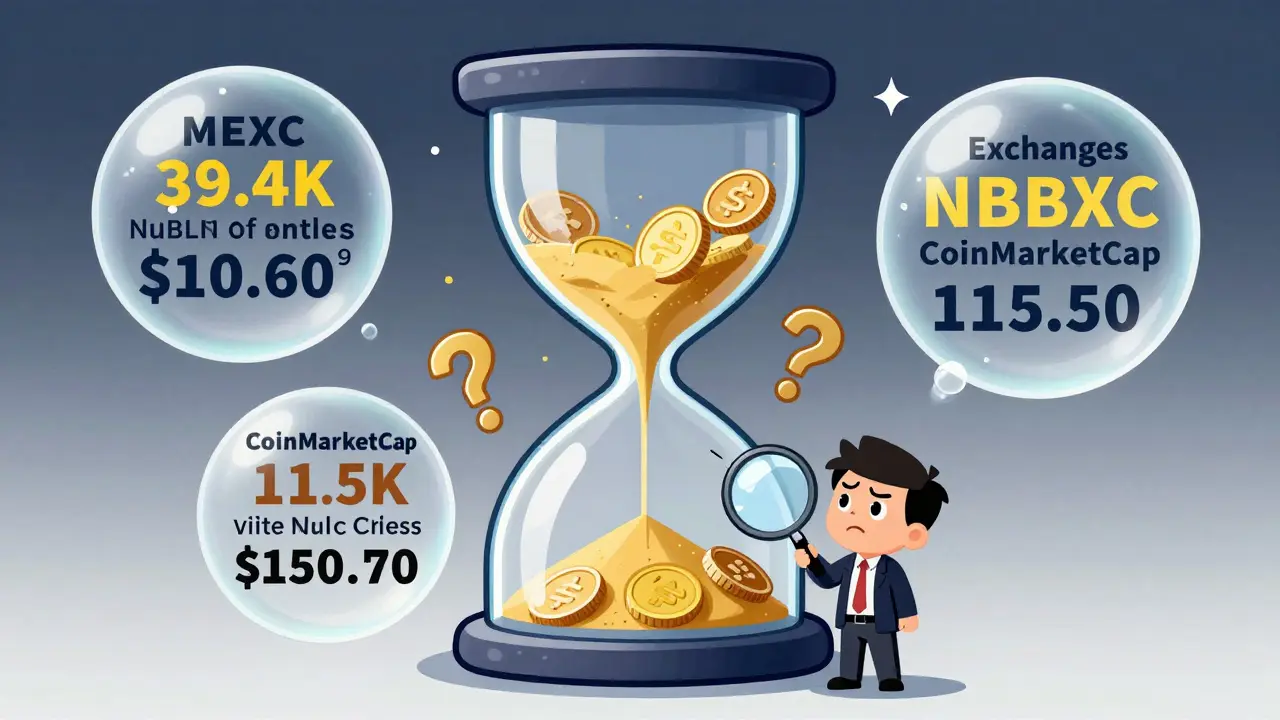
This is where things get complicated. If you check different cryptocurrency tracking sites, you will see conflicting information. This inconsistency is a major red flag in the crypto world. As of late 2023 and early 2024, NIBBLES traded in the range of $0.000007 to $0.000008 USD. At these prices, you need millions of tokens to equal a single dollar.
Let’s look at the market capitalization discrepancies. MEXC reported a market cap of around $1.03 million in October 2023. Binance showed a similar figure of $1.15 million in February 2024. However, CoinMarketCap listed a drastically lower market cap of roughly $49,747. Why the difference? It often comes down to how exchanges calculate volume and whether they include wash-trading (fake trades designed to inflate volume) in their metrics. For a retail investor, this confusion makes it nearly impossible to determine the true size of the market.
Volatility is extreme. Data from MEXC showed a 24-hour price drop of -49.62% in October 2023. In contrast, Binance showed a more moderate -3.35% change in February 2024. These swings suggest that the order books are thin. With low liquidity, a single large sell order can crash the price, while a small buy order can spike it artificially. Technical indicators like the Relative Strength Index (RSI) have hovered in neutral-to-bearish territory (around 39.57), suggesting downward momentum despite occasional spikes in "Greed" sentiment among traders.
Liquidity Risks and Trading Challenges
Liquidity refers to how easily you can buy or sell an asset without affecting its price. For Nibbles, liquidity is a significant concern. Trading volumes vary wildly: MEXC reported over $257,000 in 24-hour volume at one point, while CoinGecko listed only $360. Such disparities indicate that much of the trading activity might be concentrated on fewer platforms or potentially manipulated.
When liquidity is low, slippage becomes your enemy. Slippage is the difference between the expected price of a trade and the price at which the trade is executed. If you try to sell a large amount of NIBBLES, you might find that there aren’t enough buyers at the current price. Your sale could push the price down significantly, meaning you receive far less than you anticipated. In the worst-case scenario, you might not be able to exit your position at all if the trading pairs are delisted or if the exchange pauses trading due to abnormal activity.
Furthermore, the limited number of exchanges listing Nibbles restricts accessibility. While it has appeared on major platforms like Binance and MEXC, it is not universally available. This fragmentation means you cannot easily compare prices across venues, leaving you dependent on the specific exchange you use.
Community Sentiment and Social Presence
In the meme coin sector, community is king. Projects like Dogecoin and Shiba Inu survived and thrived because of massive, engaged online communities. Nibbles, however, shows signs of minimal engagement. Data from Binance indicates zero user votes on sentiment metrics, a stark indicator of apathy or obscurity. There are no substantial discussion threads on major forums like Reddit’s r/CryptoCurrency or Bitcoin Talk. Social media presence, as tracked by tools like CoinGecko’s social dominance metrics, appears virtually non-existent.
Without a strong community, there is no organic marketing engine to drive interest. The token relies on passive discovery rather than active advocacy. This lack of social proof makes it difficult for new investors to feel confident in the project’s longevity. In the crypto world, silence from the community is often louder than criticism-it suggests abandonment.
Risk Assessment: Is Nibbles Worth It?
Let’s be direct. Investing in Nibbles is not investing; it is gambling. The token falls into the "micro-cap" category, defined here as having a market capitalization below $5 million. According to research from Arcane Research and Chainalysis, tokens in this segment face an 87% probability of becoming worthless within 18 months if they lack clear utility. Nibbles fits this profile perfectly.
Consider the regulatory landscape. The U.S. Securities and Exchange Commission (SEC) and other global regulators are increasingly scrutinizing tokens that offer no utility and rely solely on speculative hype. Tokens like Nibbles could be deemed unregistered securities, leading to delistings from compliant exchanges. This regulatory risk adds another layer of uncertainty.
Additionally, the prediction models from technical analysis platforms like CoinCodex forecast further declines, projecting a drop to $0.0000064537 by late 2025. While predictions are never guarantees, the trend line is clearly downward. The combination of declining volume, inconsistent data, and lack of development updates paints a grim picture for long-term holders.
Comparison with Established Meme Coins
To understand where Nibbles stands, let’s compare it to more established players in the meme coin space. While all meme coins are risky, the degree of risk varies significantly based on community size, liquidity, and exchange support.
| Feature | Nibbles (NIBBLES) | Dogecoin (DOGE) | Shiba Inu (SHIB) |
|---|---|---|---|
| Market Cap | ~$1 Million (Disputed) | Billions of USD | Billions of USD |
| Liquidity | Very Low / Unstable | Extremely High | High |
| Utility | None Identified | Tips, Micropayments | Ecosystem (Shibarium), NFTs |
| Exchange Support | Limited / Inconsistent | Universal | Widespread |
| Community Size | Negligible | Massive | Large |
As the table shows, Nibbles lags behind in every critical metric. Dogecoin and Shiba Inu have evolved beyond simple memes to include ecosystems, charitable initiatives, and widespread merchant acceptance. Nibbles has none of these anchors. It is a pure play on short-term price action, which is a dangerous game for most investors.
How to Trade Nibbles Safely (If You Choose To)
If you decide to proceed despite the risks, you must prioritize capital preservation. Never invest money you cannot afford to lose completely. Treat any funds allocated to Nibbles as entertainment expenses, not investments.
- Use a Secure Wallet: Do not leave your tokens on an exchange for long periods. Transfer them to a self-custody wallet compatible with Solana, such as Phantom or Solflare. This protects you from exchange hacks or insolvencies.
- Verify Contract Addresses: Always double-check the token contract address on Solscan before buying. Scammers often create fake tokens with similar names to trick buyers.
- Set Stop-Losses: If the exchange allows it, use stop-loss orders to limit your downside. Given the volatility, a 10-20% drop can happen in minutes.
- Take Profits Early: If the price spikes, consider selling a portion of your holdings. Greed is the primary reason investors lose money on micro-cap tokens.
- Monitor Liquidity: Check the depth of the order book before entering a large trade. If the spread is wide, expect slippage.
Future Outlook and Viability
The future of Nibbles looks uncertain. Without a development team releasing updates, building partnerships, or creating utility, the token is likely to fade into obscurity. The crypto market is crowded, with thousands of new tokens launching daily. Attention is a scarce resource, and Nibbles is struggling to capture it.
Long-term viability assessments suggest that tokens with market caps below $5 million and no clear utility have a high probability of failing. Unless there is a sudden surge in viral popularity or a pivot to a legitimate use case, Nibbles will likely continue to decline in value and liquidity. Investors looking for growth should consider assets with stronger fundamentals, active development teams, and transparent governance.
Is Nibbles (NIBBLES) a scam?
There is no definitive proof that Nibbles is a coordinated scam, but it exhibits many characteristics of high-risk speculative assets. The lack of transparency, inconsistent market data, and absence of a clear utility make it vulnerable to manipulation. Investors should exercise extreme caution and assume the highest level of risk.
Which blockchain is Nibbles built on?
Nibbles is built on the Solana blockchain. This means it uses the SPL token standard and benefits from Solana’s fast transaction speeds and low fees. However, it also exposes the token to the competitive and sometimes congested environment of the Solana ecosystem.
Why are the market cap figures for Nibbles so different across exchanges?
Discrepancies in market cap often result from differences in how exchanges report trading volume and price data. Some exchanges may include wash-trading (fake volume) in their metrics, while others filter it out. Additionally, low liquidity can cause price fragmentation, where the token trades at different prices on different platforms simultaneously.
Can I store Nibbles in MetaMask?
No, MetaMask is primarily designed for Ethereum and EVM-compatible chains. Since Nibbles is a Solana-based token, you need a Solana-compatible wallet like Phantom, Solflare, or Backpack. Attempting to add it to MetaMask without proper configuration will likely result in errors or loss of funds.
What is the circulating supply of NIBBLES?
The circulating supply of Nibbles is reported as 142 billion tokens. This large supply contributes to the token’s extremely low individual price, as the total market value is divided among billions of units.
Is it safe to invest in micro-cap coins like Nibbles?
Investing in micro-cap coins is inherently unsafe and highly speculative. These assets often suffer from low liquidity, high volatility, and a lack of regulatory oversight. Most micro-cap tokens fail within 18 months. Only allocate funds you are prepared to lose entirely, and avoid putting significant capital into such assets.
Does Nibbles have any real-world use cases?
Currently, there are no documented real-world use cases for Nibbles. It does not appear to be accepted by merchants, nor does it provide access to specific services or applications. Its primary function seems to be speculative trading within the cryptocurrency market.