FATF Strategic Deficiencies Tracker
Countries must address strategic deficiencies to exit FATF's grey list. The Philippines addressed all 11 deficiencies and exited in 2025. UAE exited in 15 months with full compliance.
The FATF grey list exit process typically takes 18-36 months. This calculator estimates time based on the number of strategic deficiencies addressed.
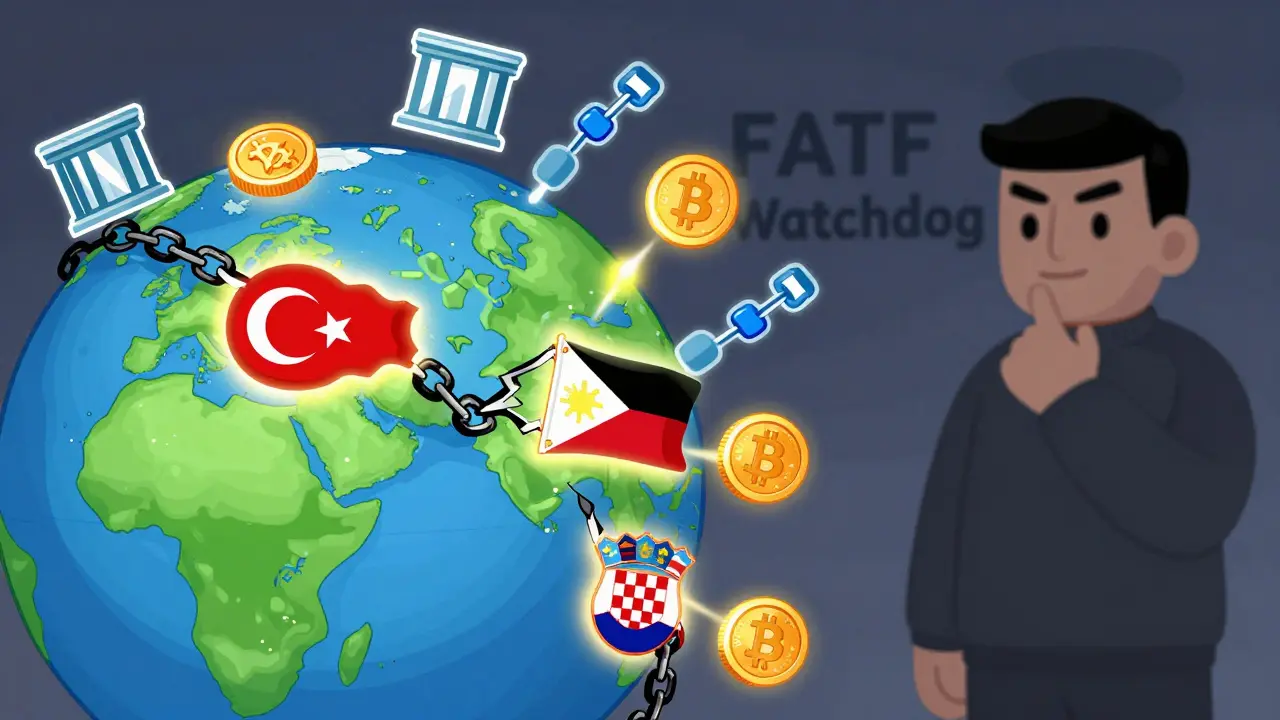
When the Financial Action Task Force (FATF) puts a country on its grey list, banks shut down accounts. Crypto exchanges pull out. Investors panic. For Turkey, the UAE, the Philippines, and Croatia, being on that list meant their digital asset markets were stuck in slow motion-blocked from global finance, seen as risky, ignored by major platforms. But between 2024 and 2025, all four got off. And it wasn’t luck. It was hard, focused reform. Here’s how they did it-and why crypto businesses are now seeing real momentum.
What FATF’s Grey List Really Means for Crypto
FATF isn’t a bank. It’s a global watchdog that sets rules to stop money laundering and terrorist financing. When a country is on its grey list-officially called Jurisdictions Under Increased Monitoring-it means FATF found serious gaps in their anti-money laundering (AML) and counter-terrorist financing (CTF) systems. For crypto, that’s a death sentence for growth.
Why? Because banks follow FATF’s lead. If a bank in Germany or New York sees a transaction coming from a grey-listed country, they flag it. They freeze it. Sometimes they refuse to work with any company tied to it. Crypto exchanges in those countries couldn’t open bank accounts. They couldn’t process fiat deposits. They couldn’t scale. Investors stayed away. Trading volumes dropped. Startups folded.
FATF’s rules for virtual assets are clear: countries must license crypto firms, track transactions (VASP rules), verify customer identities (KYC), and report suspicious activity. If they don’t, they get tagged. And until they fix it, the world treats them like financial no-go zones.
The UAE: Turning Transparency Into Trust
The UAE was on the grey list in 2023. Its crypto scene was booming-Dubai was calling itself a Web3 hub-but regulators weren’t keeping up. Shell companies were everywhere. Beneficial ownership? Hidden. Financial institutions? Lax oversight.
In 2024, the UAE didn’t just tweak rules. It rebuilt them. The Central Bank mandated that all virtual asset service providers (VASPs) register and report transaction data in real time. The Ministry of Finance launched a national beneficial ownership registry-finally making it public who owns what. Law enforcement started prosecuting shell company operators. By early 2024, FATF’s on-site team gave them a clean bill of health.
Result? Within months, Binance, Kraken, and Coinbase expanded their UAE operations. Local crypto startups like BitOasis and Rain raised funding from global VCs. Banks reopened accounts. The UAE’s crypto trading volume jumped 47% in the first half of 2025. It wasn’t just about being removed from the list. It was about proving they could be trusted.
The Philippines: From Underground to Official
The Philippines had a huge crypto user base-over 10 million people traded Bitcoin by 2023-but regulators were slow. The Securities and Exchange Commission (SEC) had no clear rules. Money changers operated like crypto exchanges without licenses. AML reporting? Nearly nonexistent.
In 2024, the government acted. The SEC created the first legal framework for VASPs in Southeast Asia, requiring licensing, KYC, and transaction monitoring. The Bangko Sentral ng Pilipinas (BSP) started auditing crypto firms. They trained police to track blockchain transactions. By February 2025, FATF confirmed the Philippines had closed all 11 strategic deficiencies in its action plan.
Now, local platforms like Coins.ph and PDAX can partner with international banks. Remittance companies using crypto to send money home are no longer flagged. A study by the University of the Philippines found that crypto-based remittances grew 62% in 2025-mostly because overseas workers could now use regulated channels without fear of account freezes.

Croatia: Small Country, Big Reform
Croatia wasn’t known for crypto. But in 2023, FATF found it had no laws governing virtual assets. Crypto exchanges operated in a legal gray zone. Tax compliance? Zero. AML reporting? Not required.
Croatia’s response was fast. By late 2024, they passed the Virtual Asset Service Provider Act, requiring all crypto firms to register with the Financial Intelligence Unit. They trained 200 financial investigators in blockchain analysis. They started prosecuting unlicensed platforms. In June 2025, FATF removed Croatia from the grey list after confirming real enforcement-not just paper laws.
Local crypto firms like CryptoKlub and Bit2Me now have banking access in the EU. Croatian developers are building DeFi tools with EU partners. The government even launched a pilot program to let citizens pay property taxes in crypto through licensed platforms. It’s small, but it’s real. And it’s only possible because FATF的信任 now exists.
Turkey: The Missing Piece
Turkey’s story is different. It’s still on the FATF grey list as of June 2025. But it’s not for lack of crypto activity. Over 15 million Turks trade crypto-more than 20% of the adult population. They use it to protect savings from inflation. But the government’s approach has been chaotic.
One year, crypto is taxed. The next, it’s banned for banks. No licensing system exists. No VASP registration. No real AML controls. FATF has repeatedly warned Turkey. Yet, the country hasn’t submitted a formal action plan.
So why include Turkey here? Because it’s the cautionary tale. The UAE, Philippines, and Croatia didn’t just say they’d fix things-they did. Turkey has the people, the tech talent, and the demand. But without structured reform, it risks being left behind. While its neighbors attract global crypto firms, Turkey’s startups still struggle to get banking services. Investors hesitate. The potential is there. The will isn’t.

Why This Matters for Crypto Businesses
Getting off the FATF grey list isn’t just about reputation. It’s about money. When a country is removed:
- Banks reopen accounts for crypto firms
- International exchanges list local tokens
- VCs start investing
- Payment processors allow fiat on-ramps
- Tax compliance becomes possible
In the UAE, a crypto startup that couldn’t get a bank account in 2023 now has one with HSBC. In the Philippines, a remittance app that was blocked by PayPal can now process payments legally. In Croatia, a DeFi project can now legally partner with a German bank.
And for users? It means safer, faster, cheaper access to crypto. No more sketchy P2P platforms. No more frozen funds. No more fear.
The Bigger Picture: FATF’s New Rules
In June 2025, FATF updated its guidance to emphasize financial inclusion. That’s a big shift. It’s no longer just about catching criminals-it’s about bringing people into the system. If you’re excluding low-income users because your AML rules are too strict, FATF says you’re part of the problem.
That’s why the Philippines’ success matters. They didn’t just crack down on bad actors-they created a legal path for millions of unbanked users to use crypto safely. That’s the future. Regulated access, not blocked access.
And it’s working. The number of countries on the grey list dropped from 31 to 24 between 2023 and 2025. The message is clear: if you fix your systems, the world will let you back in.
What Comes Next?
The next countries likely to be removed are Ghana, Morocco, and Senegal-all have completed their action plans and are waiting for FATF’s October 2025 meeting. Meanwhile, the British Virgin Islands and Bolivia were added to the grey list in June 2025, showing the list is still active.
For crypto businesses, the lesson is simple: regulation isn’t the enemy. Bad regulation is. Countries that took the time to build clear, enforceable rules didn’t kill crypto-they saved it. And the market is responding.
If you’re running a crypto business in a grey-listed country, don’t wait for FATF to push you. Start building your compliance now. License your platform. Implement KYC. Document everything. The countries that got off the list didn’t get lucky. They got serious.
What does it mean when a country is removed from the FATF grey list?
It means the country has fixed serious gaps in its anti-money laundering and counter-terrorist financing systems. Banks and crypto exchanges can now work with entities in that country without fear of regulatory penalties. International partners see it as a sign of trust and stability.
Did cryptocurrency regulation help these countries get off the FATF list?
Yes, directly. FATF requires countries to regulate virtual asset service providers (VASPs), enforce KYC, monitor transactions, and report suspicious activity. The UAE, Philippines, and Croatia all passed specific crypto laws, licensed exchanges, and trained regulators to track blockchain activity. These were key to proving they could control financial crime.
Why is Turkey still on the FATF grey list?
Turkey has not submitted a formal action plan to FATF and lacks a legal framework for crypto firms. While crypto usage is high, there’s no licensing system, no mandatory KYC for exchanges, and no real AML enforcement. Without these, FATF can’t remove it from the list.
How long does it take to get off the FATF grey list?
It usually takes 18 to 36 months. Countries must pass laws, train regulators, conduct prosecutions, and pass an on-site FATF review. The UAE took 15 months after committing to reform. The Philippines took 20 months. Speed depends on political will and how serious the gaps were.
Can crypto businesses benefit even before a country is removed from the list?
Yes. Early adopters who build compliance before FATF’s review gain an edge. In the Philippines, crypto firms that implemented KYC in 2023 got priority for licensing when the law passed. They became the first to partner with banks. Waiting until the last minute means you’re last in line.
Jessica Eacker
December 9, 2025 AT 15:26The UAE move was pure genius-real-time transaction tracking and public ownership registries? That’s not just compliance, that’s confidence.
Now banks actually want to work with them. No more hiding behind shell companies.
Real change doesn’t come from press releases. It comes from action.
Andy Walton
December 11, 2025 AT 11:24bro like… if crypto is the future why are we still babysitting banks?? 🤡 FATF is just the old guard holding the door shut with their last breaths. The Philippines didn’t ‘fix’ anything-they just let people use crypto without jail time. That’s not reform, that’s common sense. 🚀💸
Candace Murangi
December 11, 2025 AT 18:31I’ve been watching Croatia’s story unfold and honestly-it’s beautiful. A small country with zero crypto history, and they just… built it from scratch.
Not with hype. Not with influencers. Just law, training, and real enforcement.
It’s proof that size doesn’t matter. Will does.
Albert Chau
December 12, 2025 AT 22:11Let’s be real. These countries got off the list because they finally realized crypto isn’t a threat-it’s a revenue stream. They didn’t care about AML until they saw how much money they were leaving on the table.
Regulation isn’t moral. It’s transactional.
Madison Surface
December 14, 2025 AT 06:08Can we just pause and appreciate how the Philippines turned crypto from a last-resort underground tool into a lifeline for millions of overseas workers?
This isn’t about tech. This is about dignity.
People weren’t using Bitcoin to get rich-they were using it to feed their families.
And now, thanks to smart policy, they’re doing it safely.
That’s the kind of innovation the world needs more of.
Tiffany M
December 15, 2025 AT 08:59Ugh, Turkey’s situation is so frustrating!! I mean, 20% of adults are trading crypto but the government can’t even get a licensing system together??
It’s like they have all the pieces but refuse to assemble the puzzle.
Meanwhile, Croatia’s over there building DeFi tools with German banks and Turkey’s still arguing about whether crypto is ‘haram’ or not.
Stop being dramatic. Start being legal.
Eunice Chook
December 15, 2025 AT 19:12Everyone’s acting like this is a victory. It’s not. It’s just capitalism wearing a suit.
These countries didn’t fix AML-they fixed their balance sheets.
Real financial inclusion doesn’t require FATF approval.
It requires removing barriers, not adding compliance forms.
John Sebastian
December 16, 2025 AT 10:54Interesting that none of these countries are in the EU except Croatia. FATF’s influence is still dominated by Western institutions. The real test will be when a non-Western country gets off the list without copying Western models.
Until then, it’s just global power dressed up as regulation.
Stanley Machuki
December 17, 2025 AT 07:51Early adopters who built KYC before the law passed? They’re the ones now sitting at the table with HSBC and JPMorgan.
Waiting for permission? You’re already behind.
Compliance isn’t a cost. It’s your moat.
Start now. Not when FATF knocks.
Lynne Kuper
December 18, 2025 AT 19:48So Turkey’s still on the list… and yet their crypto volume is higher than Croatia’s entire GDP?
That’s not a failure of technology. That’s a failure of leadership.
Imagine if they’d just licensed exchanges in 2022 instead of playing political hot potato.
Now they’re the cautionary tale everyone quotes at conferences.
And honestly? They deserve it.