You check your phone. A notification pops up from your bank app. Your balance is frozen. Your account is closed. No warning email, no call from customer service-just a digital dead end. For thousands of people in Myanmar, this isn’t a glitch. It’s the standard penalty for touching cryptocurrency.
If you live in or send money to Myanmar, you need to understand exactly what triggers these closures and what happens next. The rules here are not just strict; they are actively enforced with a heavy hand. As of mid-2026, the landscape remains hostile to private digital assets, driven by the Central Bank of Myanmar (CBM). This article breaks down the specific penalties, the laws behind them, and how ordinary citizens are navigating-or getting caught in-this regulatory net.
The Core Penalty: Why Your Bank Account Gets Closed
When we talk about "penalties" for crypto in Myanmar, the most immediate and devastating consequence is financial isolation. The CBM does not typically send a fine first. They cut off your access to the formal banking system entirely.
This mechanism relies on the CBM’s authority under the Central Bank of Myanmar Law. The central bank holds sole power to issue currency. Any attempt to use an alternative store of value, like Bitcoin or Tether (USDT), is viewed as a direct challenge to national monetary sovereignty.
Here is how it usually plays out:
- Transaction Monitoring: Banks monitor for suspicious patterns. Large, rapid transfers to unknown entities, especially those matching known offshore exchange IPs or peer-to-peer (P2P) trader accounts, trigger alerts.
- The Freeze: Once flagged, the account is frozen immediately. You cannot withdraw cash, pay bills, or receive salaries.
- The Closure: After a brief investigation (which can take days or weeks), the account is permanently closed. The funds may be held indefinitely pending legal resolution.
This happened widely after May 2024, when the CBM issued a public notice explicitly warning individuals against selling, buying, or exchanging unregulated digital currencies. Unlike previous years where warnings were vague, the 2024 directive stated clearly that enforcement would include closing bank accounts. Since then, major banks like KBZ Bank and Ayeyarwady Bank have aggressively purged accounts linked to crypto activity.
The Legal Framework Behind the Ban
To understand why the penalties are so severe, you have to look at the stack of laws the government uses. It’s not just one rule; it’s a web of legislation designed to criminalize every aspect of crypto ownership.
| Law / Regulation | How It Applies to Crypto | Potential Penalty |
|---|---|---|
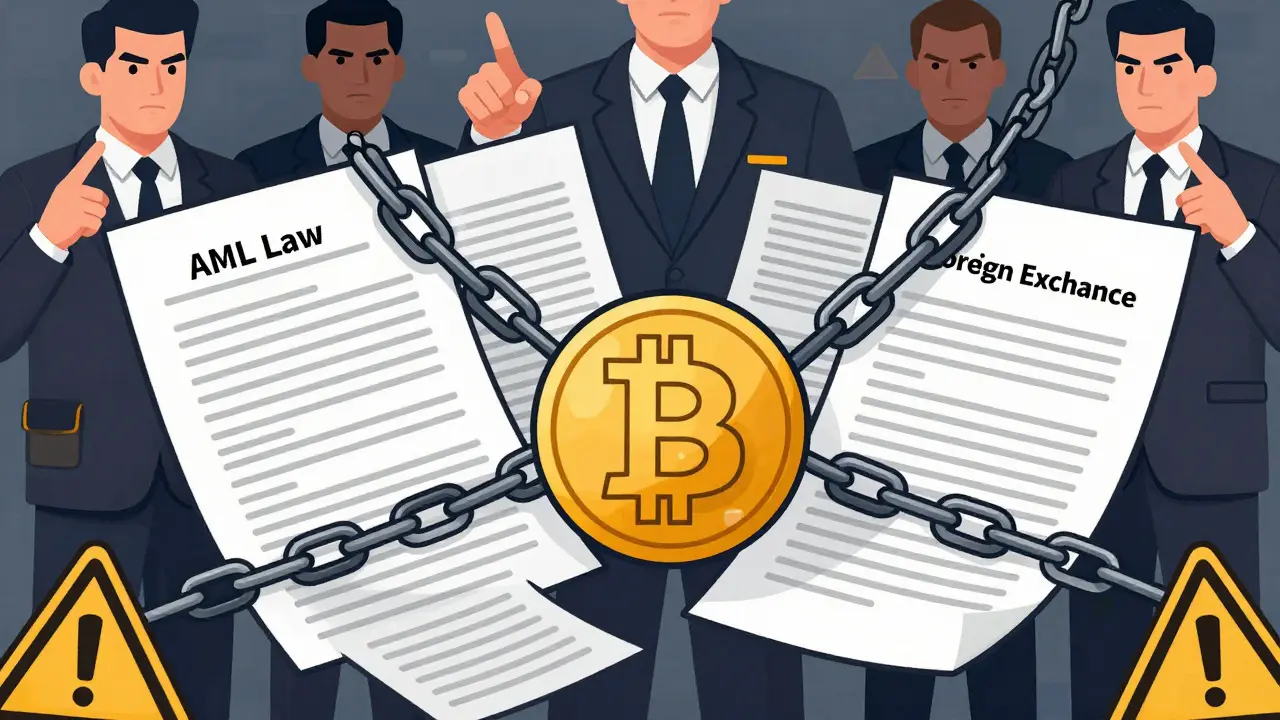
| Central Bank of Myanmar Law | Establishes CBM as the sole issuer of currency. Crypto is deemed "unauthorized currency." | Account closure, fines, imprisonment. |
| Foreign Exchange Management Law | Crypto transactions are often classified as illegal foreign exchange conversion. | Confiscation of assets, heavy fines. |
| Anti-Money Laundering (AML) Law | Used to prosecute traders who move funds through complex chains to hide origins. | Imprisonment (up to several years), asset seizure. |
| Financial Institutions Law | Gives banks the right and duty to terminate relationships with high-risk clients. | Immediate account termination. |
The Anti-Money Laundering Law is particularly dangerous for users. Even if you are just holding savings in Ethereum, moving that value into fiat kyat can be interpreted as "layering"-a technique used by criminals to disguise illicit funds. Prosecutors use this ambiguity to press charges that go far beyond simple regulatory violations.
Who Is Getting Targeted?
The CBM doesn’t target everyone equally. Enforcement focuses on specific behaviors and platforms. If you fit one of these profiles, your risk of account closure is significantly higher.
1. P2P Traders on Social Media Many locals trade using personal Facebook pages or Telegram groups. The CBM has specifically monitored social media for ads offering "BTC to Kyat" exchanges. When a trader’s bank details are linked to these posts, their accounts are shut down quickly.
2. Users of Stablecoins (Especially USDT) While Bitcoin gets the headlines, Tether (USDT) is the real problem for regulators. Because it pegs to the US dollar, it is used extensively for remittances and saving against kyat inflation. The CBM views USDT flows as capital flight. Transactions involving USDT on networks like Tron are heavily scrutinized.
3. Mining Operators Crypto mining is technically illegal due to electricity costs and environmental concerns. However, underground mining persists. When authorities raid mining farms, they don’t just seize hardware; they trace the electricity payments and bank accounts of the owners, leading to closures and arrests.
Beyond Account Closure: Criminal Charges and Imprisonment
Losing your bank account is bad. Losing your freedom is worse. The penalties for crypto involvement in Myanmar extend into the criminal justice system.
In recent years, there have been documented cases where individuals faced imprisonment for facilitating crypto transactions. The logic follows this path:
- You engage in a crypto transaction.
- The CBM flags it as illegal currency conversion.
- The case is referred to police or special tribunals under the AML framework.
- You face charges that can carry prison sentences ranging from months to years, depending on the volume of money involved.
This creates a chilling effect. Many merchants who once accepted crypto payments for goods now refuse them outright. The fear isn’t just losing money; it’s ending up in jail for trying to preserve wealth during economic instability.
The Underground Economy: How People Still Trade
Despite the risks, demand for crypto in Myanmar hasn’t disappeared. In fact, it has grown. Why? Because the local economy is struggling. The kyat has lost significant value, and capital controls make it hard to save in stable currencies. So, people adapt.
Telegram and Offshore Exchanges The bulk of trading has moved to encrypted messaging apps. Traders use code words and voice notes to negotiate rates. Payments are made via obscure local payment apps that aren’t directly linked to traditional bank accounts, or through cash handovers after crypto confirmation.
Hundi Systems Traditional informal value transfer systems (Hundi) have merged with crypto. A person might send USDT digitally, while a counterpart in another country delivers kyat cash locally. This bypasses the banking system entirely, but it carries its own risks: fraud and lack of legal recourse.
Mining Migration Some miners have fled to neighboring countries like Thailand or Laos, where regulations are more lenient. They mine abroad and send profits back via informal channels, keeping their home bank accounts "clean" to avoid detection.
The Paradox: CBDC vs. Private Crypto
There is a confusing twist in Myanmar’s policy. While banning private crypto, the government is building its own digital currency.
In June 2025, the CBM established the Central Committee for the Issuance of Central Bank Digital Currency. This body is tasked with developing a "digital kyat." The goal is clear: the state wants to control digital money, not eliminate it. They want a trackable, taxable, state-sanctioned digital token.
This creates a strange duality:
- Private Crypto (BTC, ETH, USDT): Illegal. Punishable by account closure and prison.
- State Crypto (Digital Kyat): Encouraged (in theory). Meant to replace cash and increase transparency.
For the average user, this means waiting. Until the digital kyat launches fully, the ban on private crypto remains absolute. Don’t expect loopholes to appear soon.
What Should You Do? Practical Advice
If you are in Myanmar or dealing with someone who is, here is how to navigate the current reality without losing your financial footing.
1. Separate Your Accounts Never use your primary salary or business account for any crypto-related activity. Keep your banking footprint minimal and clean. Use dedicated accounts for risky transactions, understanding they may vanish.
2. Avoid Public Ads Posting "Buy BTC" on Facebook is a fast ticket to account closure. Regulators scrape social media for keywords. Keep your trading quiet and offline.
3. Beware of "Safe" Platforms No local platform is truly safe. Even if an exchange claims to be compliant, the CBM can order banks to cut ties with them overnight. Assume all local crypto interfaces are temporary.
4. Understand the Remittance Risk If you are sending money to family in Myanmar, avoid sending crypto directly to their local wallets if they plan to cash out locally. The conversion step is where the trap springs. Consider traditional remittance services despite their fees, or use trusted intermediaries who handle the cash-out process discreetly.
Conclusion: A High-Stakes Environment
The penalty for crypto in Myanmar is not a slap on the wrist. It is financial erasure. The Central Bank of Myanmar has proven it will close accounts, freeze assets, and pursue criminal charges to maintain control over the nation’s currency.
While the underground market thrives on Telegram and through hundi networks, the risks remain existential for anyone relying on formal banking. Until the regulatory stance shifts-or the digital kyat becomes a viable alternative-crypto in Myanmar remains a game of cat and mouse where the house always holds the keys to your bank account.
Is cryptocurrency completely illegal in Myanmar in 2026?
Yes. As of 2026, mining, trading, and holding private cryptocurrencies like Bitcoin and Ethereum are considered illegal under Central Bank of Myanmar directives. While possession itself is rarely prosecuted, any transaction that touches the formal banking system triggers penalties.
Will my bank account be closed if I buy USDT?
It is highly likely. The CBM specifically targets stablecoins like Tether (USDT) because they are used for capital flight. If your bank detects transactions linked to known crypto exchanges or P2P traders, they will freeze and eventually close your account.
Can you go to jail for crypto trading in Myanmar?
Yes. Under the Anti-Money Laundering Law and Foreign Exchange Management Law, large-scale trading or facilitating conversions can lead to criminal charges, resulting in imprisonment and asset confiscation.
Is the Digital Kyat available yet?
As of mid-2026, the Digital Kyat is still in development. The Central Committee for the Issuance of Central Bank Digital Currency was formed in 2025 to oversee its creation, but it has not replaced private crypto usage yet.
How do people in Myanmar trade crypto safely?
Most traders use decentralized methods: Telegram for communication, offshore exchanges, and cash-based hundi systems to avoid linking crypto transactions to local bank accounts. However, "safe" is relative, as the regulatory environment is extremely volatile.
Which banks are most aggressive about closing crypto accounts?
Major commercial banks like KBZ Bank and Ayeyarwady Bank have been the most active in enforcing CBM directives, frequently closing accounts linked to suspicious digital currency transactions.
Heather Austin
July 21, 2026 AT 04:02honestly the part about separating accounts is the only sane advice here i see people trying to use their main salary account for p2p trades and then acting surprised when kbz bank freezes everything its basic operational security if you are dealing with unregulated assets you need a burner account that you dont care about losing because the cbm has zero chill right now they are literally scraping facebook for keywords so keep it offline or keep it quiet
Lisa Chong
July 21, 2026 AT 12:59it is obvious that this is all part of a grander scheme to control every single penny we earn they want us to rely on the digital kyat so they can watch our every move through the blockchain which is ironic since crypto was supposed to be anonymous but the state always wins in the end trust no one and especially not the central bank who claims to protect your savings while freezing them without warning it is financial slavery disguised as regulation and those who comply are merely waiting for the next trap to spring shut
the hundi system is the only way to remain free from their surveillance capitalism
Ran Tao
July 22, 2026 AT 20:37😂 oh look another person crying about how hard it is to trade in myanmar meanwhile the rest of the world is using crypto for actual innovation and you guys are playing hide and seek with telegram bots 🤡 it is pathetic how dependent everyone is on these fragile banking systems that collapse at the slightest hint of innovation if you cannot handle the risk of holding bitcoin then maybe stick to gold bars under your mattress but dont act like victims when the market corrects itself 💎🙌
Anuj Kashyap
July 23, 2026 AT 04:08one must consider the philosophical implications of currency sovereignty versus individual liberty the cbm views money as a tool of state power whereas the individual views it as a store of value this conflict is inevitable yet tragic 😔 the irony is that by banning private crypto they have driven the economy underground making it less transparent not more perhaps the digital kyat will launch but will it restore faith or merely digitize the oppression time will tell but until then the people adapt as they always have 🕊️
Guy Davis
July 23, 2026 AT 11:15stop buying illegal stuff and you wont get caught simple as that
KEITH WONG
July 24, 2026 AT 01:06listen up folks the real issue is that most traders are amateurs posting buy btc on public pages like idiots 🚫 if you are smart you use cash handovers and never link your primary bank account to any exchange ever the banks are just doing their job protecting the nation from capital flight so blame yourselves for being careless and getting caught in the dragnet 📉
Natalie Lucas
July 24, 2026 AT 02:07i know it feels overwhelming but remember that resilience is key! many of my friends in yangon have successfully navigated this by sticking to small amounts and using trusted local networks instead of big exchanges stay positive and keep learning about opsec because knowledge is power! you got this 💪✨
Curtis Johnson
July 24, 2026 AT 21:34it really is a dramatic situation for everyone involved the fear of imprisonment is not something to take lightly and yet people continue to trade because the alternative is watching their life savings evaporate in kyat inflation i think we should show more empathy to those struggling rather than judging their methods the system is broken and people are just trying to survive let us hope for a more balanced regulatory approach in the future 🙏
Steven Briggs
July 25, 2026 AT 14:50i guess the silence speaks volumes most people just do what they have to do quietly
Hamza k
July 26, 2026 AT 20:11what a absolute circus of financial repression we are witnessing here! the authorities are waving the red flag of national sovereignty while secretly terrified of losing control over the narrative it is a theatrical display of power meant to intimidate the populace into submission but the underground economy thrives in the shadows like a resilient weed cracking through concrete the drama is palpable and the stakes could not be higher for the common citizen caught in the crossfire of ideological warfare 🎭💥
Tracy Marshall
July 28, 2026 AT 00:02they are watching you every step of the way the cbm has agents everywhere even in your telegram groups you think you are safe but your metadata is being harvested and analyzed to build a profile of dissent against the state currency it is a conspiracy to erase privacy entirely and replace it with a monitored digital leash so beware the digital kyat it is not freedom it is a cage made of code and compliance officers :o