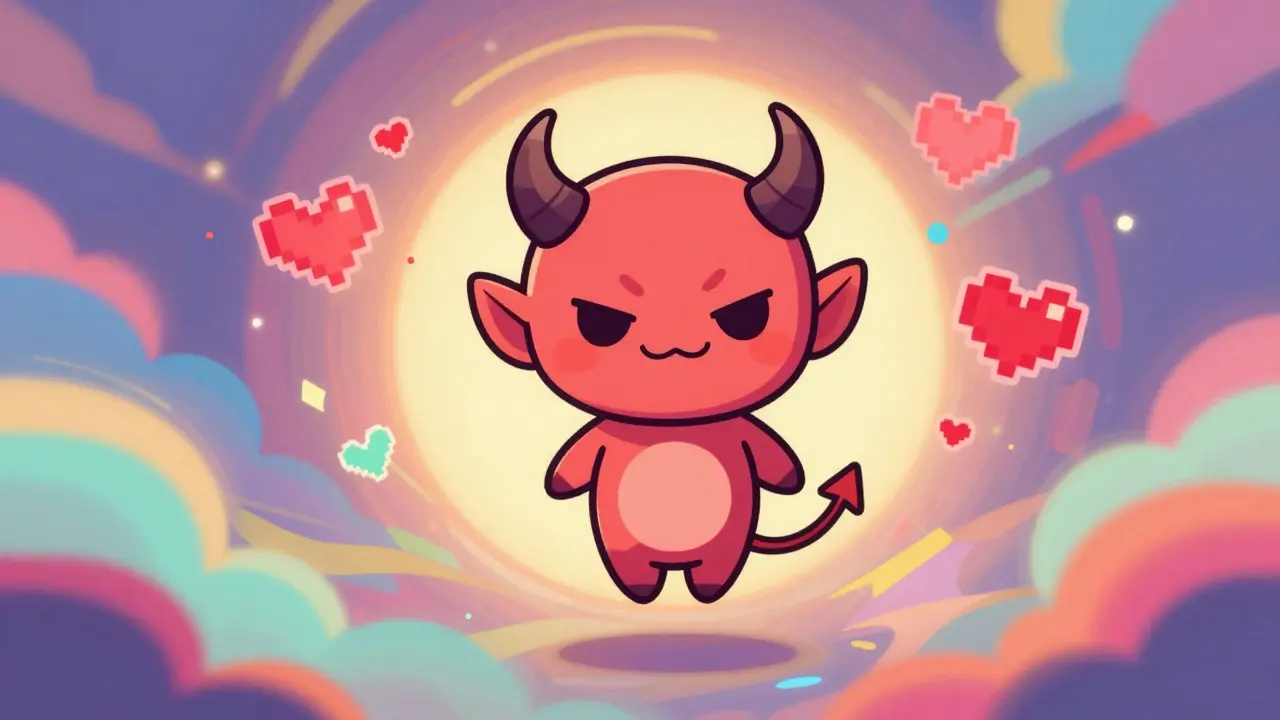
You might have seen LUCI popping up on your social media feed or a crypto tracker. It’s not a complex blockchain protocol, and it doesn’t promise you a seat on a governance board. Instead, LUCI is a memecoin built around a "cute demon" character created by an artist for pure entertainment. If you are wondering what this coin actually does, the short answer is: nothing technical. It exists because people like the art and the community vibe.
This guide breaks down exactly what LUCI is, where it lives on the blockchain, how much it costs, and whether it makes sense for your portfolio. We will look at the hard numbers from mid-2026 so you can make an informed decision without getting lost in hype.
The Origin Story: Art Over Utility
Most cryptocurrencies try to solve a problem. They want to be faster, cheaper, or more secure. LUCI takes a different approach. It started as a creative project by a single, pseudonymous artist who wanted to experiment with digital art and community building. The central figure of the project is a "cute demon" character. The artist became obsessed with this character and decided to create a token to breathe life into it.
According to data from CoinGecko and CoinMarketCap, the creator explicitly stated that LUCI has no utility. There is no staking reward system, no fee discounts, and no voting rights attached to holding the token. The goal was never to build a decentralized finance (DeFi) empire. Instead, the focus is on content creation and supporting community initiatives through art. As of July 2026, the original artist has stepped back, letting the community take the lead on future directions. This makes LUCI a true community-driven asset rather than a corporate-backed product.
Technical Basics: Running on Solana
Even though LUCI lacks its own blockchain, it still needs a home. LUCI operates on the Solana network. This is a crucial detail for anyone looking to buy or trade it. Because it is a Solana token, it inherits the network's speed and low transaction fees, but it also means you need a wallet compatible with Solana, such as Phantom or Solflare, to hold it.
Launched in 2024, LUCI is implemented as a standard token on Solana. It does not have its own independent consensus mechanism or validator nodes. When you see LUCI moving, it is happening within the broader Solana ecosystem. This connection is why you will often see it traded against SOL (the native Solana currency) rather than just USDT or Bitcoin.
| Attribute | Value |
|---|---|
| Blockchain Network | Solana |
| Token Type | Memecoin / Community Token |
| Launch Year | 2024 |
| Primary Use Case | Entertainment & Art Community |
| Governance | None (Community-led) |
Supply and Economics: How Many Tokens Exist?
When evaluating any crypto, supply matters. For LUCI, the numbers are fairly consistent across major trackers, though minor rounding differences exist. The maximum supply of LUCI is approximately 997.68 million tokens. Some platforms, like CoinGecko, round this up to 1 billion for simplicity, but the actual circulating supply is very close to that max number.
As of early 2026, nearly the entire supply is already in circulation. There are no hidden reserves waiting to be dumped on the market later, which is a common risk with many new tokens. However, with roughly 3,500 to 3,600 holders reported by CoinMarketCap, the distribution is relatively concentrated compared to larger coins like Dogecoin. This means a small number of wallets could theoretically influence the price if they decide to sell large amounts at once.

Price History and Volatility: Expect Rollercoasters
If you are looking for stability, LUCI is likely not for you. Like most memecoins, it is defined by extreme volatility. Let’s look at the recent history to understand the risk profile.
In August 2025, LUCI hit an all-time high (ATH) of roughly $0.08 per token. By October 2025, the price had crashed by over 99%, dropping to around $0.0005. Then, in July 2026, data shows the price hovering near $0.000086. These swings are brutal. A 99% drop means that if you bought at the peak, you would lose almost everything unless you sold during a brief rebound.
The market capitalization reflects this instability. At its peak, LUCI briefly touched a market cap of over $32 million. By mid-2026, that number had shrunk to under $100,000. This places LUCI firmly in the "micro-cap" category. Micro-caps are cheap to enter but carry a high risk of going to zero. Always check the current volume before trading; low volume means it can be hard to sell your tokens without crashing the price further.
Where Can You Buy LUCI?
One of the biggest hurdles for new investors is finding where to trade LUCI. You won’t find it on major centralized exchanges like Coinbase or Binance. In fact, Coinbase explicitly lists LUCI as "not tradable" on their platform, even though they track its price for informational purposes.
To buy LUCI, you need to use decentralized exchanges (DEXs) on the Solana network. The primary venue for trading LUCI is Meteora, a DEX tailored for Solana assets. The most popular trading pair is LUCI/SOL. Here is the basic process:
- Set up a Solana Wallet: Download a wallet like Phantom or Solflare.
- Buy SOL: Purchase Solana on a major exchange (like Coinbase or Kraken) and send it to your wallet.
- Connect to Meteora: Go to the Meteora website and connect your wallet.
- Swap SOL for LUCI: Find the LUCI token contract address (always double-check this to avoid scams) and swap your SOL for LUCI.
Be aware of slippage. Because daily trading volume is often very low-sometimes less than $100 in a day-buying a large amount can push the price up significantly, meaning you pay more than expected. Selling large amounts can have the opposite effect.

Risks and Considerations for Investors
Before you put money into LUCI, consider these specific risks:
- No Fundamental Value: Since there is no utility, the price is driven entirely by sentiment and speculation. If interest in the "cute demon" art fades, the price may follow.
- Low Liquidity: With thin order books, exiting a position quickly can be difficult. You might get stuck holding tokens you can’t sell at a fair price.
- Scam Tokens: On Solana, fake tokens with similar names pop up frequently. Always verify the contract address on reputable sites like CoinGecko before buying.
- Artist Dependency: While the community is taking over, the initial momentum came from one artist. Changes in their involvement or content output can impact community morale.
Is LUCI Right for You?
LUCI is best suited for experienced crypto users who understand the risks of memecoins and want to support a specific piece of digital art or community culture. It is not an investment vehicle for long-term wealth preservation. Treat any money you put into LUCI as entertainment spending-if you lose it, it shouldn’t affect your daily life.
If you enjoy the aesthetic and want to be part of the community, buying a small amount via Meteora is straightforward. Just remember to do your own research, keep an eye on the liquidity, and never invest more than you can afford to lose.
Does LUCI have any utility or staking rewards?
No. According to official descriptions from CoinMarketCap and CoinGecko, LUCI has no utility. It does not offer staking rewards, governance votes, or fee discounts. It is purely an entertainment and community-focused memecoin.
Can I buy LUCI on Coinbase or Binance?
No. LUCI is not listed on major centralized exchanges like Coinbase, Binance, or Kraken. You must buy it using a decentralized exchange (DEX) on the Solana network, such as Meteora, by swapping SOL for LUCI.
What is the total supply of LUCI tokens?
The maximum supply of LUCI is approximately 997.68 million tokens. Nearly all of these tokens are currently in circulation, meaning there is no significant inflationary pressure from new token releases.
How volatile is the price of LUCI?
LUCI is extremely volatile. It has experienced drawdowns of over 99% from its all-time highs. Prices can swing dramatically based on social media trends and community activity, making it a high-risk asset.
Who created LUCI?
LUCI was created by a pseudonymous artist who designed the "cute demon" character. The creator initially led the project but has since stepped back to let the community drive future initiatives and content creation.