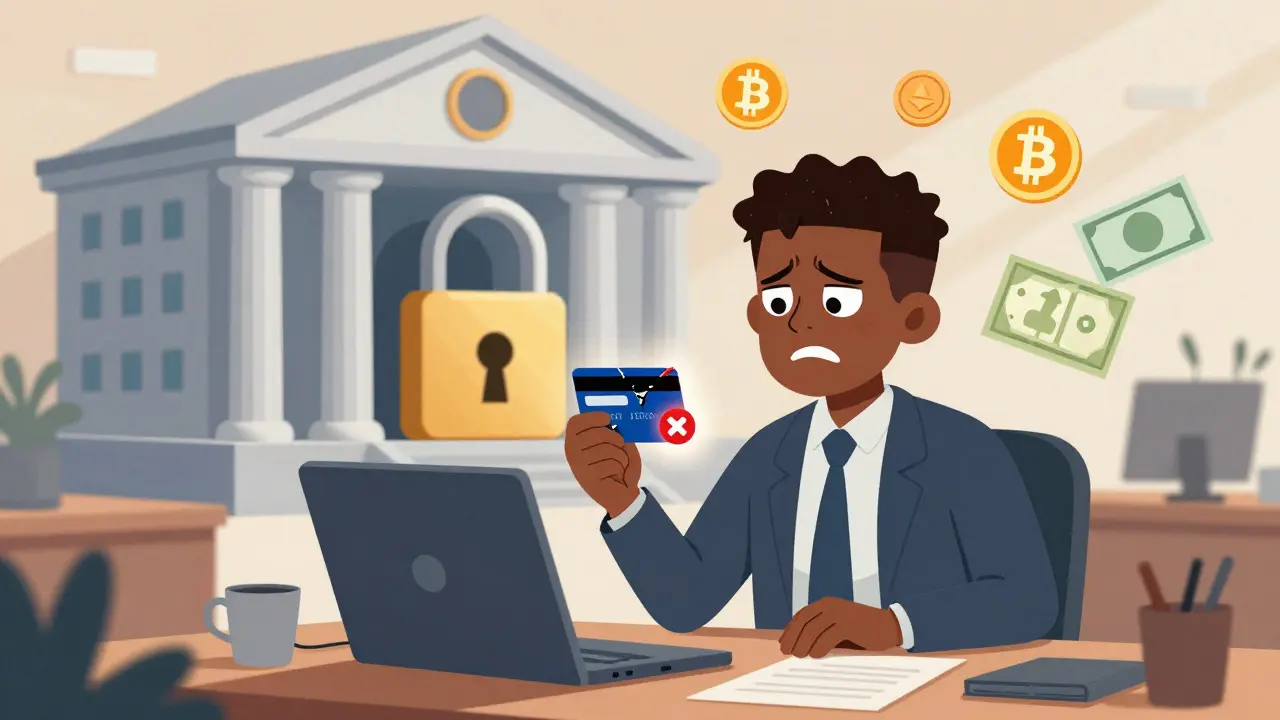
Imagine trying to send money to a supplier in Lagos or pay for raw materials in Yaoundé, only to find your bank account frozen because you bought Bitcoin. This isn't a hypothetical scenario; it's the daily reality for millions of Africans navigating a fragmented regulatory landscape. While some nations like South Africa have built robust frameworks to protect investors, others maintain strict bans on institutional involvement, leaving users in a precarious and reliant on informal networks. Understanding these banking restrictions is no longer just for tech enthusiasts-it’s critical for anyone seeking financial stability in an increasingly digital economy.
The situation across the continent is far from uniform. It is a patchwork of laws, directives, and silent prohibitions that can change overnight. For businesses and individuals alike, this unpredictability creates significant operational hurdles. You might be legally allowed to own crypto in one country, but unable to use a bank card to buy it in another. This guide breaks down the current state of play, highlighting where the doors are open, where they are locked, and how to navigate the gray areas safely.
The Patchwork of Regulatory Approaches
Africa does not have a single crypto policy. Instead, each nation operates under its own central bank guidelines or regional economic union rules. This leads to three distinct categories of treatment: regulated, banned at the banking level, and legally ambiguous. Knowing which bucket your target market falls into is the first step toward effective planning.
- Regulated Frameworks: Countries like South Africa have clear rules. The Financial Sector Conduct Authority (FSCA) oversees Virtual Asset Service Providers (VASPs), ensuring compliance with anti-money laundering (AML) standards.
- Institutional Bans: In places like Nigeria and Cameroon, individuals can hold crypto, but banks are forbidden from facilitating transactions. This creates a disconnect between legal ownership and practical access.
- Legal Gray Areas: Some nations, such as Tanzania, do not explicitly ban crypto but discourage it. The central bank advises against its use, citing the local currency as the only legal tender, yet enforcement remains inconsistent.
This diversity means that a strategy working in Johannesburg might fail completely in Kigali. You need to look beyond national borders and consider regional bodies like COBAC (Central African Banking Commission), which imposes directives on multiple countries simultaneously. Ignoring these regional overlays can lead to unexpected compliance traps.
Case Study: Nigeria’s Paradoxical Ban
Nigeria offers perhaps the most confusing example of banking restrictions. In January 2017, the Central Bank of Nigeria (CBN) issued a circular prohibiting banks from dealing in virtual currencies. This ban was reinforced in February 2021, with stern warnings that any institution facilitating crypto payments would face stiff penalties. Banks were even directed to identify and cancel accounts of individuals known to trade in crypto.
However, here is the twist: owning and trading cryptocurrency remained legal for individuals. There was no law stating that a Nigerian citizen couldn’t hold Bitcoin. But without bank rails, how did people transact? They turned to peer-to-peer (P2P) markets, cash deposits, and international exchanges that didn’t require local bank integration. This created a massive underground economy of sorts, where trust replaced transparency.
The CBN justified these restrictions by pointing to risks like money laundering and terrorism funding. They argued that the anonymity of crypto made it vulnerable to illicit uses. While valid concerns, the result was a two-tier system: the formal banking sector stayed clean, while the real demand flowed through informal channels. For businesses, this meant higher costs and slower settlement times compared to regions with integrated banking solutions.
Cameroon and the Regional COBAC Directive
Move west to Cameroon, and you encounter a different kind of restriction. Here, there is no explicit national law banning individual crypto use. Instead, the complexity comes from COBAC, the regional banking commission for the Central African Economic and Monetary Union. COBAC issued a directive banning all banks in its member states from engaging in cryptocurrency-related transactions.
This creates a "complex legal gray area." Technically, you aren’t breaking the law by buying Ethereum in Douala. But practically, you can’t use a debit card from a Cameroonian bank to do so. You are forced to rely on slower, more expensive traditional banking systems or cross-border transfers that incur high fees. For businesses engaged in cross-border trade, these stringent regulations complicate supply chain payments and hinder foreign investment. The cost of doing business rises simply because the payment rails are broken.
| Country | Regulatory Status | Banking Access | Key Authority |
|---|---|---|---|
| South Africa | Regulated (FAIS Act) | Open via licensed VASPs | FSCA |
| Nigeria | Individual Use Legal / Institutional Ban | Prohibited for banks | CBN |
| Cameroon | Legal Gray Area | Banned by Regional Directive | COBAC |
| Tanzania | Legal but Discouraged | No Explicit Ban, High Risk | Bank of Tanzania |
| Kenya | Draft Legislation (2025) | Uncertain / Evolving | Central Bank of Kenya |

South Africa: The Model for Balanced Regulation
If you want to see what a mature regulatory environment looks like, look at South Africa. In 2023, the country recognized crypto assets as financial products under the Financial Advisory and Intermediary Services (FAIS) Act. This wasn’t just a label change; it brought crypto under the same scrutiny as stocks and bonds. All VASPs must now register with the FSCA and comply with strict AML and counter-terrorist financing (CTF) regulations.
A key feature of this framework is the Travel Rule. For transactions exceeding ZAR 25,000 (roughly USD 1,500), VASPs must collect and share detailed information about the sender and receiver, including names, account numbers, and ID details. This promotes transparency and makes it harder to hide illicit funds. For legitimate businesses, this clarity is a huge advantage. It reduces the risk of sudden account freezes and provides a stable foundation for growth. South Africa’s approach shows that you don’t have to choose between innovation and security-you can have both if the rules are clear.
Navigating the Gray Areas: Practical Strategies
So, how do you operate when the rules are unclear or restrictive? First, stop relying solely on local banking rails. In countries with institutional bans, build relationships with P2P traders who offer competitive rates. These networks are resilient and often faster than waiting for a bank transfer that might get flagged. Second, diversify your custody solutions. Don’t keep all your assets on a single exchange that might suddenly suspend local services. Use multi-signature wallets or hardware devices for larger holdings. This gives you control independent of any single platform’s compliance decisions. Third, monitor regional directives closely. If you operate in West or Central Africa, keep an eye on ECOWAS and COBAC announcements. A new directive from these bodies can impact five or ten countries simultaneously. Proactive monitoring saves you from reactive panic. Finally, consider compliance technology. Tools that offer real-time transaction monitoring and automated reporting can help you stay ahead of regulators. Even if you’re not a registered VASP, having clean records protects you in case of an audit or inquiry.

The Future: From Bans to Frameworks
The trend across Africa is shifting away from outright bans and toward formal legislation. As of mid-2025, Kenya, Zambia, and Rwanda published draft legislation for crypto regulation. Morocco, which had banned crypto transactions since 2017, signaled a move toward a regulatory framework by the end of the year. This suggests that governments recognize crypto activity will continue regardless of their stance. It is better to regulate it than ignore it. The reversal of the Central African Republic’s decision to adopt Bitcoin as legal tender in 2023 serves as a cautionary tale. Political and economic pressures can quickly undo progressive policies. However, the collaborative approach seen in Kenya, where industry players like Yellow Card were invited to help draft legislation, points to a maturing environment. Regulators are starting to listen to the people actually using the technology. For you, this means the window for informal workarounds may be closing, replaced by structured opportunities for compliant businesses.
Frequently Asked Questions
Is cryptocurrency illegal in Africa?
No, it is not illegal across the entire continent. Most countries allow individual ownership. The restrictions usually apply to banks and institutions facilitating transactions. Always check the specific status of your target country, as rules vary significantly.
What is the Travel Rule in South Africa?
The Travel Rule requires Virtual Asset Service Providers (VASPs) to share originator and beneficiary information for transactions over ZAR 25,000. This helps combat money laundering by ensuring transparency in large transfers.
Can I use my Nigerian bank card to buy crypto?
Generally, no. The Central Bank of Nigeria prohibits banks from facilitating crypto transactions. Using a local card often results in declined payments or account reviews. Most Nigerians use P2P platforms or international cards instead.
How does COBAC affect crypto users in Cameroon?
COBAC bans regional banks from handling crypto transactions. This forces users to rely on alternative methods like cash or P2P trading, which can be slower and more expensive due to the lack of direct banking integration.
Which African countries have drafted crypto laws recently?
As of 2025, Kenya, Zambia, and Rwanda have published draft legislation. Morocco is also moving toward a regulatory framework. These moves indicate a shift from bans to structured regulation.
Darren Moon
August 19, 2026 AT 13:25It is, quite frankly, a monumental failure of institutional governance to allow such fragmented regulatory arbitrage to persist across the sub-Saharan continent. The juxtaposition of robust frameworks in Johannesburg against the sheer bureaucratic inertia in Lagos or Douala highlights a profound disconnect between modern financial engineering and legacy banking infrastructure. One must observe how the Central Bank of Nigeria’s circulars have effectively created a two-tiered monetary system where the 'formal' sector is sterile and the 'informal' sector is hyperactive yet opaque. This dichotomy is not merely an inconvenience; it is a systemic risk vector that invites capital flight and currency devaluation. The reliance on peer-to-peer networks as a primary settlement mechanism is, by any reasonable metric, a regression to pre-industrial trust economies. It suggests that the state has abdicated its role as the guarantor of transactional security. Furthermore, the mention of COBAC directives illustrates the complex web of supranational regulatory capture that often stifles local innovation. We are witnessing a scenario where compliance costs for legitimate enterprises are artificially inflated due to the lack of clear, enforceable legal tender status for digital assets. The travel rule implementation in South Africa serves as a stark contrast, proving that transparency does not require prohibition. Yet, the broader continent remains trapped in a cycle of reactive policy-making rather than proactive legislative design. This guide, while useful, merely scratches the surface of the deep-seated cultural and institutional resistance to non-fiat settlement layers. Until these central banks recognize that their authority is being bypassed by necessity rather than choice, the status quo will remain precarious.
OLIVER CHRISTIAN
August 19, 2026 AT 18:31This is a really solid breakdown, thanks for sharing! I’ve been working with some logistics partners in East Africa and the banking side is definitely the biggest headache.
The part about P2P markets being faster than bank transfers actually surprised me because I always assumed banks would be the secure route. But yeah, if your account gets frozen just for holding BTC, you’re kind of stuck using cash or trusted traders.
I think the Kenya draft legislation is super important to watch. If they get it right, it could set a template for the rest of the region. Have you seen any updates on the Rwanda bill? Seems like they’re moving fast too.
Kelsey Anne
August 21, 2026 AT 13:15You are all ignoring the moral hazard here.
If you want stability, use the dollar.
Crypto is gambling.
Banks know best.
Teri W
August 23, 2026 AT 02:11Omg wait so my cousin who lives in Lagos can't even buy coffee with his Bitcoin?? That is literally insane. I mean we complain about our credit card fees but at least they work!
It feels like these governments are just trying to keep power over people's wallets. Who do they think they are freezing accounts over?! It’s so dramatic and unfair. I feel for everyone there. 😭
Leah Humphrey
August 23, 2026 AT 22:42The liquidity fragmentation in these emerging markets is a textbook example of regulatory arbitrage gone wrong. The cost of capital is sky-high when you have to bridge fiat-to-crypto via P2P with zero institutional backing. It’s basically a tax on inefficiency.
Rod Sidoroff
August 25, 2026 AT 06:03Let us be clear: this is not 'innovation', it is chaos dressed up in blockchain jargon. The average citizen in Cameroon does not care about 'VASPs' or 'AML standards'; they care about whether their money will be there tomorrow. These regulators are protecting their own jobs, not the public interest. The 'gray area' is simply a polite term for a lawless zone where the strong prey on the weak. Do not mistake a workaround for a solution. It is a band-aid on a bullet wound. The only real fix is to abandon the fantasy that decentralized finance can coexist with centralized authoritarianism without one crushing the other. And yes, it will be the central bank that wins, eventually, because they control the printing press. Or in this case, the freeze button.
Jay Johhnston
August 25, 2026 AT 11:21Good point about the regional bodies. I was focusing mostly on national laws but COBAC makes a lot of sense for the Central African states. It explains why the rules feel so similar across borders there. Thanks for clarifying that.
Niall O'Rourke
August 27, 2026 AT 05:44actually the whole premise is wrong. africa isn't restricted. it's just poor. stop blaming the banks and look at the infrastructure. also south africa is not a model. it's just more corrupt. lol
Jillian Groskreutz
August 27, 2026 AT 23:38Oh, please. “Poor” is not a regulatory category, darling! 🙄
You clearly haven’t read the CBN circulars. They explicitly banned *banks*. Not people. Not poverty. Banks. There is a difference!
And calling SA “corrupt” instead of “regulated” is just lazy thinking. At least FSCA has a framework. In Nigeria, it’s just... vibes and fear.
Read the article before you comment, sweetie. It’s right there. Section 2. Page 1. Easy stuff. 😉
Carmene Jackson
August 28, 2026 AT 20:10Ugh, why does everyone make it so complicated? My heart just hurts for the small business owners. They just want to pay their suppliers! Why is it so hard to send money in your own country? It’s like living in the stone age but with phones. Just let them use what works!
Jade Brown
August 29, 2026 AT 18:18Let’s dissect this carcass of a policy landscape, shall we? The Nigerian CBN didn’t just ban crypto; they executed a surgical strike on the middle class’s ability to hedge against naira depreciation. By severing the bank rails, they forced a migration to OTC desks where spreads are fat and counterparty risk is a live grenade. It’s a beautiful, toxic dance of state control vs. market resilience.
Notice how the ‘Travel Rule’ in SA is framed as ‘security’ but functions as a surveillance tool? It’s the panopticon of finance. Meanwhile, in Tanzania, the ‘discouragement’ is just soft censorship until the next election cycle demands a scapegoat. The patchwork isn’t accidental; it’s a deliberate strategy to keep capital trapped in low-yield domestic assets. You’re not navigating gray areas; you’re walking through a minefield laid by bureaucrats who fear volatility more than they value growth. The future isn’t ‘frameworks’; it’s either full integration or total isolation. There is no middle ground in politics, only in marketing brochures.
Claudio Perrone
August 30, 2026 AT 10:32so basically the govt is scared of losing control right? i mean its not about safety its about power. they dont want people to move money without permission. its like a big game of chess but the board is broken. also typos happen when you type fast sorry
Aaron Morrissey
August 31, 2026 AT 00:25A most illuminating perspective on the dichotomy of sovereignty and decentralization. One cannot help but marvel at the intricate tapestry of regulatory capture that binds the financial fate of millions to the whims of central bankers. It is a testament to the human spirit that commerce finds a way, even when the official channels are barred. However, the fragility of these informal networks is a source of great concern. To rely on trust in an era of digital anonymity is a paradox worth pondering deeply. Perhaps the true lesson here is that regulation is not the enemy of freedom, but its necessary scaffold. Without it, the structure collapses into chaos. We must strive for a harmony between oversight and liberty, a delicate balance that few nations have achieved. The path forward lies not in resistance, but in dialogue and structured integration.
Patrick Quairoli
August 31, 2026 AT 05:32you guys are missing the big picture. the cants aren't banning crypto they are protecting us from the global elites who want to steal our wealth. its all connected. the fscd in sa is just a front for wall street. wake up sheeple. the real story is hidden in the regional directives. they are setting up a new world order in africa and crypto is just a distraction. trust me. i know what i am talking about. check the dates on the cobac directive again. its no accident.
Hicham Mounir
September 2, 2026 AT 02:09Wow, this thread is intense! I just wanted to say thank you to everyone for sharing their experiences. It’s so hard to find reliable info on this topic. I’m planning a trip to Nairobi soon and was worried about paying for things. Seeing that Kenya is drafting laws makes me feel a bit better. It shows that change is coming, even if it’s slow. Let’s keep supporting each other and stay informed! 💖