
Imagine trying to track a package moving from a factory in Shenzhen to your doorstep in Wellington. You check three different websites, call two different carriers, and still have no idea if your item is stuck in customs or sitting on a shelf somewhere. This lack of transparency isn't just annoying; it costs the global logistics industry billions every year in lost efficiency and trust deficits. Enter dKargo, a blockchain-based logistics platform designed to fix these broken connections by creating a transparent, decentralized network for shipping data.
The native cryptocurrency behind this ecosystem is called DKA. It’s not just another speculative meme coin hoping for a moonshot. Instead, DKA functions as the utility fuel for a real-world infrastructure project aiming to bridge the gap between traditional shipping companies and the emerging world of Web3. If you’ve been wondering what this coin actually does, how it works technically, and whether it has any legs beyond hype, you’re in the right place.
The Core Problem: Why Traditional Logistics Needs Blockchain
Before we get into the tech specs, let’s look at why dKargo exists. The traditional logistics industry is fragmented. Carriers, freight forwarders, customs brokers, and warehouses all operate in silos. They use different software systems that don’t talk to each other well. When information gets passed from one node to the next, it often gets delayed, corrupted, or hidden entirely.
This fragmentation creates a "trust deficit." Who do you believe when tracking numbers disagree? Who pays for delays caused by bad data? dKargo solves this by putting the logistics chain on an immutable ledger. Once data about a shipment is recorded on the blockchain, it can’t be quietly altered by one party to save face. This creates a single source of truth for everyone involved, from the first mile pickup to the last mile delivery.
Technical Architecture: A Layer 3 Solution on Arbitrum
So, how does dKargo pull this off without clogging up the Ethereum mainnet with millions of small transaction fees? The answer lies in its architecture. dKargo operates as a Layer 3 blockchain built on top of Arbitrum Orbit, which itself sits on Ethereum.
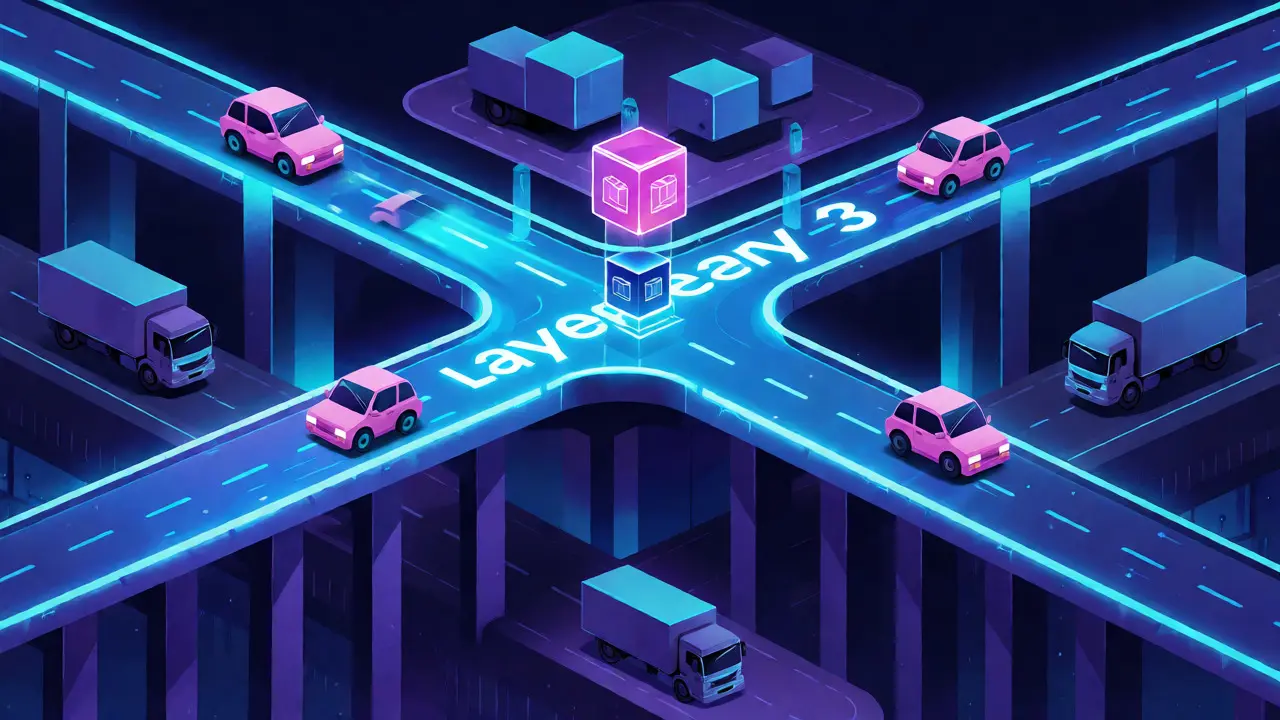
You might be asking, "Why Layer 3?" Think of it like this: Ethereum is the highway system. Layer 2s are express lanes. Layer 3s are specialized local roads designed for specific types of traffic. For logistics, you need high throughput and near-zero fees because shipping involves thousands of micro-transactions-scans, status updates, payment releases. Standard rollups can sometimes struggle with gas efficiency under heavy load.
dKargo uses a consensus mechanism called AnyTrust. This mode was stress-tested heavily before the mainnet launch. In October 2025, during a rigorous test involving 2,500 addresses processing over 92,540 transactions, the AnyTrust mode demonstrated gas efficiency ten times greater than standard rollup solutions. That’s a massive win for enterprise applications where cost per transaction matters more than decentralization maximalism.
The mainnet officially went live on October 24, 2025. This wasn’t just a marketing stunt; it marked the transition from a testing ground to a functional network capable of handling real-world logistics data. Because it’s EVM-compatible, developers who already know how to build on Ethereum can easily port their apps to dKargo without learning a new language.
Tokenomics: What Does DKA Actually Do?
A blockchain is useless without economic incentives. That’s where the DKA token comes in. It serves two primary roles within the ecosystem:
- Utility Payment: Companies using the dKargo network pay transaction fees in DKA. Whether it’s logging a container’s arrival at port or releasing payment upon delivery confirmation, DKA is the currency of exchange.
- Incentivization: Participants who provide accurate data or validate transactions earn DKA rewards. This aligns the interests of shippers, carriers, and validators, ensuring everyone plays by the rules.
As of April 2026, the circulating supply of DKA stands at 5 billion tokens. The token follows a planned release schedule to prevent sudden dumping by early investors. Market data shows DKA trading around $0.0066 USD, placing it in the mid-tier of market capitalization rankings. While price volatility is always present in crypto, the underlying utility drives long-term value rather than just speculation.
| Feature | Detail |
|---|---|
| Blockchain Type | Layer 3 (Built on Arbitrum Orbit/Ethereum) |
| Consensus Mechanism | AnyTrust Mode |
| Circulating Supply | 5 Billion DKA |
| Mainnet Launch Date | October 24, 2025 |
| Primary Use Case | Web3 Logistics Infrastructure & Data Transparency |
Market Presence and Accessibility
If you want to buy DKA, you aren’t limited to obscure exchanges. The token is listed on major platforms including Binance, Coinbase, and Changelly. This broad availability is crucial for liquidity. On Changelly, for instance, you can start buying DKA with as little as $5, and for purchases under $150, there’s no KYC requirement. This low barrier to entry helps onboard regular users who might be intimidated by complex crypto interfaces.
Payment options are equally user-friendly. You can use credit cards, debit cards, Apple Pay, Google Pay, or bank transfers. The goal here is clear: make it as easy as possible for people to participate in the ecosystem, regardless of their technical expertise.
However, keep an eye on sentiment. As of early 2026, DKA showed signs of "high-greed" on some Asian exchanges like Upbit. This indicates speculative fervor. While bullish trends are good for short-term gains, they can lead to sharp corrections. Technical indicators like the MACD have shown mixed signals, suggesting that while the long-term infrastructure is solid, short-term traders should exercise caution.

Real-World Impact: Bridging Web2 and Web3
The biggest challenge for any blockchain project is adoption. Most companies aren’t going to rip out their existing ERP systems overnight to adopt a new blockchain. dKargo understands this. It doesn’t ask logistics giants to replace their current tools. Instead, it offers an API layer that connects their existing Web2 systems to the Web3 blockchain.
This means a company like Maersk or FedEx could potentially plug into dKargo to share verified tracking data without changing their internal operations. For smaller players, the open infrastructure allows them to compete with larger entities by accessing transparent routing solutions and optimized logistics info previously reserved for big corporations.
The platform covers the entire journey: first-mile pickup, middle-mile transport, and last-mile delivery. By connecting these nodes, dKargo enables smart contracts to automate payments. Imagine a scenario where payment is automatically released to the driver only when the IoT sensor confirms the package arrived at the correct GPS coordinate. No invoices, no disputes, no waiting weeks for checks to clear.
Risks and Considerations
No investment is risk-free. Here are a few things to watch out for with dKargo:
- Adoption Rate: The technology is ready, but will traditional logistics companies actually use it? Success depends on signing partnerships with real-world carriers.
- Competition: Other projects like VeChain and Waltonchain also target supply chain management. dKargo needs to differentiate itself through speed and cost-efficiency.
- Regulatory Uncertainty: Cross-border logistics involves international laws. How regulators view blockchain-based proof of delivery could impact adoption.
Despite these risks, the fundamental problem dKargo solves is real. The inefficiencies in global trade are well-documented. If dKargo can capture even a small fraction of the logistics data market, the demand for DKA tokens could grow significantly.
Is dKargo (DKA) a good investment?
It depends on your risk tolerance. DKA has strong fundamentals due to its working mainnet and clear use case in logistics. However, like all altcoins, it is subject to high volatility. Investors should look for signs of real-world adoption by major logistics firms before making large commitments.
Where can I buy DKA tokens?
DKA is available on major exchanges such as Binance, Coinbase, and Changelly. Changelly offers a simplified purchase process with low minimums and flexible payment methods like Apple Pay and credit cards.
How does dKargo differ from other supply chain coins?
dKargo focuses specifically on being a Layer 3 solution on Arbitrum, prioritizing extreme gas efficiency and near-zero fees. Unlike general-purpose blockchains, it is tailored for the high-volume, low-value transaction nature of logistics data, making it more scalable for enterprise use.
What happens if the logistics industry doesn't adopt blockchain?
If adoption stalls, the token’s value may remain speculative. However, dKargo’s hybrid approach-bridging existing Web2 systems rather than replacing them-lowers the barrier to entry, increasing the likelihood of gradual integration compared to disruptive competitors.
Is dKargo compatible with Ethereum wallets?
Yes. Since dKargo is built on Arbitrum Orbit and is EVM-compatible, you can interact with it using standard Ethereum wallets like MetaMask. You simply need to add the dKargo network details to your wallet configuration.