
Ever tried to trade a token on a decentralized exchange and felt like you were fighting the gas fees? You are not alone. The early days of Automated Market Makers (AMMs) changed everything by removing order books and human middlemen, but they left us with high costs and fragmented liquidity. As we move through 2026, the next generation of AMM innovations is solving these headaches. We are seeing systems that scale across multiple blockchains, price assets using complex algorithms, and even tokenize things that used to be impossible to trade, like intellectual property or celebrity endorsements.
This shift is not just about faster transactions. It is about making decentralized finance (DeFi) usable for everyone, from casual traders to institutional investors. Let’s break down what is actually changing under the hood and why it matters for your portfolio.
Key Takeaways
- Scalability is solved via Layer 2: Optimistic Rollups and zk-Rollups are now standard integrations, drastically reducing Ethereum mainnet congestion and fees.
- Cross-chain liquidity is real: New AMMs allow seamless trading of assets across different blockchain networks without manual bridging.
- Pricing is getting smarter: Function Oracle models and AI-driven heuristics replace simple constant product formulas for better price discovery.
- Non-traditional assets are entering the market: Art, IP, and community engagement are being tokenized as premium-powered assets.
- TradFi and DeFi are merging: Traditional financial institutions are adopting AMM structures to improve transparency and automation.
The Scalability Leap: Layer 2 and Sharding
The biggest complaint about early AMMs was always speed and cost. If you wanted to swap ETH for USDC during a bull run, you could wait minutes and pay tens of dollars in fees. That is not sustainable for mass adoption. The current wave of innovation focuses heavily on Layer 2 solutions. These are secondary networks built on top of Ethereum that bundle transactions together before submitting them to the main chain.
There are two main types you should know about. Optimistic Rollups assume transactions are valid unless proven otherwise, offering a good balance of security and speed. zk-Rollups, on the other hand, use zero-knowledge proofs to mathematically verify transactions off-chain. This makes them more secure but computationally heavier. For AMMs, this means users can execute trades with near-instant finality and fractions of a cent in fees. It transforms DeFi from a niche activity into a daily utility tool.
Beyond Layer 2, sharding technology is gaining traction. Instead of one massive blockchain processing every transaction, sharding splits the network into smaller pieces called shards. Each shard handles its own set of transactions simultaneously. This increases throughput significantly. Imagine a highway where instead of one lane handling all traffic, you have ten lanes moving at once. That is what sharding does for AMM infrastructure, allowing for higher volume without the bottleneck effect.
Cross-Chain Interoperability: Breaking Silos
For years, if you held assets on Polygon, you couldn’t easily trade them on Arbitrum without bridging. Bridging meant locking funds, waiting for confirmations, and taking on smart contract risk. Next-gen AMMs are designed to operate natively across multiple chains. This is often referred to as omnichain functionality.
How does this work in practice? Protocols are implementing interoperable liquidity pools. Your liquidity might be represented as a single asset that can be traded across Ethereum, Solana, and Avalanche seamlessly. This expands the user base dramatically because you don’t need to choose a single ecosystem. You can access the deepest liquidity available anywhere. For example, a trader in Wellington, New Zealand, can hold stablecoins on an L2 solution while trading tokens listed primarily on a high-throughput chain, all within a single interface. This removes friction and reduces slippage, which is the difference between the price you expect and the price you get.

Evolution of Pricing Models: From Constant Product to Function Oracles
The original AMM formula, popularized by Uniswap, used a constant product invariant ($x \times y = k$). It worked well for simple pairs but struggled with volatile assets or complex relationships. Today, we are seeing a diversification of models tailored to specific needs.
| Model Type | Best For | Liquidity Structure | Fee Efficiency |
|---|---|---|---|
| Uniswap V3/V4 | Volatile assets, concentrated liquidity | Range-bound pools | High (due to capital efficiency) |
| Curve Finance | Stablecoin swaps, similar assets | Fixed ratio pools | Very High (low slippage) |
| Balancer | Baskets, multi-asset strategies | Dynamic ratios up to 8 assets | Medium-High |
| Function Oracle AMM | Novel assets, expectation-based pricing | Peer-to-pool dynamic adjustment | Variable (captures 'premium') |
A particularly interesting development is the Function Oracle AMM. Unlike traditional models that rely solely on pool balances, this system acts as a peer-to-pool mechanism. It continuously adjusts prices based on user assessments and expectations. Think of it as capturing the "premium" traders are willing to pay for future outcomes. This is huge for tokenizing intangible assets. If you are trading a token representing a celebrity endorsement, the value isn't just in the supply and demand; it's in the perceived future impact. Function Oracles allow the price to reflect that sentiment dynamically.
Tokenizing the Intangible: Beyond Crypto Assets
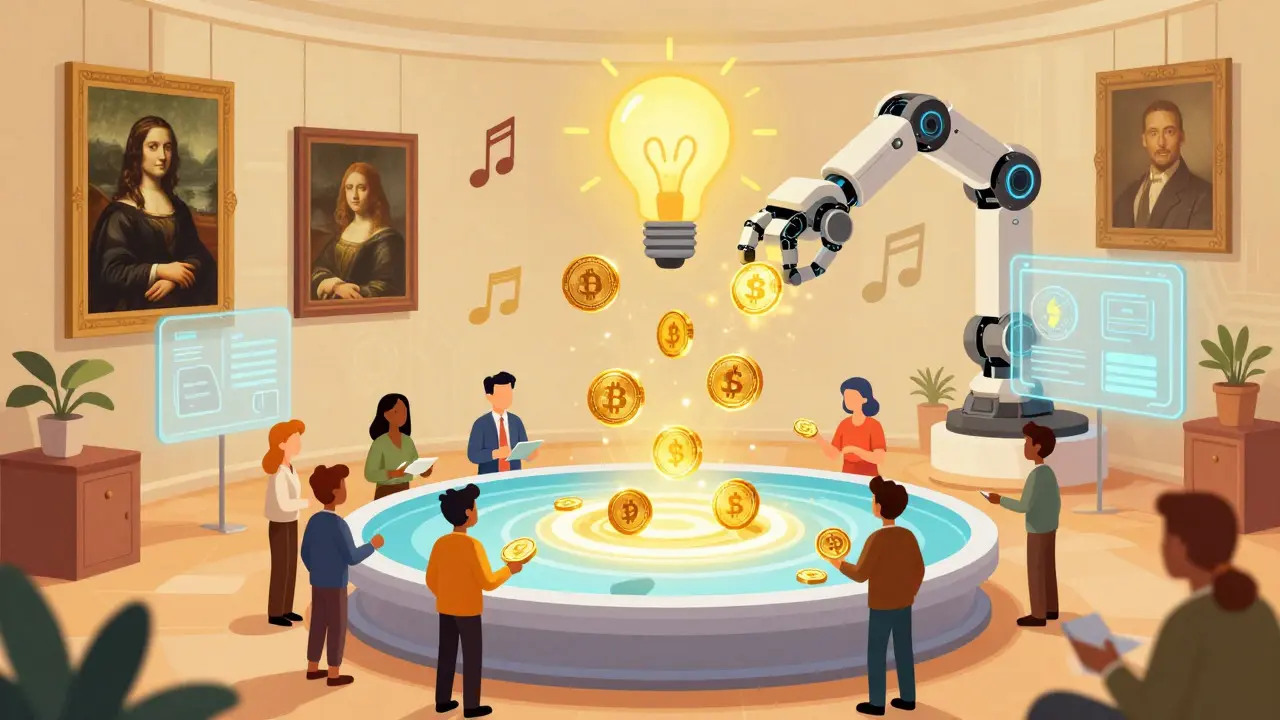
We are no longer just trading cryptocurrencies. Next-gen AMMs are enabling the trade of non-traditional assets. This includes artworks, intellectual property rights, and even community engagement metrics. How do you put a price on a song or a patent? By creating a native incentive structure where the asset is tokenized as a "premium-powered" asset.
These tokens can be bought and sold on AMMs just like any other ERC-20 token. This makes previously illiquid assets liquid. An artist can tokenize their royalties, and fans can buy shares of those royalties on a DEX. The AMM provides the price discovery mechanism. It also serves as an oracle for lending scenarios. If you hold a tokenized IP asset, you can potentially use it as collateral for a loan, with the AMM providing the real-time valuation. This mirrors credit endorsement in traditional finance but without the bank overhead.
Integration with Traditional Finance (TradFi)
There is a growing convergence between TradFi and DeFi. Traditional banks and hedge funds are looking at AMMs because they offer transparency and 24/7 availability. The electronification of trading workflows is accelerating. ETFs are starting to incorporate DeFi mechanisms, and derivatives markets are using AMMs for liquidity provision.
For the average user, this means more stability. When large institutions enter the space, volatility tends to decrease over time because there is deeper liquidity. However, it also brings regulatory scrutiny. The good news is that modern AMMs are designed with compliance in mind, featuring audit trails and transparent algorithmic execution. This hybrid approach allows for the best of both worlds: the accessibility of DeFi and the robustness of TradFi.
Practical Implications for Traders
If you are active in DeFi, here is how you can benefit from these innovations right now:
- Check the Chain: Before trading, ensure you are on a Layer 2 network or an interoperable protocol to save on fees. Mainnet Ethereum is still viable for large institutional flows, but L2s are superior for retail.
- Understand the Pool: Not all AMMs are created equal. Use Curve for stablecoins to minimize slippage. Use Uniswap V3/V4 for volatile pairs where you can manage risk ranges. Use Balancer if you want to track a basket of assets.
- Watch for Premiums: In Function Oracle models, watch the spread. A wide spread indicates uncertainty or high speculation. Tight spreads indicate consensus.
- Diversify Across Chains: Don’t lock yourself into one ecosystem. Use cross-chain bridges or omnichain protocols to access the best prices regardless of where the liquidity sits.
The learning curve is steeper than it was three years ago. You need to understand concepts like zero-knowledge proofs, sharding, and dynamic pricing. But the payoff is significant. Capital efficiency has improved by orders of magnitude, meaning you need less money locked up to achieve the same trading volume. This frees up capital for other investments or opportunities.
Frequently Asked Questions
What is the main advantage of next-generation AMMs over old ones?
The primary advantages are lower transaction fees due to Layer 2 integration, higher throughput via sharding, and the ability to trade across multiple blockchains seamlessly. Additionally, pricing models are more sophisticated, allowing for better price discovery on complex or novel assets.
Are zk-Rollups safer than Optimistic Rollups for AMMs?
Generally, yes. zk-Rollups provide mathematical proof of validity, eliminating the fraud period associated with Optimistic Rollups. However, zk-Rollups require more computational power to generate proofs, which can sometimes lead to slightly higher latency in extreme cases, though this is improving rapidly.
Can I trade real-world assets like art on an AMM?
Yes, through tokenization. The asset must first be minted as a digital token on a blockchain. Once tokenized, it can be added to an AMM liquidity pool. The AMM then facilitates the buying and selling of these tokens, effectively trading the underlying asset's value.
What is a Function Oracle AMM?
It is a type of AMM that uses dynamic functions to adjust prices based on user behavior and market sentiment rather than just static pool balances. It captures the "premium" or extra value traders assign to assets based on expectations, making it ideal for speculative or intangible assets.
Do I need to bridge my assets to use cross-chain AMMs?
Often, no. Many next-gen protocols support omnichain liquidity, meaning your assets are recognized across multiple networks automatically. However, some setups may still require initial bridging to establish your presence on a specific chain, depending on the protocol's architecture.
Rajni Mathur
August 26, 2026 AT 07:36Oh, look at you all, playing with your shiny new toys while the rest of us are still trying to figure out why our gas fees cost more than a tank of petrol 🙄💸. You call this 'innovation'? I call it expensive vaporware for people who think they understand math but don't know how to manage risk. The 'Function Oracle' is just a fancy word for 'gambling with extra steps,' isn't it? 📉🤡
Bill Patterson
August 27, 2026 AT 08:23yeah another long read about things that will break in 6 months. zk-rollups are cool i guess but who actually reads the whitepaper before buying the dip. most people just follow the hype train and get wrecked when the bridge breaks again. nice post tho.
Matt Reckdenwald
August 27, 2026 AT 11:20It feels like we are standing on the precipice of a golden age, doesn't it? The sheer magnitude of change here is almost overwhelming, like watching a thunderstorm roll over the plains of DeFi. We used to be so afraid of the lightning strikes, but now we are learning to dance in the rain. It is beautiful, terrifying, and utterly magnificent all at once. Can you feel the electricity in the air?
Melanie Armijo
August 28, 2026 AT 03:10Have you ever stopped to wonder if liquidity is just a collective hallucination we agree to believe in? We put numbers on screens and call them value, but what is really being traded? Perhaps the tokenization of intangibles is just the next step in our shared delusion, or maybe it is finally waking up to the true nature of human desire. Either way, it makes me think about what we truly value as a species.
Laine Van Sickle
August 28, 2026 AT 22:26i dont get it why everyone is so excited about this. its just crypto stuff right? i tried using one of these dapps last week and lost half my money because i clicked the wrong button. so its not for normal people. also the writing was so boring i fell asleep. can we just stick to stocks please??
Ashwin Bhandurge
August 29, 2026 AT 20:23This is where the magic happens! 🚀 Look at the potential here. We are not just trading tokens; we are building a new financial ecosystem. Imagine the opportunities for creators and artists. This is not just tech; it is freedom. Let's embrace the future together. The energy is palpable! Who else is ready to dive into the deep end? 💪🔥
Teresa Watson
August 30, 2026 AT 15:23oh great another article pretending layer 2 is the answer to everything. its not. its just moving the problem from one congested highway to another slightly less congested one. and cross-chain? good luck with that. bridges are just trust machines waiting to fail. stop selling the dream and start fixing the code.
Nadia Christian
August 31, 2026 AT 20:19Finally! Something that makes sense! 😊 The US needs to lead this space! These innovations are perfect for American innovation! We need to make sure our regulations support this growth! It is exciting to see such progress! Let's keep pushing forward! 🇺🇸✨
jeffry jones
September 2, 2026 AT 16:35Great breakdown. Key takeaway: capital efficiency via L2s is non-negotiable. If you're not on Arbitrum or Base, you're leaving alpha on the table. Cross-chain liquidity aggregation is the real unlock for institutional flow. Watch the slippage metrics closely.
Aaliyah Simpson
September 4, 2026 AT 01:46You guys are all naive. They are tracking every trade. The 'privacy' of zk-rollups is a lie. The banks are coming in to take over. Once TradFi touches this, it is game over for retail. Just wait and see. The conspiracy is unfolding right before our eyes.
Paul Needham
September 5, 2026 AT 20:34So let me get this straight. You want me to trust my life savings to a mathematical proof generated by a computer that might have a bug? And you call this 'safe'? I prefer my old-fashioned bank account where I can shake hands with a guy in a suit who looks like he owes me money. Very convincing argument there.
Linda Jevne
September 6, 2026 AT 22:44The idea of tokenizing intellectual property is fascinating. It reminds me of how art was historically collected by patrons. Now, the patron is the community. It is a shift from ownership to participation. Do you think this changes the artist-audience dynamic permanently? It feels like a cultural revolution disguised as a financial tool.
Carey Thornton
September 7, 2026 AT 07:37My dear friends, you are all missing the forest for the trees. While you fumble with your little Layer 2 solutions, the true elite are already positioning themselves in the function oracle markets. It is a sophisticated beast, this thing. One must appreciate the elegance of the algorithm, not just the utility. How quaint of you to focus on the fees. Truly, a display of limited intellect.
David Powell
September 7, 2026 AT 13:08Scalability is solved. Sure. Why does it always sound like a marketing pitch written by someone who has never actually used a DEX? I bet the slippage on those 'seamless' cross-chain trades is going to eat your lunch. But hey, let's pretend the world is fixed because a blog post said so. Bravo.
Ellie Brooks
September 9, 2026 AT 02:21Okay so I read through the whole thing and I am honestly so pumped because it feels like we are finally getting to a point where DeFi isn't just for the tech-savvy folks who spend all day on Discord, and that is huge because I have been trying to get into this space for years but the gas fees were just too much of a barrier to entry, especially when I am just trying to swap some stablecoins for yield farming, and now with these Layer 2 solutions and the cross-chain stuff it seems like I can actually participate without losing half my principal to transaction costs, which is amazing!
Jillian Pye
September 10, 2026 AT 06:13I find the concept of the Function Oracle particularly intriguing. It suggests that price is not just a reflection of supply and demand, but of collective expectation. It is a philosophical shift in how we define value. Does this mean the market becomes a mirror of human sentiment rather than a calculator of economic utility? 🤔